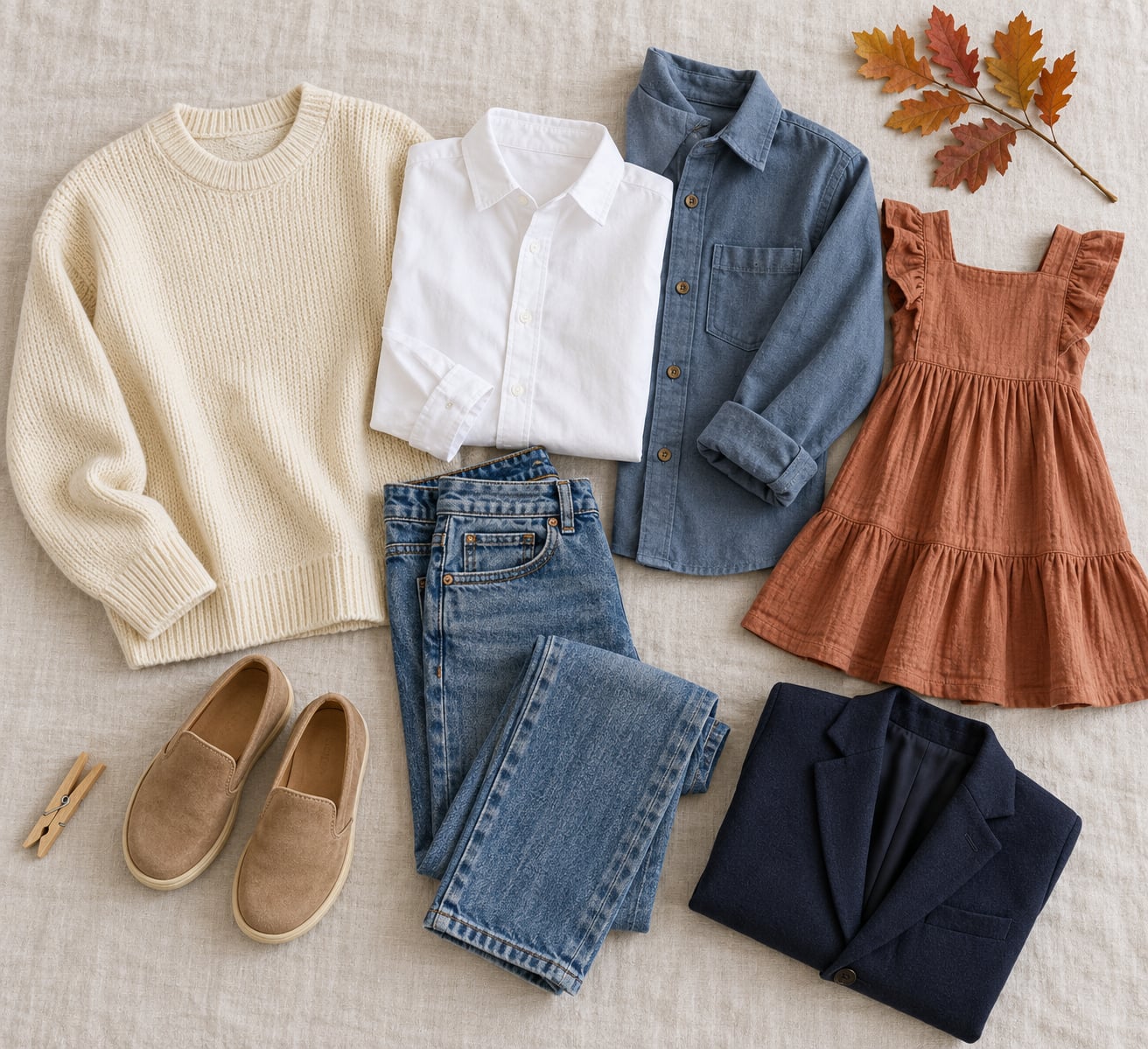
If you’re wondering what to wear for a family photo session, the answer is simpler than the outfit boards on social media suggest: pick three or four colors that work together, choose one person’s outfit first, and build the rest around it. Coordinate, don’t match. Nobody should wear the same shirt, and nobody needs a brand new wardrobe.
Most families get better results when they start with a palette rather than a shopping list. I’ve talked to plenty of parents who assumed they needed seven brand-new outfits and ended up spending an afternoon in front of their closets instead, walking away with a set that looked better than anything they’d have bought.
The real goal is a portrait that looks like your family, not a catalogue. Clothes change the way light falls across faces and how each person separates from the background, so a few deliberate choices do more than any expensive piece.
Table of Contents
- What to Wear for a Family Photo Session at a Glance
- 1. Neutral Colors for a Classic Family Portrait
- 2. Coordinating Denim for a Relaxed Family Look
- 3. Soft Neutrals for Children and Adults Together
- 4. Matching Shades of One Color
- 5. Earth Tones for an Outdoor Family Shoot
- 6. Bright Colors Without Clashing
- 7. Dresses and Suits for a Polished Portrait
- 8. Casual Layers for a Lifestyle Family Shoot
- 9. Patterns Mixed with Solid Colors
- 10. White and Cream for an Airy Family Portrait
- 11. Dark Outfits for a Dramatic Family Portrait
- 12. Playful Color Families for Memorable Portraits
- Frequently Asked Questions
- Should family members wear exactly the same color for photos?
- What colors look best in family portraits?
- Can everyone wear white for a family photo session?
- Should children wear matching outfits in family photos?
- What shoes and accessories should we wear?
- How early should we finalize outfits with the photographer?
- Conclusion
What to Wear for a Family Photo Session at a Glance
The twelve combinations below cover most sessions, from a quiet studio portrait to a windy beach afternoon. Scan the table first, then read the section that matches your setting.
| # | Outfit idea | Best for | Color approach | Who wears it |
|---|---|---|---|---|
| 1 | Neutral colors | Classic portrait, wall print | Cream, taupe, gray, navy, charcoal | Everyone, any age |
| 2 | Coordinating denim | Casual outdoor session | Three different washes of blue | Teens through adults |
| 3 | Soft neutrals | Families with young kids | Darker adults, lighter children | Parents and kids |
| 4 | Matching shades of one color | Studio or minimal backdrop | Monochromatic, several tones | Everyone |
| 5 | Earth tones | Outdoor shoot, fall | Olive, rust, tan, warm brown | Whole family |
| 6 | Bright colors, controlled | Children-led, playful session | One bright plus neutrals | Kids lead, adults anchor |
| 7 | Dresses and suits | Formal or holiday portraits | Deep navy, charcoal, burgundy | Adults and kids |
| 8 | Casual layers | Lifestyle session at home | Cream, white, denim, muted blue | Everyone |
| 9 | Patterns with solids | Spring or summer outdoors | One repeat pattern plus blocks | Children and adults |
| 10 | White and cream | Bright airy portrait | Pale with contrast in weight | Everyone, careful planning |
| 11 | Dark outfits | Dramatic, moody portrait | Black, navy, charcoal, forest, burgundy | Teens and adults mainly |
| 12 | Playful color families | Beach, park, candid session | Shared color notes, varied pieces | Families with kids |
1. Neutral Colors for a Classic Family Portrait
Neutrals are the safest thing that photographs well, and the reason is simple: low-saturation colors don’t reflect harsh light back onto skin. Cream, taupe, gray, navy and charcoal give you a range without looking like a uniform.
Try one adult in a soft knit jumper, another in a cream blouse and straight trousers, kids in oatmeal cardigans over white tees. Keep silhouettes different so nobody blends into the person next to them.
If you want one thing to remember: if a color disappears against your wall color, it may be time to shift the shade rather than the outfit.
2. Coordinating Denim for a Relaxed Family Look
Denim is the easiest connector in family wardrobes because almost everyone owns two or three pairs in different washes. Medium-wash for one person, dark indigo for the next, pale blue for a child, and the group reads as related.
Build the outfit around denim rather than wearing it head to foot. A denim jacket over a cream dress, or a chambray shirt tucked into dark jeans, gives you texture without the double-denim look that dates fast in a framed print.
How to make denim look intentional in photos
Fit matters more than wash here. Straight or wide legs photograph cleanly, while very baggy or very skinny cuts can date the frame within a few years. Add one non-denim color to each person so the blue has somewhere to sit.
3. Soft Neutrals for Children and Adults Together
When kids are involved, the trick is value rather than color: adults in the darker shades of the palette, children in the lighter ones. Adults in charcoal and deep taupe, a four-year-old in cream and beige, a toddler in soft gray. Same family, different weight.
This also solves a practical problem. Children’s clothes get marked, spilled on and outgrown constantly, and a pale shade on a toddler looks like a normal afternoon rather than a mistake.
4. Matching Shades of One Color
A monochromatic palette is the most striking option in this whole list, and it’s less risky than it sounds when you vary the tone rather than repeat it exactly.
Think three shades of rust: a brick-colored coat, a terracotta dress, and a soft copper shawl. Or three greens, from forest to sage to mint. The rule is that no two people should wear the identical shade in the identical fabric.
Warn your photographer ahead of time if you go this route, so they can plan the backdrop contrast. A single-color family can disappear into a similarly colored wall.
5. Earth Tones for an Outdoor Family Shoot
Olive, rust, tan, warm brown, muted blue and cream work well outdoors because they already exist in the setting around you. Clothing that echoes the setting stops competing with the trees, grass and light.
Add one small brighter note, maybe mustard or a deep teal, to give the eye somewhere to land. If you are photographing in autumn foliage, go a shade darker than the leaves so faces stay bright against the background.
6. Bright Colors Without Clashing
Bright color is not the problem. Saturated color in five places at once is the problem. Pick one dominant bright color for the session and let everything else be quiet.
A coral dress on one parent, mustard on one child, and the rest in white, denim or gray makes a frame that pops without a clash. Hard rule from photographers: one bright, one support, everything else neutral.
Skin tones matter here too. Highly saturated shades reflect back into the face, and the cast they create is what makes neon look strange on camera. If in doubt, dial the shade down one step.
7. Dresses and Suits for a Polished Portrait
For holiday cards, anniversaries or a formal sitting, dresses and suits give you a clean shape that fills the frame. Keep the tailoring simple and the accessories restrained.
A deep navy midi dress, a charcoal suit with an open collar, kids in a cream dress and navy trousers or a soft blazer over a white shirt. Kids in suits look sharp for about eleven minutes, so bring a second outfit for after the first frame.
One practical note: a single dress silhouette photographs better than a top and jeans, because a visible waist break splits the body visually. If you prefer separates, keep them tonal so the break reads as shadow, not a seam.
8. Casual Layers for a Lifestyle Family Shoot
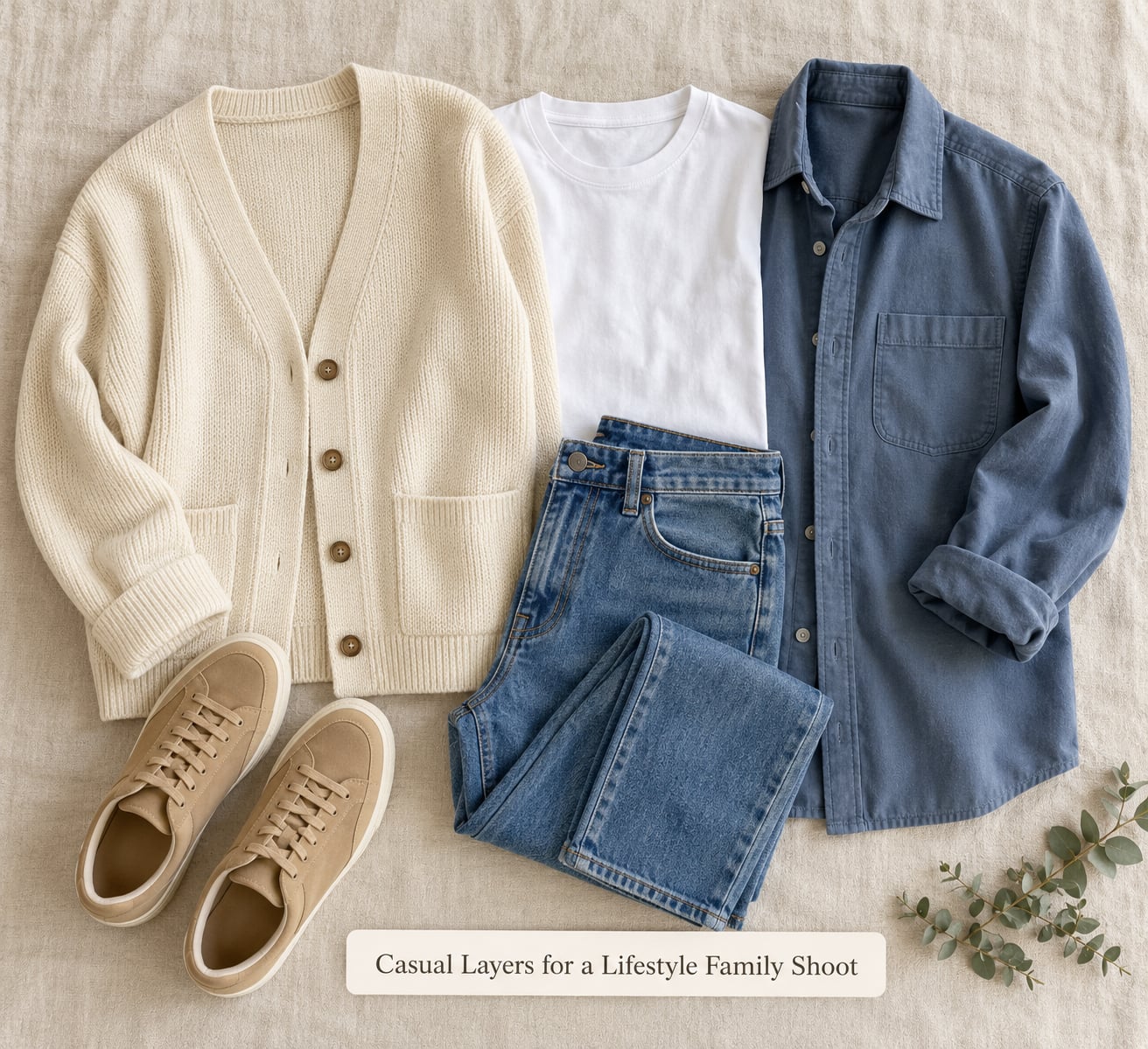
A lifestyle session happens in your living room, kitchen or yard, so the clothes should look like something you actually do on a Saturday. Layers do the heavy lifting here.
A cream cardigan over a white tee and medium-wash jeans, a muted blue overshirt, tan sneakers that have been cleaned rather than rescued. Textured knitwear photographs with more depth than flat cotton, and it hides lint marks on the knees.
Comfort matters more than polish for this style. Bare feet are fine. You are going to sit on the floor.
9. Patterns Mixed with Solid Colors
Patterns photograph well when only one or two people wear them. A floral dress, a striped shirt, everyone else in solid colors pulled from that pattern. Repeat one pattern across the family only if the pieces are visibly different in scale and color.
Skip very small repeating prints. Fine plaids and micro-checks hit the camera sensor at a scale that creates shimmer and moiré, so a shirt that looks sharp in person turns into visual noise in a print. The rule of thumb: if you can count the individual lines from an arm’s length away, it is too small.
Small repeating prints on a newborn’s romper, on the other hand, are effectively a neutral, because the baby rarely fills more than a small part of the frame.
10. White and Cream for an Airy Family Portrait
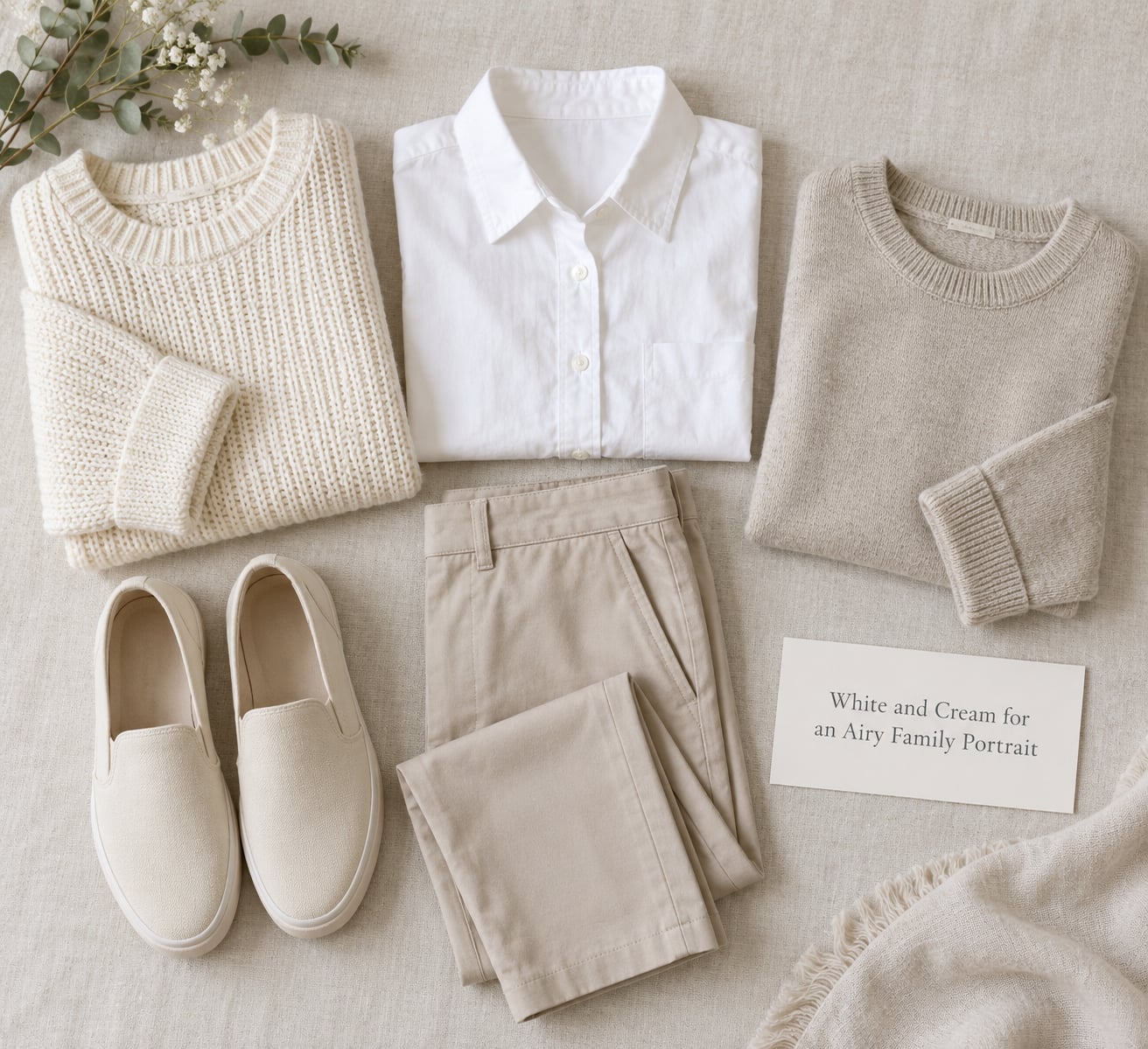
All white photographs beautifully in a bright studio or against a pale backdrop, and it’s one of the few cases where matching genuinely works. Vary the shade, though. Ivory, bright white, oatmeal and pale beige all read as different colors next to each other.
Add contrast through weight and texture instead. A chunky ivory knit beside a crisp white collared shirt, pale beige trousers, cream slip-on shoes. If everything is the same weight and shade, the portrait looks flat and the silhouettes blur into one shape.
Skip white for outdoor sessions in strong sun or on a green lawn. A light garment will bounce light back up under the chin and wash out faces.
11. Dark Outfits for a Dramatic Family Portrait
Black is not automatically wrong, and a full dark palette gives you a moody, modern portrait that suits a blank wall or a dim historic house. The trick is varying the fabric.
Matte black wool next to slightly shiny black, then navy, charcoal, forest green and burgundy to keep depth. Vary necklines and lengths too, so the family reads as individuals rather than a single silhouette.
Have someone bring a lint roller. Dark fabric shows every speck of lint and dust, and nothing wrecks a frame faster. This palette also runs warmer than most, so limit the truly all-black combination to older kids and adults and give the little ones a lighter shade.
12. Playful Color Families for Memorable Portraits
When the plan is a park, a beach or a session built around kids running around, let the color get cheerful. The control comes from shared color notes, not from matching.
Two adults in denim and white, a child in a sunny yellow sundress that echoes a mustard towel, another in coral and cream. Each person has their own color, but every color has a partner somewhere in the frame.
Finish with shoes and accessories that belong to the palette. Sneakers that match the denim, simple small earrings instead of a statement necklace, hair tied back if it is windy. Comfortable closed-toe shoes for a beach session, because sand finds every opening.
Frequently Asked Questions
Should family members wear exactly the same color for photos?
No. Matching identical outfits across a family dates the photographs and removes each person’s individuality. Coordinate instead: pick three or four colors that work together, then give each person a different combination built from that palette. You still read as a family because the colors are related, and the frame looks more relaxed.
What colors look best in family portraits?
Low-saturation colors photograph best. Cream, taupe, gray, navy, charcoal, olive, rust and dusty blue are all reliable, because they don’t bounce harsh light back onto skin. Jewel tones like forest green, burgundy and teal also work well. Bright and saturated shades are fine when only one person wears them.
Can everyone wear white for a family photo session?
Yes, with care. All white works in a bright studio or against a pale backdrop, and it is one of the few situations where genuine matching looks right. Vary the shade between ivory, bright white and oatmeal, and add contrast through weight and texture. Skip all white outdoors in strong sun or on a green lawn.
Should children wear matching outfits in family photos?
Not identical ones. Young children in coordinated but different outfits look more natural and photograph better. Give the adults the darker shades of your palette and the children the lighter ones, so a spill or grass stain reads as normal. If you want one fun repeated element, match accessories or shoes rather than the whole outfit.
What shoes and accessories should we wear?
Wear closed-toe shoes you can stand and walk in for at least an hour, and clean them the night before. Neutral colors like tan, cream, brown or white coordinate with almost any palette. Keep accessories simple: one small pair of earrings, a watch, or a single textured layer. Skip logos, busy scarves and large statement necklaces.
How early should we finalize outfits with the photographer?
Two to three weeks is usually enough for a session, and one week is workable if you are pulling everything from your own closets. Send your photographer a photo of the palette and the outfit you are least sure about. They can flag contrast issues, check it against the location and tell you what to adjust before anyone gets dressed.
Conclusion
Start with a palette of three or four colors, build around one anchor outfit, and let everyone wear a different combination from it. Pull the pieces from your closets first, then decide whether anything genuinely needs to be bought.
Send the palette to your photographer a couple of weeks ahead, check each person’s outfit in a mirror for any color cast under the chin, and test the shoes the night before. Then wear something you like. The families whose photos still look good a decade from now are usually the ones who were comfortable enough to be themselves.