Most photography newsletters fail in the same three places: a subject line that describes the send rather than the story, an opening paragraph of self-announcements, and ten images with nothing holding them together. If you want to know how to write a newsletter that photographers actually read, the fix is structural, not tonal. You promise one useful thing, open with a moment from the work, show a small number of images that earn their place, and end with one invitation a real person would actually accept.
This guide walks through the whole build, from choosing the promise to reading the responses after you send. It should take about 45 minutes per issue once the structure is in your hands, and the hardest part is deciding what to leave out.
Table of Contents
- What You Need
- Step-by-Step
- How to Write a Newsletter That Photographs Want to Read
- Choose One Reader and One Useful Promise
- Open With Context, Not a Sales Pitch
- Build the Issue Around a Photographic Story
- Use Images to Create Curiosity and Context
- Make the Layout Easy to Scan
- End With One Clear, Human Next Step
- Proof, Send, and Learn From Responses
- Common Mistakes
- Frequently Asked Questions
- How often should photographers send a newsletter?
- Should a photography newsletter focus on a project or practical tips?
- What is a good subject line for a photography newsletter?
- What should the call to action in a photographer newsletter say?
- How can I grow a photography newsletter without buying subscribers?
- Conclusion
What You Need
Six things, and none of them expensive. Everything else is optional detail.
- One specific reader. Portrait clients booking a family session this winter, or documentary shooters who want more editorial assignments. Pick one, not “everyone who likes photos.”
- A repeatable promise. A sentence you could say out loud that tells people why this specific email is worth their morning.
- One useful project story. A shoot, an edit you argued with, a lighting decision that went wrong. One is enough.
- Images that add context. The final frame, the sequence, the before-and-after, or the behind-the-scenes shot that explains the final frame.
- One next action. A reply, a question, a related project. Singular.
- A platform that handles signups and delivery. Flodesk and MailerLite are common picks for visual businesses because the templates start with an image block; ConvertKit suits writers with paid tiers; anything that sends reliably is fine at this stage.
A big subscriber list is not on that list. Fifty people who read every issue are worth more to your practice than five thousand who signed up from a giveaway and never opened anything since. Expensive software is not on it either. The bottleneck is the writing, not the tool.
Step-by-Step
How to Write a Newsletter That Photographs Want to Read
Readers do not experience an issue as eight separate blocks. They experience one argument with pictures in it. Treating the whole edition as a single thing you are making, rather than a list of things you are including, is what separates an issue people finish from one they abandon halfway.
Four decisions do most of the work: one reader benefit, an opening built from context rather than a claim, a balance of story and visuals rather than one or the other, and a single closing action that matches what the issue was about. A portrait issue about winter light, for example, can open on a window at 4pm, show three frames that failed and the one that worked, and end by asking which lighting setup they would have tried instead. Same photos every time would be dull. Same promise, different story each issue, is a newsletter people recognise.
Before you send, check five things: could someone repeat the promise after one read, does the first paragraph contain a moment rather than an announcement, does every image have a reason to be there, is there exactly one action, and can you read the whole issue on a phone without pinching to zoom.
Choose One Reader and One Useful Promise
The promise is one sentence describing what your reader gets from this issue, in terms of their problem rather than your process. Test it by imagining them repeating it to another photographer. If they cannot repeat it, it is not finished.
“Photos from recent work and updates about availability” tells a reader nothing. It describes your business. “You will see how to get warm window light in a small room, with three frames that show what to avoid” tells them what changes for them after five minutes of reading.
The broad version sounds modest and quietly loses the issue. The specific version names a constraint a reader already has, which makes it easy to click and easy to remember. Keep a running list of promises that have worked, and reuse the shape across issues without repeating the subject.
Open With Context, Not a Sales Pitch
Start with a moment, a decision, an observation, or a question from the work itself. The first three lines exist to give a reason to keep reading, and the reason should come from the craft rather than from you.
Weak: “Hi everyone, I’m excited to share some new work from a recent portrait session. Bookings for spring are now open.” That is an announcement. It gives the reader a reason to close the tab, because it leads with your calendar instead of their curiosity.
Stronger: “The window faced west and the sun hit it at 4:10, which is exactly twenty minutes after I wanted softer light. I moved the chair, lost the reflection in her glasses, and moved it back.” Now the reader is inside the problem. Bookings can still appear later, in the close.
A quick check: read the opening and look for your own name, your dates, or your prices. If any of them appear before the reader has a reason to care, rewrite the paragraph and try again.
Build the Issue Around a Photographic Story
One story, three layers: the personal narrative of what happened, the practical lesson a reader could use, and the visual proof. Photography has an unusual advantage here, because the images carry information the words can skip.
Take a family session in a cluttered kitchen. The narrative is the grandmother insisting on the old table, the lesson is about shooting in bad light and using what the room already gives you, and the visuals are the sequence that shows the room becoming usable. Three short paragraphs plus four frames does the whole job.
Test every paragraph against one question: does this advance the promise, or does it help the reader recognise something in their own practice? If neither, cut it. Most stalled issues are not too short, they carry two paragraphs of preamble about your week that satisfies nobody.
One shoot can carry several issues if you change which layer you lead with. The contact sheet becomes a lighting issue, the rejected frames become an editing issue, and the client becomes a story about what they asked for versus what the light gave you. That is how photographers who shoot weekends still write on weekdays without repeating themselves.
Use Images to Create Curiosity and Context
Most photography newsletters that disappoint readers either show no images or show far too many. The working range for a single-issue newsletter is four to eight images, chosen deliberately, not exported as a batch.
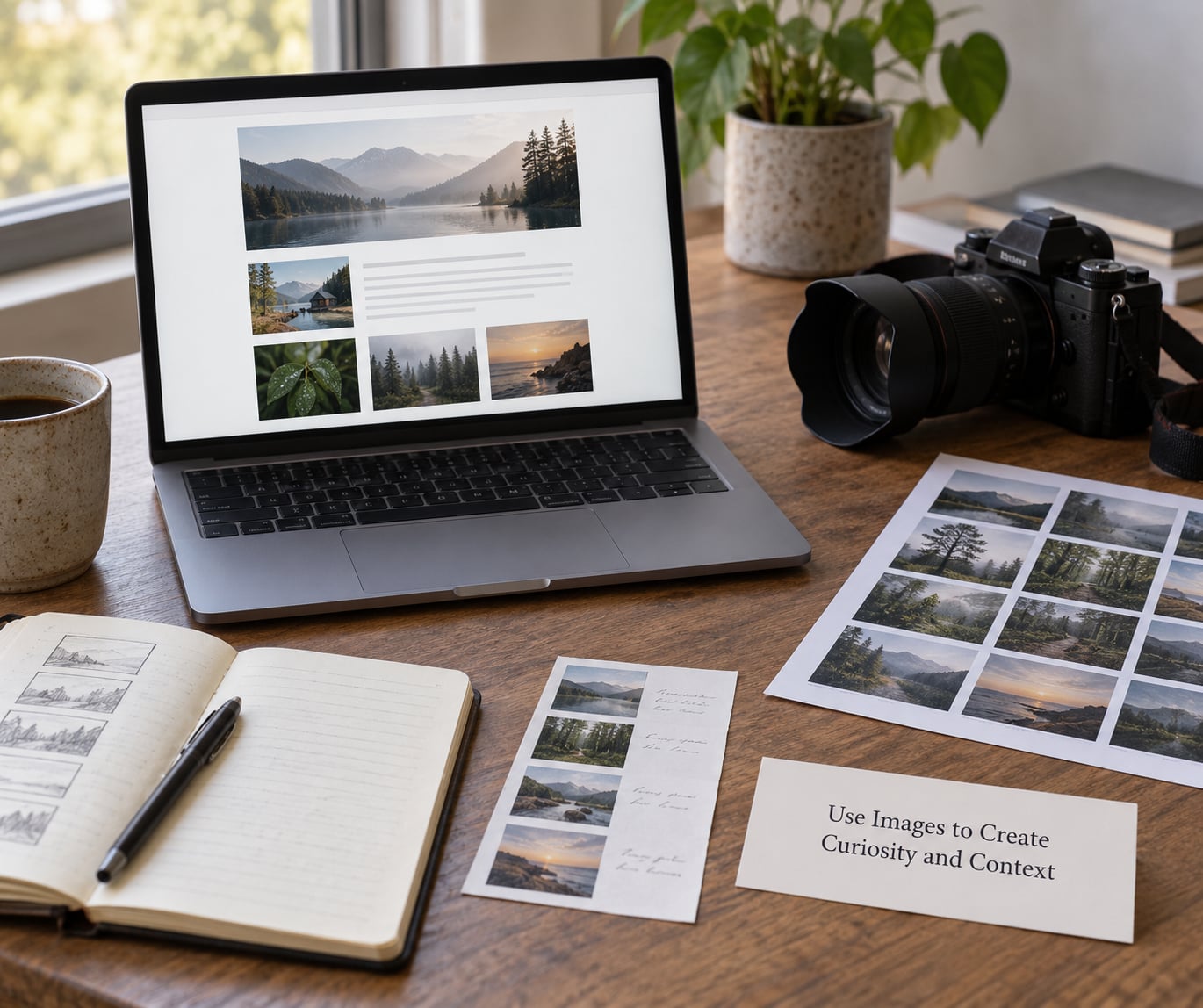
Four formats do most of the useful work. A single final image gives a reader something to want. A contact-sheet sequence of four to six frames shows how a shoot was made and creates curiosity about the frames you did not include. A before-and-after edit teaches something. A behind-the-scenes frame explains the final image, and readers love seeing the mess.
Three technical details matter more than the images themselves. Crop tightly so the subject survives a narrow phone screen, write a caption that adds information rather than repeating the file name, and fill in alt text that describes the picture in words for anyone whose client blocks images. Images that load at full camera resolution are the usual reason an issue takes eight seconds to open; send them small.
The line worth holding: every image either explains the story or earns attention for the story. A portfolio dump does neither, and readers quietly resent it.
Make the Layout Easy to Scan
Nobody reads a photography newsletter the way they read a contract. Layout is the thing that decides whether your writing gets read at all, and the subject line does about half of that work.
Write the subject line as a small honest headline about the issue, not a label for the send. “Three ways I rescued a backlit portrait” earns attention. “August newsletter” does not. Keep it under about 50 characters so it survives mobile truncation, and put the interesting half first because the end gets cut.
Then add preview text. Most platforms let you type the sentence that follows the subject line in the inbox list, and by default many fill it with “View in browser” or the first hundred characters of the email. Write it deliberately, roughly eight to fourteen words, and let it finish the thought the subject line started.
Inside the issue: short paragraphs of one to three sentences, headings that describe content rather than label it, images in the order the story moves, and enough whitespace that the eye has somewhere to rest. Read the whole thing on your phone before you send. If you pinch to zoom anywhere, the layout is wrong.
Length follows the story rather than a target. A single-image issue with a strong frame and one paragraph is a complete issue, and roughly 300 to 800 words covers most of what you would send in a month. The warning sign is padding: a short photo essay that drags to 1,500 words because you had nothing more to say is harder to read than a tight 400-word version.
Then write like you speak. Readers trust a sentence that sounds like it came from the same person who made the pictures, including the awkward parts. Naming what went wrong in front of a client, or admitting you shot twenty frames for one usable shot, earns more trust than any polished introduction.
End With One Clear, Human Next Step
The close should ask for one thing that a real reader could actually give you. After an issue about choosing between frames, ask which one they would have picked and why. After a behind-the-scenes issue, ask for the photograph they would most want to see made next.
Stacking requests is what turns a newsletter into a chore. Subscribe, book a session, follow me here, fill in the survey, and share this with a friend in the same paragraph teaches readers that your emails are a cost. One invitation, and it should match the subject of the issue rather than your business goals for the quarter.
Replies are also the best research you will get. When three people describe the same problem in an issue about window light, that is a signal about what the next issue should be.
Proof, Send, and Learn From Responses
Send on a fixed day and keep it. Readers recognise a rhythm, and a known schedule is one of the trust signals people in photography forums mention most often when they describe newsletters they actually keep. If you travel or shoot heavily, reduce the frequency and keep the day rather than skipping weeks.
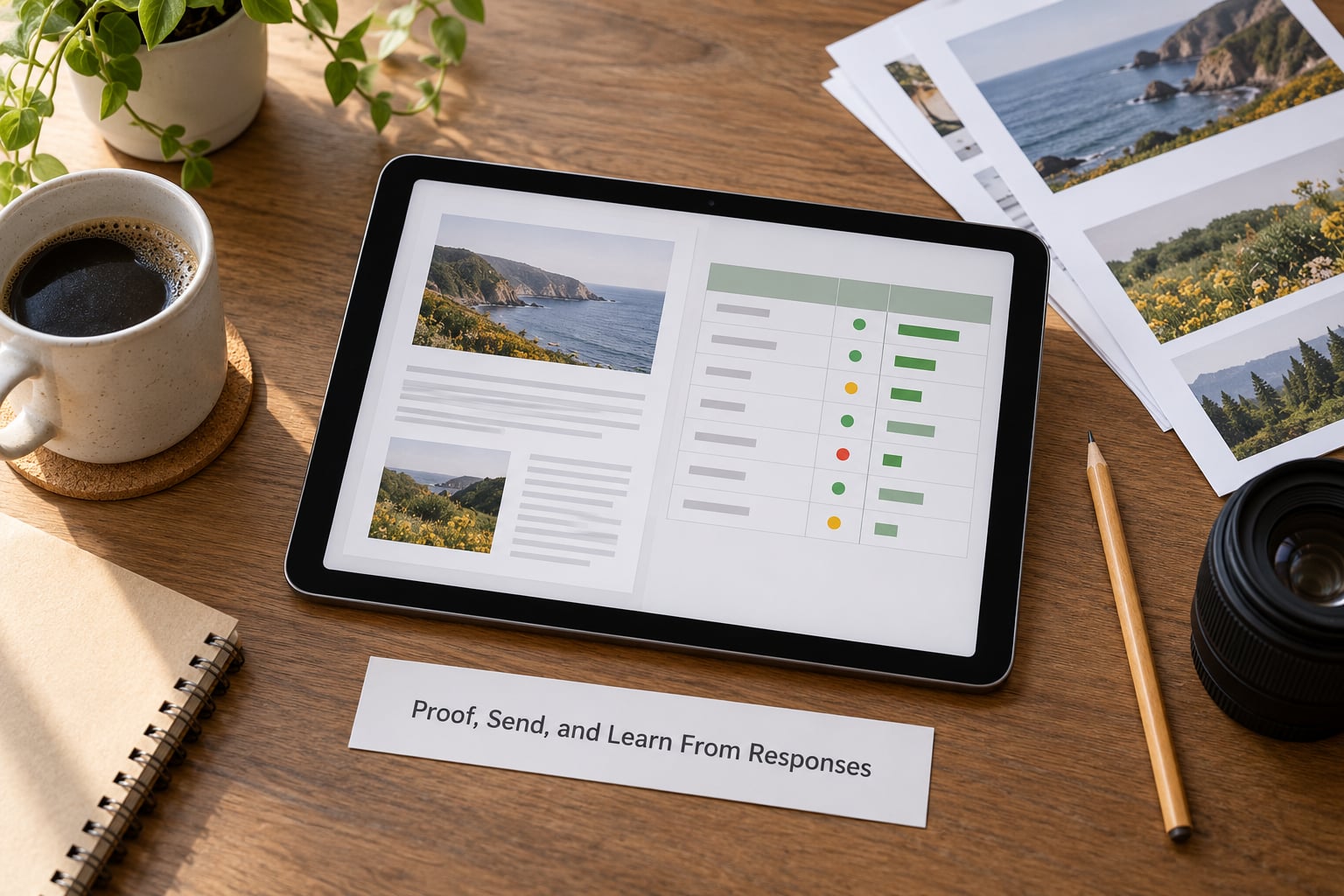
Before sending, read the draft once on a phone, once on a desktop, and once as a stranger. Confirm the images loaded, the preview text is right, the links work, and there is exactly one action. Then schedule it rather than sending at midnight when you finish the edit.
Read the numbers, but do not worship them. Industry benchmarks put average open rates somewhere around the mid-thirties with click rates near two percent, and one large platform’s published averages land around a 2% click rate with unsubscribes under a quarter of one percent. Open rates in particular are unreliable, because recent privacy features on major mail clients preload tracking images and register opens that never happened. A list of fifty real readers who reply beats five thousand inflated opens, every time.
Track replies, clicks, unsubscribes, and the questions that keep recurring. Those four tell you more about whether the writing worked than any single percentage.
Common Mistakes
Six problems account for most unread issues, and each has a straightforward fix.
Vague promises. Fix: write the one-sentence promise before you write anything else, and make a stranger able to repeat it.
Opening with your personal news. A trip, a milestone, a new lens is not automatically reader value. Fix: keep one line of it, then move to the decision, problem, or observation that a reader would recognise.
Posting images without a story. A grid of finished frames with captions that repeat the file names wastes the only thing your format has that a blog does not. Fix: every sequence needs a reason behind it, stated in a sentence.
Sales-heavy subject lines. Discounts and scarcity language get you filtered, which is exactly the complaint that shows up repeatedly when photographers ask for newsletters that are not sellouts. Fix: write about the issue, promote inside it where it earns its place.
Formatting for desktop only. Fix: design for the narrow screen first, then check the desktop version.
Asking for too much. Fix: one action per issue, chosen from reply, forward, click, or reply to a specific question.
One last editing tip: read the draft aloud. Sentences you stumble over are usually sentences carrying two ideas, and splitting them fixes both the rhythm and the length.
Frequently Asked Questions
How often should photographers send a newsletter?
Once a week or once a month, whichever you can sustain through a busy shooting season. Consistency matters more than frequency, because readers learn when to look for you. If your schedule breaks, reduce the frequency and keep the same day rather than going silent for weeks. A schedule you keep for two years beats a weekly promise you break in March.
Should a photography newsletter focus on a project or practical tips?
Rotate them. Projects give people a reason to open, and practical tips give them something to act on, so an issue that carries both usually performs better than either alone. A good ratio is one project narrative for every two or three shorter tip issues. Whatever you choose, state the benefit in one sentence so readers know why this particular email is different from the last one.
What is a good subject line for a photography newsletter?
A short, honest headline about what the issue contains, under about 50 characters, with the interesting half first because the end gets cut on mobile. Name the specific problem or result rather than labelling the send. Finish it with 8 to 14 words of preview text that completes the thought, since most platforms otherwise fill it with a view-in-browser notice.
What should the call to action in a photographer newsletter say?
Ask for one thing a reader could genuinely give, and make it match the issue. After an issue about choosing frames, ask which one they would have picked. Stacking a booking request, a follow, a share and a survey in the same paragraph teaches readers that your emails cost them time. Learning how to write a newsletter that photographers actually read depends more on this restraint than on any trick.
How can I grow a photography newsletter without buying subscribers?
Earn signups where you already have attention. Put a signup link on every blog post and gallery page, mention the list at the end of a shoot or during delivery, and give people something the social feed cannot hold, such as the unedited sequence behind a finished frame. Ask existing readers to forward a specific issue. Never buy a list; those addresses damage your sender reputation and your numbers at once.
Conclusion
A photography newsletter people read is the same issue every time: one specific reader, one promise stated in a sentence, an opening built from a moment in the work, four to eight images that explain the story, and a single invitation. The craft lives in what you remove.
Start with the next issue. Write the promise, pick one story, choose the images that carry it, and ask one question at the end. Send it on the same day you sent the last one, then read the replies before you touch the metrics.