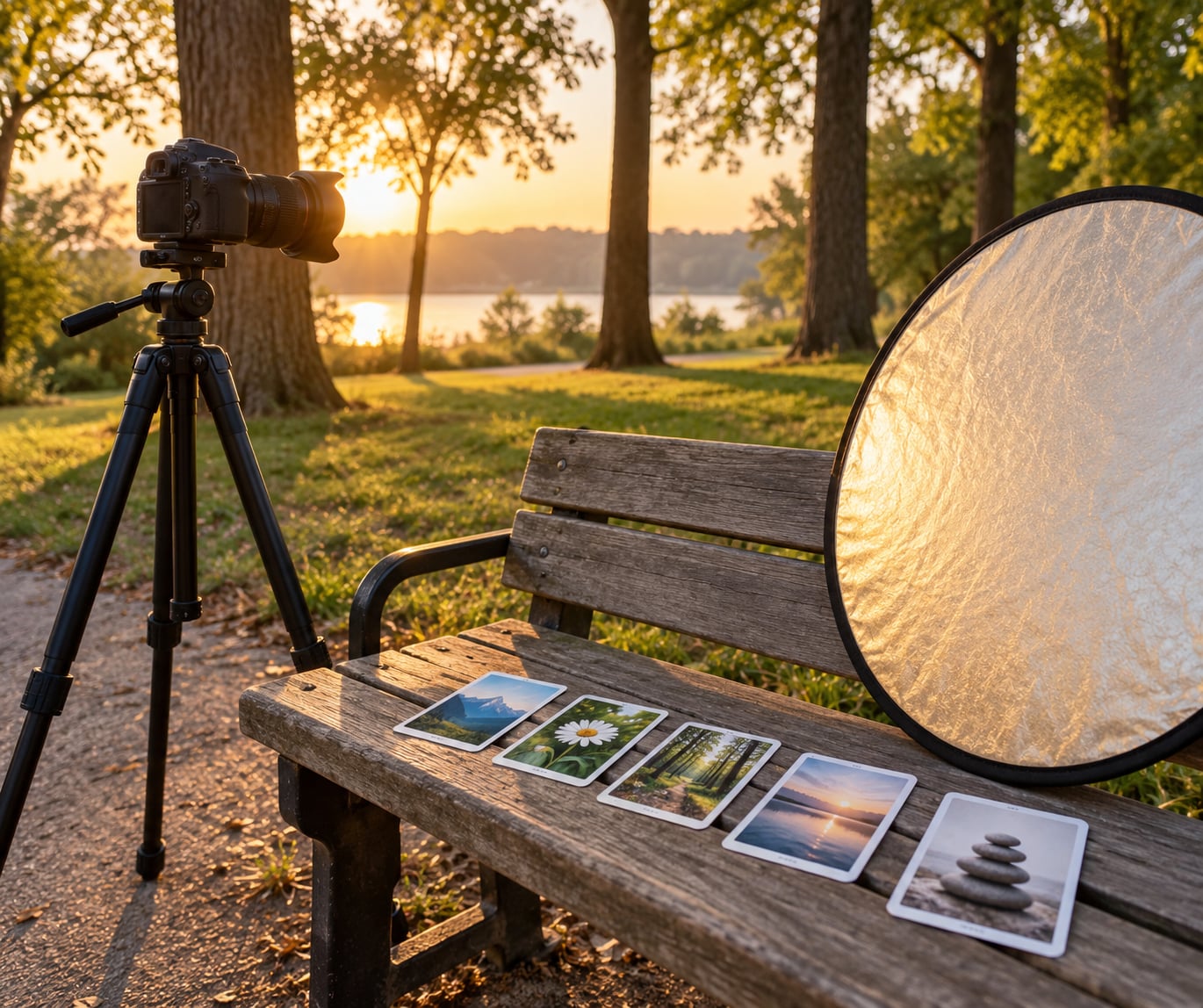
To photograph a family of five without chaos, you fix three things in a fixed order: the arrangement of the people, the camera settings, and the order you add people to the frame. Get the order right and the session takes 20 minutes; get it wrong and you spend an hour chasing five kids who each have a different idea of what is happening.
The reason five is harder than three is simple. Three people can be told to stand still and mostly will. Five is two adults with opinions plus three children at three different attention spans, spread across maybe 15 inches of height, and the tallest one is going to look fine while the smallest one picks up a stick.
I shoot a lot of these. The families who get usable photos from a five-person session are almost never the ones with the best camera. They are the ones where somebody decided beforehand which combinations matter most, and shot those first, while everyone was still fresh and willing.
Here is the workflow I use, step by step.
Table of Contents
- What You Need
- Step-by-Step
- Step 1: Create a simple shooting order
- Step 2: Choose a location with room to move
- Step 3: Set the camera for fast movement
- Step 4: Use one child or parent as the anchor
- Step 5: Give everyone a specific job
- Step 6: Build groups gradually
- Step 7: Keep the energy active and specific
- Step 8: Capture the full group more than once
- Step 9: Review and finish with a favorite moment
- Common Mistakes
- Frequently Asked Questions
- What aperture should I use for a group of five?
- How do you pose five people for a photo?
- How do you get kids to cooperate for family photos?
- How long should a family photo session last with young children?
- Should I use flash for a family group photo?
- Do I need a telephoto lens to photograph a family of five?
- Conclusion
What You Need
You need a camera that shoots faster than one frame per second, a lens that lets you stand far enough away, light that is soft, and a plan written down before anyone arrives. That last item does more work than the first three combined.
Camera and lens
Any camera with a continuous burst mode will do. The rate matters less than people think, but 3 frames per second or faster is the minimum I would bring, because blinks are guaranteed and one blink ruins the frame. A fast shutter is what lets you keep the burst short and still catch a real expression.
For the lens, a short-to-medium zoom gives you the framing freedom you actually need. A 35mm on full frame, or roughly 24mm on a crop body, is the wide end that lets you get all five in without a swimming-pool distortion look. Going to 70mm lets you compress them back together and lose the background clutter. Stepping back and cropping in gives nearly the same result when light is tight.
Light
Open shade is the goal. A big tree, a building overhang, a porch, or the shadow side of a house gives you even light across a wide group, which matters more with five people than with two, because every step sideways changes the exposure on whoever is standing over there.
Bring a reflector, even if it is just a white car sunshade propped against something. It costs nothing and it fixes the one face that ended up in shade. A flash is optional here, and in bright open shade it is usually more trouble than it is worth.
A plan
One page. List the combinations you actually need: the full group of five, each parent with the kids, the three kids alone, and any sibling pair that matters to you. That list is the session.
Timing matters as much as the gear. Outdoors, start about an hour before sunset and finish with the sun low. That window gives you soft light and a short session, which suits young children better than a long one.
People management tools
You need one adult who is fully at ease near the camera, a way to get the children’s attention back after every setup, and a voice tone that does not rise. Volume is a signal children read as danger, and it usually produces the opposite of what you want.
What changes with your gear tier
| Gear | What changes | Best single setting to start |
|---|---|---|
| Phone | Depth of field is deep, so focus is not the problem. Tap-to-expose can drift, so lock exposure and focus before the frame and back up two steps for the widest view. | Tap the group, lock AE/AF, use burst or Live Photo, clean the lens first |
| Mirrorless | Eye tracking holds a moving toddler far better than a point-and-shoot. Silent shutter helps with red-eye but can dim the screen in low light. | 1/500s, f/4, Auto ISO, subject tracking |
| DSLR | You get manual ISO and back button focus, which makes the settings lockable across the whole session instead of drifting. | 1/500s, f/5.6, ISO 400 to 1600, single-point AF, high-speed continuous |
On any tier, shoot RAW. A blown highlight on a child’s white shirt is much easier to recover from a RAW file than from a JPEG.
Step-by-Step
Step 1: Create a simple shooting order
Before the day, order your family combinations from most stable to least stable. Stable means fewer people, calmer members, and a pose they already know how to hold.
A workable sequence for a family of five looks like this: the full group of five first, while everyone is still cooperative. Then the adults with all three kids in a smaller cluster, which reads almost as a group shot. Then the three kids alone, which is usually the easiest and often the best image of the day. Then the parent pairs, then the individual kids while they still have attention.
Doing the full group first feels backwards and it is the single biggest improvement you can make. Everyone is rested, nobody has had time to get bored, and you get a strong frame bank to fall back on. Everything after that is upside.
Write the order down. Memory is not reliable when three people are talking over each other asking when they can leave.
Step 2: Choose a location with room to move
Pick a spot where a child can walk a few steps in any direction without you losing them, and where you can change your shooting angle by moving sideways rather than by zooming.
Room matters because rearranging a group five times is what actually creates chaos. If the space is tight, every reset is a small relocation, and every relocation is another chance to lose the arrangement.
Check the background before anyone arrives. Walk behind your planned camera position and look the other way. Look for things growing out of heads, bright patches, straight lines that will cut through a body, and other people’s dogs. You can often fix a background by stepping a metre to one side rather than by moving anybody.
Shade is also a comfort decision. Kids who are not overheating last considerably longer, and a warm, tired four-year-old stops cooperating at about the ten-minute mark.
Step 3: Set the camera for fast movement
Start at 1/500 second and f/5.6, with Auto ISO or an ISO range of roughly 400 to 1600. Children in family photos are almost always moving a little, and 1/500 gives you enough latitude to walk forward and shoot at a comfortable distance without dragging the shutter.
Here is the number you asked about most often: the best aperture for a group of five is f/5.6 to f/8 on full frame, narrower if your lens or your light demands it. Depth of field is what keeps the person in the back row as sharp as the person in front. With five people staggered over roughly a metre of depth, f/5.6 on a 35mm lens usually covers it. If you are checking the LCD and the back row is soft, stop down one more step rather than raising the shutter.
On crop bodies, think in equivalent focal length rather than the printed number. A 24mm behaves like a 35mm.
Use a single autofocus point or subject tracking, and put it on the nearest face. Back button focus or a half-press to focus and hold works well because it stops the autofocus from hunting when a child crosses the frame. Set continuous high-speed drive, shoot RAW, and check that your fastest shutter is actually enabled rather than a 6 fps auto-low setting.
Turn off anything that makes a sound or a light in the dark. Silence matters more than most camera settings when there are toddlers involved.
| Situation | Aperture | Shutter | ISO | Focus |
|---|---|---|---|---|
| Five people, two staggered rows, standing still-ish | f/5.6 to f/8 | 1/500s | Auto or 400 to 1600 | Single point on nearest face |
| Three kids running or walking toward you | f/4 | 1/1000s | Auto | Subject tracking |
| Full group seated on the ground | f/4 to f/5.6 | 1/500s | Auto | Centre face, single point |
| Family walking together along a path | f/4 to f/5.6 | 1/640s | Auto | Tracking, framed slightly wide |
| Harsh sun, no shade available | f/8 | 1/1000s | Low or Auto | Single point, meter the faces |
Whichever numbers you pick, lock them and stop adjusting mid-session. Changing settings in front of a family reads as fiddling, and fiddling costs you their attention.
Step 4: Use one child or parent as the anchor
One calm person holds the arrangement together. In most families of five that is one parent, because they are the one who already knows where they will stand. Put that person in place first, every single time.
Build outward from the anchor rather than scattering people into place. A hand on a shoulder, an arm around a waist, a parent crouched in front with both kids tucked in. Contact between people is what makes a photograph of five look connected instead of assembled.
For the height spread, use whatever the location gives you. Steps, a low wall, a bench, or just adults crouching work better than carrying anything. Two rows, staggered, tallest at the back, youngest in front. Never line five heads up at the same height, because then nobody reads at a glance and the frame looks like a school photo.
One adult standing near the camera is a deliberate choice, not an accident. Children do better when they are not being addressed by a stranger holding a large object. The second adult stays with the kids, talking, handling the bag, keeping everyone fed, and relaying your instructions.
Step 5: Give everyone a specific job
The words say cheese stop working by age four. What works is a task, because a task has an end point a child can understand.
Some that have worked for me: walk toward me and stop when I say stop, put your hands in your pockets and look at grandma, help your little brother find the yellow leaf, all of you hold hands and squeeze three times when I count, sit on the step and read this page out loud, stand still and watch the bird on the fence.
Two rules make these work. Say what happens next, not what expression to make. And give the shy child a job rather than a smile, because smiles can be asked for and jobs can be done.
Expect the third take to be the best one. The first is positioning, the second is correcting a hand, and the third is when people have stopped thinking about the instructions.
Step 6: Build groups gradually
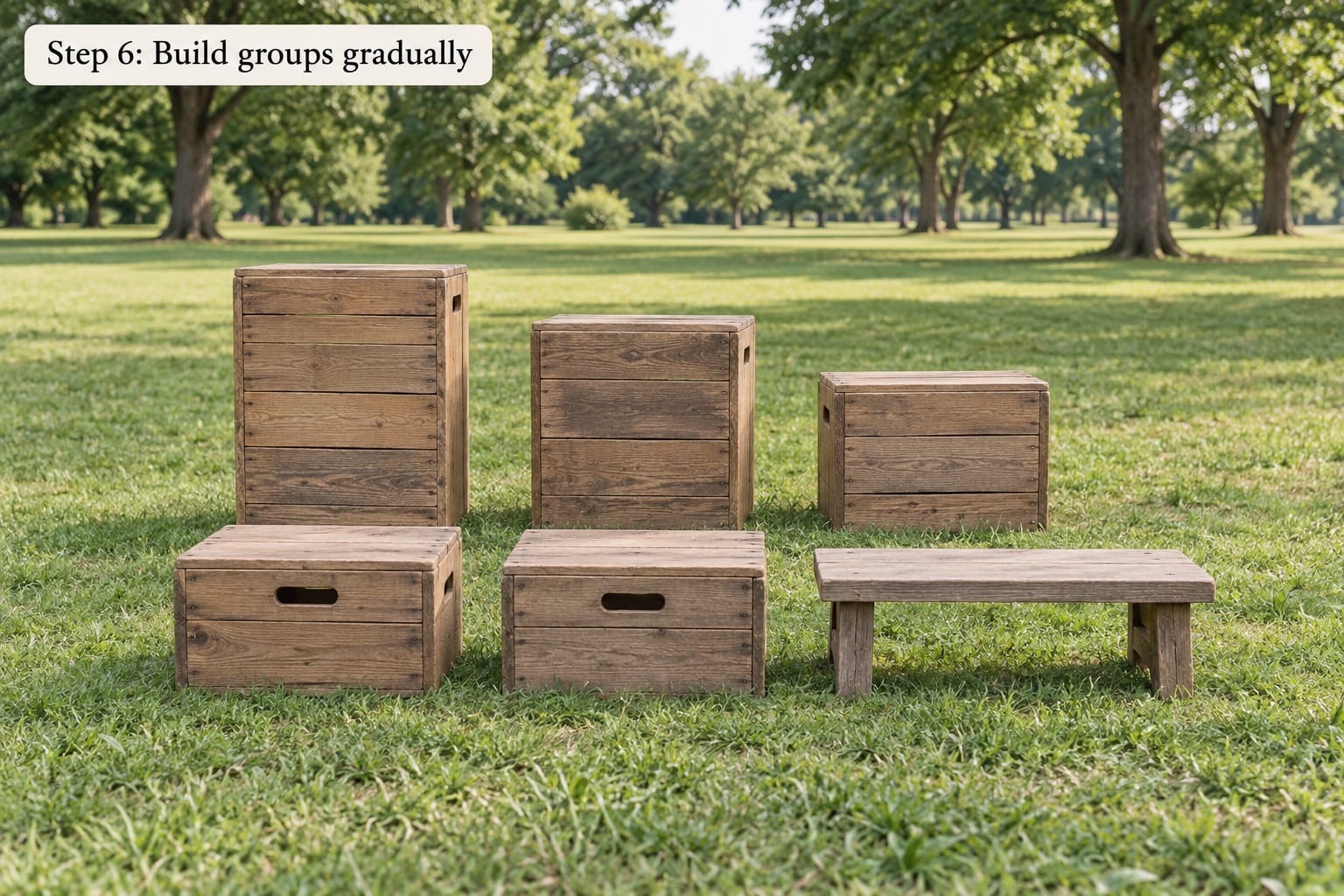
Move up the ladder one rung at a time: one person, then pairs, then trios, then four, then all five. Each rung is a small reset that the family already understands, which is why it feels calm.
Never go straight from all five to a subset. When people come out of a big arrangement they relax, and that relaxed version is the best material you have.
Five arrangements worth having ready, with the same five people:
- Two staggered rows. Three standing at the back, two seated or crouched at the front. The workhorse and the safest default.
- Triangle. The tallest at the back, two at their sides, two in front. Strongest when you want the frame to feel tall rather than wide.
- Staggered V. Everyone on a shallow curve, nobody directly behind anybody. Nobody hides, and no face sits on a shoulder.
- Seated and standing. Two seated on a bench, two standing beside them, one standing further out. Good in front of tall doors or railings.
- Kids in front. All three children at the front, adults behind with hands on their shoulders. Reads instantly as a family, and youngest kids love it.
Two things to watch in every arrangement: heads that line up exactly, and limbs that touch at exactly the same place. Both make a frame look wrong in a way most viewers cannot name but everybody feels.
Step 7: Keep the energy active and specific
Short direction, delivered once, then shoot. Say it in under five words: hands in pockets, look at the tree, come closer, step in one foot.
Then count down from three and fire the burst as they reach the pose. Do not re-pose mid-burst, because a change on frame nine means frames one through eight are all wasted.
Keep talking between shots. The chatty seconds between setups are where the real expressions happen, and the camera is often still in your hands when they do.
When someone breaks, go quiet and shoot rather than talking. Waiting for a silence is the fastest way to get a genuine expression from a distracted child.
Step 8: Capture the full group more than once
Five people will not all hold a pose on one take. Shoot the full group four or five times minimum, and treat the first attempt as a rehearsal that cost you nothing.
Vary something each time. Change the height arrangement, change the background by moving your own position, ask for a slightly tighter crop, then ask for something looser where they can hold hands. Variation gives you options that a repeated identical pose never will.
Shoot the same arrangement at a different focal length too. A slightly wider frame with air around the edges is often more useful than the tightest one, especially for printing.
Count your frames, not your minutes. One good frame of all five is worth more than forty frames of four, so check after every take that you actually have a full five in the frame and nobody walked out of it.
Step 9: Review and finish with a favorite moment
Zoom into the back row on the LCD before you call anything good. At 100 percent, check the face furthest from the camera. If it is soft, stop down one step, refocus, and reshoot.
Scan for the four usual failures: a blink, a person looking away, a tangency where an arm sits exactly on a hip, and a background distraction that intersects a head.
On tangencies, a small reposition of one person usually beats cropping. Move them a few centimetres, not the whole group.
Then end on something loose. Put the camera down on a tripod, hand the job to another adult, and let them play for a few minutes while you shoot walking frames and interaction frames. The last few minutes usually produce the image the family actually puts on the wall.
Common Mistakes
Almost every messy five-person session comes from one of the same handful of causes. Here is what goes wrong and what to change.
| Symptom | What is actually happening | Fix |
|---|---|---|
| Someone blinked in most frames | You fired a slow burst, or you fired too early before people settled | Shorten the burst to half a second, fire after the count-in, and shoot far more frames than feels necessary |
| Back row is soft | Aperture too wide for the depth of the group, or you focused on the front row | Stop down to f/8, focus on the nearest face, and check the LCD at 100 percent |
| One face is darker than the rest | They stepped into shade or the light fell off across the group | Use a reflector, or move them a step into the light and re-expose on the faces |
| Kids wander off | The pose was static and had no end point | Give every child a specific job and shoot the walking version of the pose |
| Everyone looks assembled rather than related | Nobody is touching, or the arrangement is too even | Build from the anchor outward with hands on shoulders and staggered heights |
| Heads line up in a row | Heights were not varied | Move one person a foot forward or back, or have them crouch |
| The session drags past twenty minutes | You shot the full group last, or the order was never written down | Shoot all five first, then work down the list of subsets |
| Shouting makes it worse | Rising volume reads as threat | Get down to their eye level and use short, calm, specific directions |
| Too many props in the frame | Every prop is one more thing for a child to ignore | One prop, used by one person, and often not even in the final frame |
Two more habits cause most of the rest. Nobody tells the family what happens next, so they spend every setup wondering how long this lasts, and the tiredness shows in their faces. And chasing a perfect frame leads to repeating the same pose eight times, which is eight chances for someone to get worse instead of better.
Shoot until you have it, then change one variable. If nothing works after three takes of the identical setup, the answer is a different arrangement or a break, not a fourth take.
Frequently Asked Questions
What aperture should I use for a group of five?
Start at f/5.6 on full frame and stop down to f/8 if anyone is standing more than a metre behind anyone else. Depth of field is what keeps the back row as sharp as the front. Pair it with 1/500s and raise ISO as needed rather than slowing the shutter, because children in family photos are almost always moving slightly.
How do you pose five people for a photo?
Use two staggered rows with the tallest at the back and the youngest in front, or build a triangle with one person at the apex and two on each side. Give everyone a specific job rather than an expression to make. Nobody should stand directly behind anybody else, so no face hides on a shoulder.
How do you get kids to cooperate for family photos?
Give each child one concrete task with an obvious end point: walk toward me and stop when I say stop, or find the yellow leaf. Tasks work because a child can complete them, while smiling on demand becomes impossible past about age four. Shoot the full group while everyone is still fresh, then relax into play.
How long should a family photo session last with young children?
Plan for 20 minutes with children under six, and treat anything longer as a bonus. Their attention runs out well before yours does, and the last ten minutes usually produce the tired faces that end up discarded. Shoot all five first, capture the combination list while energy is high, then finish with free play on a tripod.
Should I use flash for a family group photo?
In open shade or overcast light, no. Flash at short range gives the nearest faces a much brighter exposure than the back row, and the fall-off is exactly the problem you are trying to solve. Flash becomes useful when you are indoors, in harsh sun with deep eye sockets, or after sunset. A reflector solves most outdoor shade problems instead.
Do I need a telephoto lens to photograph a family of five?
No, but do give yourself room. A short-to-medium zoom around 35mm on full frame, or 24mm on a crop body, lets everyone fit in without wide-angle distortion at the edges. Stepping back and cropping in works nearly as well when the light is tight. Save the long end of the range for compressing a wide group against a busy background.
Conclusion
Before anything else, write down the order of family combinations you need and put the full group of five at the top of it. Everything after that follows from that one decision.
Then make movement part of the session rather than something you fight against, lock your settings so you stop fiddling in front of five people, and take the full group four or five times before you change anything. Review the back row on the LCD at 100 percent, keep the frames where all five are actually present, and finish with ten minutes of play.
Chaos in a family of five session is almost always a planning problem wearing a temperament problem’s clothes. Write the order, and the session takes twenty minutes.