A client questionnaire is the fastest way to arrive at a portrait session already knowing what your client wants, what would make them comfortable, and what you need to bring. Used well, knowing how to use a client questionnaire before a portrait session turns a form into a shot list, a location plan and a calm ten-minute start on the day instead of a page of vague answers and on-the-day negotiation. The whole workflow takes about twenty minutes per client once you have built the form.
The trick is that a questionnaire is a listening tool, not a contract. You are reading for patterns and constraints, not collecting instructions to follow literally. Clients who write “nothing in particular” are handing you freedom, not a problem, and clients who paste forty images without a word are handing you a mood to translate. Both are workable if you know which parts of the form to read closely and which to treat as a starting point.
Table of Contents
- What You Need Before Reading the Answers
- Step-by-Step: Turning a Questionnaire Into a Session Plan
- Design Questions That Produce Useful Answers
- How to Use a Client Questionnaire Before a Portrait Session: Review the Answers
- Build a Shared Session Plan
- Prepare Clothes, Props, and Poses
- Confirm Logistics and Boundaries
- Send a Short Pre-Session Summary
- Review the Final Details Before the Shoot
- Common Mistakes
- Tips for Using Questionnaire Answers Well
- Frequently Asked Questions
- How many questions should a portrait client questionnaire include?
- When should I send a client questionnaire before a portrait session?
- What should I do if a client’s questionnaire answers conflict?
- Should clients choose their own poses and outfits?
- How do I use a client questionnaire without making the session feel scripted?
- Conclusion
What You Need Before Reading the Answers
You cannot use a questionnaire properly if you have nothing to write the answers onto. Set up these pieces once and reuse them for every client.
- The form itself, built once with required and optional fields marked, then trimmed per session type so nobody sits through questions about pets during a corporate headshot booking.
- A scheduling and consent tool that holds the booking, model release and any guardian permission in one place.
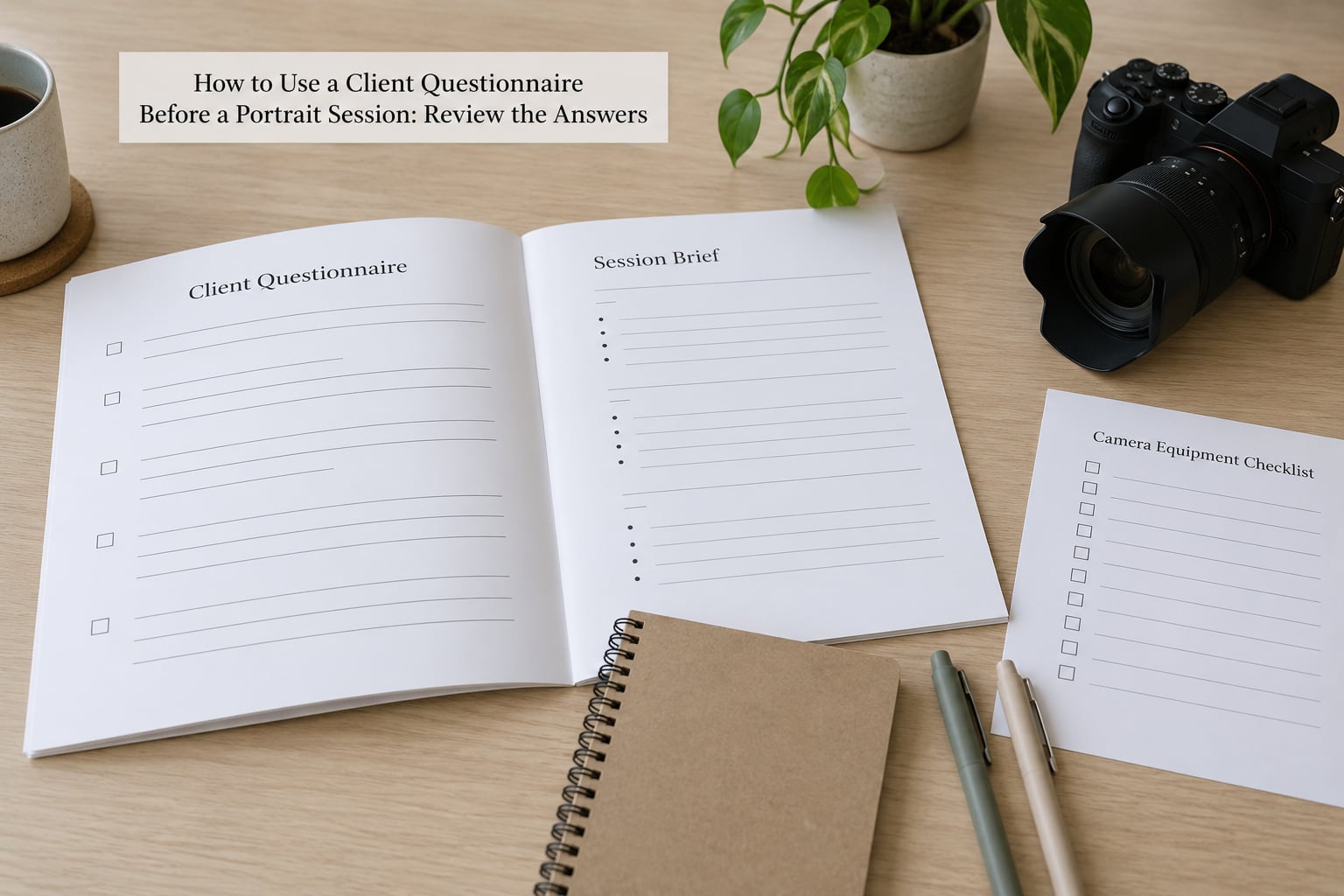
- A one-page session brief template, the single document where answers get condensed. One page, so it stays readable in ten minutes.
- A place for visual references, whether clients upload images into the form or link a board. Ask for three to five, not forty.
- Wardrobe and prop notes, including colour preferences, heirloom items, anything fragile, and what the client will not wear.
- An equipment checklist that expands based on the session type: extra lenses, reflectors, a stool for sitting portraits, clamps for a low angle, or a second body for a multi-person session.
- An emergency contact, required for any session involving children or a large group.
- Payment and image usage terms, sent in the booking agreement rather than buried in a creative form where they read as a bait and switch.
If you take one thing from the list, make it the session brief. The form collects; the brief is what you actually shoot from.
Step-by-Step: Turning a Questionnaire Into a Session Plan
Design Questions That Produce Useful Answers
Design the form around the decisions you have to make before you pick up the camera, not around what you find interesting. A question earns its place only if your answer changes what happens on the day.
Cover these areas in roughly fifteen to twenty fields: what the session is for, who will appear and their relationships, the mood they want, how comfortable they are being photographed, clothing and colour, accessibility needs, location preferences, timing constraints, how the images will be used, and any boundaries you should respect.
Mix open prompts with practical choices. “Describe what you want these photos to feel like” gets you language; a tick list of moods gets you something you can scan quickly. Offer time windows instead of exact times, ask for first names and pronouns rather than legal names unless a release genuinely requires more, and end with an honest completion-time estimate. Ten minutes is a fair promise, fifteen is honest for a family form.
Two rules keep response rates up: mark optional fields as optional so nobody feels guilty skipping them, and give a one-line reason next to anything sensitive. “Telling me about allergies means I can plan snacks and know what to avoid at the location” beats a bare checkbox.
How to Use a Client Questionnaire Before a Portrait Session: Review the Answers
Read for five things: recurring priorities, anxieties, hard constraints, relationships between the people in the frame, and visual cues in the reference images.
Priorities repeat. If a client mentions their late grandmother three times, that name goes near the top of your shot list, and you can say so in the summary so they know you actually read it.
Constraints hide in plain sight. A bedtime of eight, a wheelchair user, a second shoot that starts at noon and a nervous twelve-year-old all change the schedule, the location or the posing, and none of them show up under a heading called “preferences.”
Anxieties are worth more than preferences. If someone writes that they dislike having their photograph taken, that tells you to open with conversation, skip the tight group pose in the first ten minutes, and give them something to look at that is not a lens pointed straight at them.
Then group the answers into the brief: one paragraph on who is coming, one on the look, one on the shape of the day, and a bullet list of must-haves. Anything you cannot act on, either leave it out or ask. Contradictions get a question, never a guess. Asking about ten extra minutes for a second outfit costs you one email and saves a session that ends short.
Build a Shared Session Plan
Turn the brief into a plan you and the client can both read: where you meet, what time, roughly how the session moves, what you are photographing and in what order.
Sort ideas into must-haves and options. The must-have list is short enough to shoot in any weather and in any order, the things that define the session for that client. Options fill the golden hour at the end if everyone is comfortable. This structure protects the session when a toddler melts down or a location turns out to be busy.
Decide the order of the combinations too. In a multi-person session, I start close and small, one adult with one child, before any attempt at the full group. That warms people up and it gives you a frame everyone can look at to understand what you are asking for.
Build in breaks and a changeover. Water, a sit-down, five minutes to let a child run around. Twenty-five to forty-five minutes before you change outfits or move locations, and never more than two looks unless the client has specifically asked for more.
Prepare Clothes, Props, and Poses
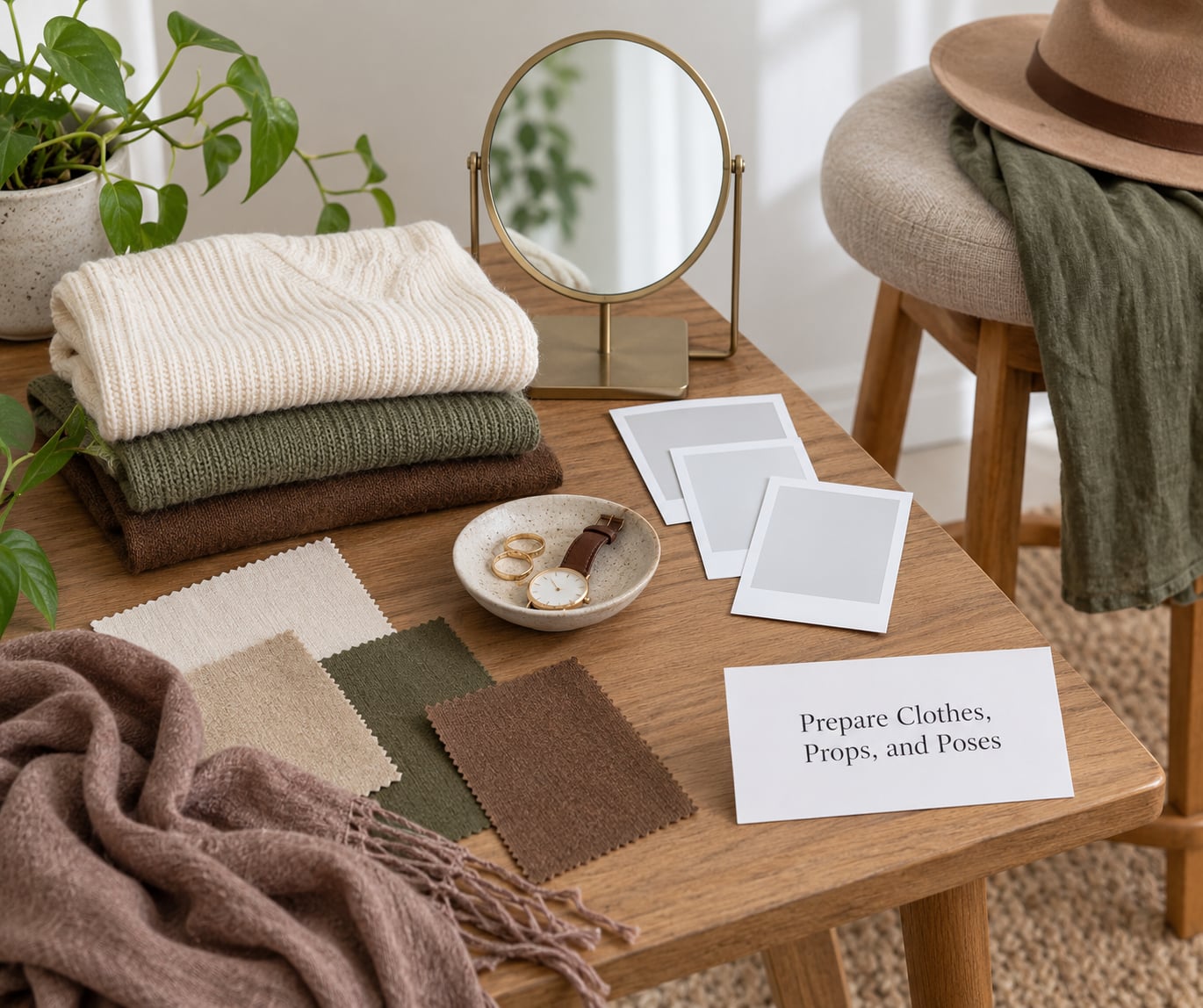
Client preferences should shape your recommendations, not replace them. If someone sends three warm-toned images, you can absolutely suggest a colour that works better against the location they have chosen, and then explain why in one sentence.
Watch for practical clashes. Loose or long sleeves change how you direct hands. Patterns across the whole body pull attention away from a face. Shoes decide whether you can shoot seated on grass. Heirloom jewellery gets its own close-up in the plan, and fragile items travel in a box you bring, not in a client’s pocket.
Pets, allergies and sensitivities belong in this section too. Know whether a child reacts to strong scent, whether anyone is sensitive to bright sun, and whether a dog will actually hold a sit. Accessibility details change your kit list more than any style preference does.
Finally, run each proposed pose through a quick check: can the client hold it comfortably, does it suit their stated comfort level, and does it need a prop or surface you have not already planned to bring. A pose that needs someone to kneel on wet grass is a bad plan for a session in January.
Confirm Logistics and Boundaries
This is the stage where the questionnaire quietly prevents problems, because it is the only place the client can tell you things they would never say in front of a photographer.
Get explicit permission for any minor, and from a guardian if the parent is not the one attending. If you are shooting at a private home or land, ask about neighbours, parking, dogs in the yard and areas people would rather you did not enter.
Agree on a weather backup in advance, with a date it can be used by, so nobody is trying to renegotiate at seven in the morning. Confirm a mobile number that works on the day, plus the emergency contact, and confirm the remaining payment and the image usage terms in writing.
Say plainly what happens if someone falls ill: the rescheduling window and how much notice you need. Clients who plan a session around a birthday or a graduation can plan around a clear policy, and they will far less often panic in a message at 6am.
Send a Short Pre-Session Summary
One message, under a screen. Summarise the plan, list the two or three things you need them to decide or bring, confirm the arrival details, and invite corrections.
The invitation matters. Something like “if any of this does not match what you had in mind, tell me now and we will fix it” converts a client who quietly disagreed into a client who tells you. Keep it to one round; sending the original questionnaire back for a second pass is how you lose the goodwill you just built.
Review the Final Details Before the Shoot
The evening before, check the weather at the actual location and at the actual hour, then confirm any change with the client rather than quietly adapting. Charge batteries, clear and format two cards, and confirm a second copy exists of anything you will not recreate.
Load the brief and the shot list on your phone so you are not holding notes. Pack the kit the brief implies, not the kit you always pack. Check releases and model permissions are signed, and re-read the client messages in case something arrived after your summary.
On arrival, spend the first ten minutes with nothing else planned: no camera prompts, no shot list. Have a look at the light, talk through the plan out loud, confirm outfits and any changes, and ask about anything that shifted overnight. Most of the value of the questionnaire is already in the room by then.
Common Mistakes
Asking too many. Forty fields reads as homework, and abandoned optional fields teach you nothing. Keep it to fifteen or twenty and cut anything you would not act on.
Treating answers literally. “Relaxed and candid” is a preference, not a brief. Translate it into three setups you can steer toward and note it, then adjust once you meet them.
Ignoring contradictions. A request for tight formal portraits and a stated dislike of posing cannot both drive the session, so ask rather than pick a winner.
Over-planning. A brief that runs to four pages turns you into a reader on the day instead of a photographer. One page, three must-haves, everything else optional.
Using a generic form. The same twenty questions sent to a family, a headshot client and a maternity client wastes everyone’s time. Build one base form and swap the middle block per session type.
Failing to explain sensitive questions. Anything about health, weight, family transitions or money needs a reason attached to it, or you get a blank field and a client who felt judged.
Copying a client’s idea unchanged. A shared board is inspiration, not a shot list. Keep the feeling, choose the execution.
Not confirming logistics. If timing, parking, payment and releases only exist inside a form, one of them will be missed. Put them in the booking agreement and the summary.
Tips for Using Questionnaire Answers Well
Personalise the prompts. “Tell me about the three people you most want photographs of” gets a better answer than “list everyone attending,” and it is the same length.
Ask follow-ups by voice or message rather than by form. A second round of questions after reading the first set feels like homework; one specific question feels like attention.
Give examples. When you ask about style, show two or three of your own frames that resemble what they described, so you are comparing like with like.
Treat sensitive answers as sensitive. Health information, children’s details and family circumstances should not live in a shared spreadsheet or get forwarded to an assistant. Store them with the booking, limit access, and delete them on your normal schedule.
Finish with a visual brief, not a script. A mood board of three references plus three must-have shots tells you far more on the day than a page of instructions, and it leaves room for the session to go somewhere better than planned.
Frequently Asked Questions
How many questions should a portrait client questionnaire include?
Fifteen to twenty fields is the useful range for a single portrait session. Below ten you will miss something that changes the day, and above thirty clients start abandoning optional answers. Mark sensitive or niche questions as optional so a headshot booking never gets asked about pets and school runs.
When should I send a client questionnaire before a portrait session?
Send it at booking with a short welcome note, then chase once about a week out and send your summary roughly 48 hours before the session. That first message frames the form as preparation rather than paperwork, the reminder catches busy clients while there is still time to adjust, and the summary gives everyone a final chance to correct something.
What should I do if a client’s questionnaire answers conflict?
Ask. Send two or three specific questions naming the conflict plainly, such as asking whether they want a formal group pose when they also said they dislike being posed. Keep it light and assume the answer is a preference you can rank rather than a mistake. Guessing risks delivering a session that looks technically right and feels wrong.
Should clients choose their own poses and outfits?
Invite them to shape both, then translate. Their references and comfort level tell you what direction will land, while you decide the execution, the colours that work against the location and the poses they can actually hold comfortably. Handing over every decision usually produces a session neither of you is happy with, so offer options rather than an open brief.
How do I use a client questionnaire without making the session feel scripted?
Use the answers to shape the first ten minutes, not every frame of the session. Read for comfort, constraints and visual mood, write down three must-haves, and leave the rest of the shoot open to what happens in front of the camera. A questionnaire that names the priorities still leaves plenty of room for the session to surprise you.
Conclusion
A client questionnaire is a planning and listening tool. It earns its keep when you read the answers for what they tell you about the person, not when you follow them word for word.
Before the next session you book, do three things. Read the completed form properly and write the answers onto a single page. Pick the three priorities that would make the session a success if nothing else worked. Then send one short summary that names the plan, asks for the decisions only the client can make, and invites corrections.
That is the whole workflow. Knowing how to use a client questionnaire before a portrait session means twenty minutes of reading and writing before you travel, not twenty minutes of paperwork after. That preparation is what turns an unpredictable afternoon into photographs the client was already hoping for before you raised the camera.