A good subject for a long-term photo series is one you can return to repeatedly, that changes visibly over time, and that you can photograph with the gear and free time you actually have. Pick it by curiosity first, then test it on a small pilot series, then write down the boundaries and the shooting rhythm before you commit to a year.
Most projects do not die because the photography was bad. They die in month four, when the novelty wears off and the subject turns out to have nothing left to say. Choosing well is mostly a matter of asking sharper questions before you commit, and of testing the idea cheaply rather than discovering the problem in month five.
On this blog I have watched people start dozens of personal projects. The ones that finished were almost never the most ambitious ideas. They were the ones with a narrow question, a subject that changed without being forced, and a schedule the photographer could survive a bad week in.
Table of Contents
- What You Need
- How to Choose a Subject for a Long-Term Photo Series
- Step 1: Start with a question, not a topic
- Step 2: Look for meaningful change
- Step 3: Test the subject through a small first series
- Step 4: Define the boundaries
- Step 5: Build a repeatable shooting routine
- Step 6: Use a consistent visual language
- Step 7: Review and refine the series
- Step 8: Decide when the series is complete
- Common Mistakes
- Frequently Asked Questions
- How much time should I devote to a long-term photo series?
- What if I do not know in advance how the series will end?
- Should a long-term photo series always include people?
- How do I keep a photo series consistent without making every image look the same?
- How often should I edit and sequence a long-term photography project?
- Can I return to a photo series after taking a long break?
- Conclusion
What You Need
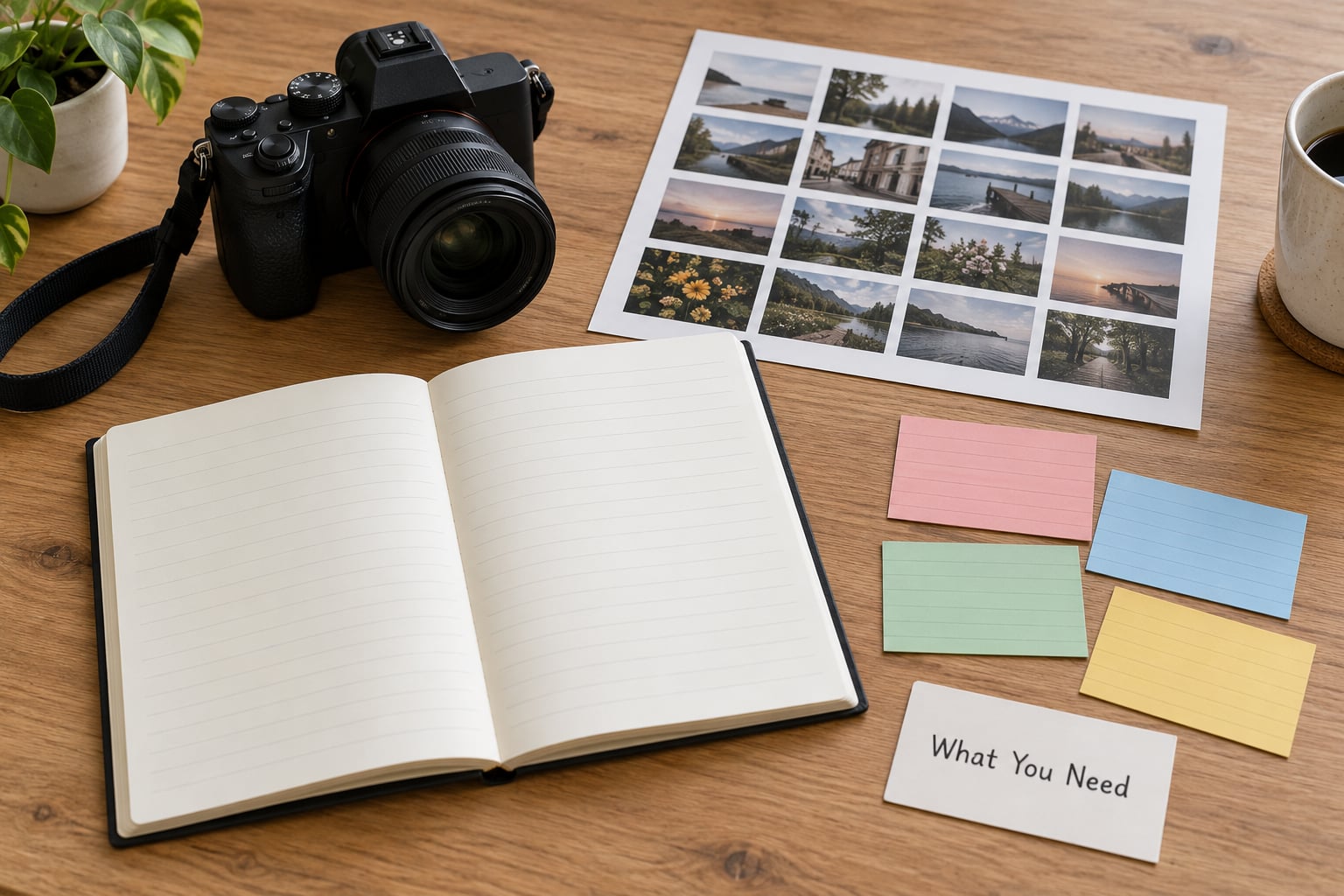
Before you shoot anything, five things need to exist on paper.
- Real curiosity. Not “this would look nice” but a question you would still be poking at after the novelty wore off.
- One visual question. A single sentence you can answer with photographs rather than with words.
- A defined purpose. Portfolio, personal archive, learning exercise or a book. Each one tolerates a different amount of imperfection.
- A shooting rhythm. A frequency you can keep when work gets busy and motivation drops.
- A review method. A way to look at everything you have made, roughly every month, without falling in love with your worst frames.
If one of those is missing, it will not show up until you are three months in. That is the expensive moment to discover it.
How to Choose a Subject for a Long-Term Photo Series
The decision framework has five filters: sustained curiosity, observable change, reliable access, some emotional or social weight, and the real possibility of making images that differ from each other. A subject passes when it clears all five. Most abandoned projects fail on change and access, not on interest.
| Quality | Strong sign | Weak sign |
|---|---|---|
| Sustained curiosity | You have opinions about it and arguments with yourself about it | It just looks nice right now |
| Observable change | Something about it is genuinely different in eight weeks | It looks the same every time you go |
| Reliable access | You could probably get back to it next Sunday | It depends on a stranger saying yes |
| Specific scope | You can say exactly who, where and when | “People” or “city life” as a whole |
| Room for distinct frames | You can already picture ten different images | You can only picture one, the obvious one |
Step 1: Start with a question, not a topic
A topic is a noun. A question is a camera pointed at that noun. “Old buildings” is a topic; “how a block of flats decides what to keep and what to throw out during a renovation” is a question you can shoot for two years without repeating yourself.
Good questions tend to contain a verb and a tension: how people care for older relatives, what a neighbourhood looks like an hour after the shops close, where friendship actually shows up in small gestures. If your question can be answered with a list, it is still a topic. If it can only be answered with pictures, you have something.
Step 2: Look for meaningful change
Change is what gives a series its momentum, and it does not have to be dramatic. Routines shift, relationships move in and out of tension, rooms get repainted and repopulated, weather reorganises a street, work wears people down, gardens take over, buildings decay on a schedule you could set a watch by.
Ask what will be different about this subject in three months that is not different today. If you cannot answer in one sentence, the subject is probably static, and static subjects make dull series no matter how good your eye is.
Step 3: Test the subject through a small first series
Run a pilot before you commit. Three to five sessions over two or three weeks is enough to tell you most of what you need to know.
What to watch for: whether you can actually get there and get access without drama, whether you make more than one interesting frame in a session, whether the images excite you when you look at them cold the next morning, and whether you can imagine returning in eight weeks without dread. Three strong frames out of five sessions is a pass. One standout frame and four flat ones usually means the subject is narrower than you thought.
Step 4: Define the boundaries
Boundaries protect the series. Without them, a project on “my street” becomes every photograph you have ever liked, and there is nothing holding the set together.
Limit the people, the places, the time period, the situations you will shoot, your framing and your focal length. Write the limits as a one-page brief and put a date on it. Boundaries should be firm enough to make decisions for you on a tired Tuesday, and loose enough that a good accident can still get in.
Step 5: Build a repeatable shooting routine
Pick the rhythm from the subject, not from an arbitrary productivity target. A subject that changes weekly can be shot weekly. One that changes with the seasons needs less frequent, longer sessions, and a calendar reminder or it will never happen.
Then keep the boring parts in order: a short field note after each session, two backups in separate places before you leave, and a simple folder structure by date. A year of photos with no notes becomes an archive you cannot search, and curating from memory is how projects get abandoned at the sequencing stage.
Step 6: Use a consistent visual language
Consistency is what lets a viewer recognise the series without being told. Choose two or three recurring decisions and stick to them: a distance, a viewpoint, a lens, a time of day, a treatment. One 50mm lens used everywhere makes a body of work that a mixed bag of focal lengths never will.
The trap is over-constraining. If every frame is identical in scale and position, the set becomes monotonous and the middle of the series dies. Consistency should sit at the level of approach, not the level of individual pictures.
Step 7: Review and refine the series
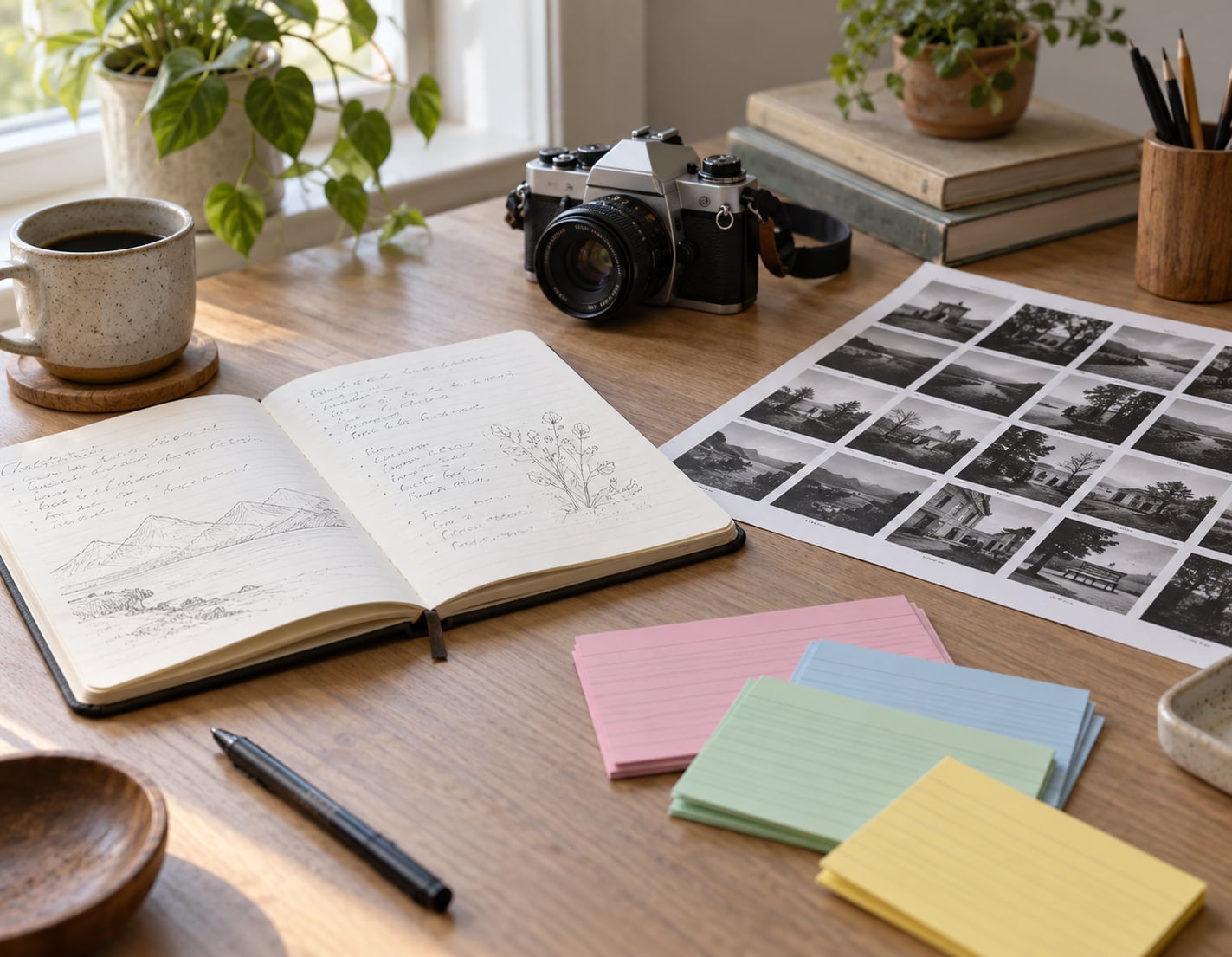
Review on a schedule, not when you feel like it, because enthusiasm is exactly when you are least objective. Once a month, lay out everything as a contact sheet and ask three questions: does this still answer my original question, where is the repetition, and what is missing.
Signs of drift are easy to spot once you name them. The images are technically better but emotionally flat. You are photographing the same frame from slightly different angles. The question you wrote in week one no longer describes what you are making. The fix is almost always smaller than people expect: tighten the brief, revisit one location you have been avoiding, or go back to a detail that mattered earlier.
Step 8: Decide when the series is complete
Completion is not the day you reach a date on the calendar. It is the day further shooting adds repetition rather than understanding.
The signs are concrete: your question has been answered in photographs, the set shows a visible progression from beginning to end, the strongest images support the idea rather than merely existing alongside it, and the last three sessions produced work you would not miss. When those are true, finish it, edit it, and put it away. You can return to the same subject years later as a different series, which is a better outcome than never editing the first one.
Common Mistakes
Choosing a subject because it sounds impressive
Grand subjects are not bad, but they rarely survive contact with a real Tuesday. Scale the idea down until it is something you can shoot in your own neighbourhood, with your own camera, this month. “Strangers at 4am” is a book; “night-shift workers at the hospital two streets away” is a project.
Making the idea too broad
Broad subjects produce broad, shapeless sets. If your subject cannot be described in one sentence with a place and a limit in it, it is two or three projects wearing a coat. Split it, and keep the piece you care about most.
Confusing consistency with repetition
A series where every frame looks the same has failed at variety, not won at consistency. Consistency lives in your approach: same lens, same distance, same hours, same treatment. The pictures themselves should still surprise you.
Ignoring access and ethics
Plenty of good subjects depend on people who have no obligation to you. Ask early, ask plainly, explain what the project is, and accept a no without negotiating. Photographing the same people for a year means they are trusting you with an accumulating record of their life, and that deserves more care than a single frame does.
Skipping documentation
Six months in, you will not remember why a certain frame mattered, what the person said, or which rule you had set. Notes cost a minute per session and they are the difference between curating a series and digging through folders.
Abandoning the project before it develops
The flat middle is normal and it is not a sign you chose wrong. Almost every long series feels pointless around the two-month mark, because the interesting material has run out and the payoff is still far away. Shoot through it. If you are still bored at month eight with the same results, then close the file deliberately and learn from it rather than drifting.
Frequently Asked Questions
How much time should I devote to a long-term photo series?
Enough to revisit the subject regularly, not enough to notice nothing. For most subjects a weekly 30 to 90 minute session is more useful than one long weekend a month, because change is easier to catch and rhythm is easier to keep. A pilot of three to five sessions costs you a few evenings and is enough to test the idea before it costs you a season.
What if I do not know in advance how the series will end?
That is normal and it is not a reason to wait. Decide the question and the boundaries at the start, then let the sequence reveal itself. You will know you are close to done when the question is answered, the images show a progression, and recent sessions keep returning to frames you already have. Editing is what reveals the ending, not the shooting.
Should a long-term photo series always include people?
No. Places, objects, routines and craft all change over time and often demand less negotiation than people do. People give you the strongest narrative material and the hardest logistics, so they are worth the effort when you genuinely have access, but a series built on a workshop, a market stall or a single doorway can run for years without asking anyone for anything.
How do I keep a photo series consistent without making every image look the same?
Apply consistency at the level of approach rather than the individual frame. Fix a focal length, a distance, a time of day or a treatment, then let the subject supply the variety. If every picture is composed the same way, you have removed the thing that makes a series worth reading. Keep the method fixed and the pictures surprising.
How often should I edit and sequence a long-term photography project?
Look at everything monthly as a contact sheet, but hold off on final sequences more than once or twice a year. Editing early tends to lock in the weakest version of your idea, and editing constantly costs the momentum you need to keep shooting. Reserve the heavy curating for a quiet stretch near the end.
Can I return to a photo series after taking a long break?
Yes, and the gap often helps. Photographing the same subject after a year or more gives you a before-and-after structure you could never have staged. Treat it as a new series with its own question rather than forcing it back into the old sequence, and note what changed in your own eye as well as in the subject.
Conclusion
Write one visual question, test it in three to five sessions, and keep the subject only if it produced change, access and a reason to go back. Everything else, the gear, the constraints, the editing, can be fixed later. The subject is the one decision you cannot rescue in month five.
Pick something specific enough to guide you and open enough to surprise you. That combination is what separates a long-term photo series that lasts from a folder of photographs you meant to finish in 2026.