To sequence photos for a photo essay, you build a working order where every frame has a job in the story, then test two or three versions of that order and refine the one that survives. A sequence that works has an opening that establishes context, a middle that develops through variety, and a closing image that lands the point. Plan for a few hours at the desk once you have a culled set of 10 to 20 images, and less if your story is simpler than that.
Table of Contents
What You Need
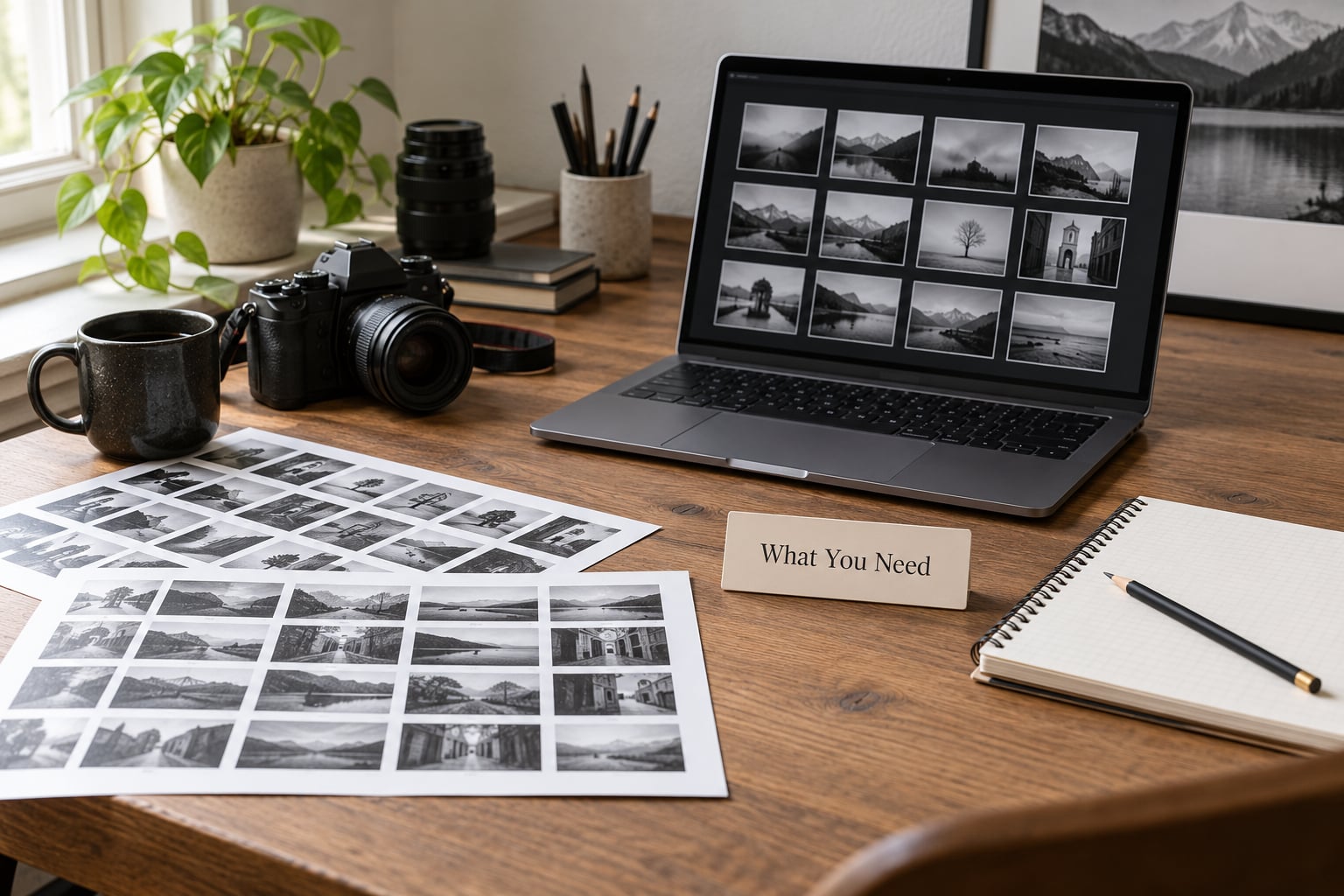
Sequencing only works on an edit, not on a memory card. Get these four things sorted before you start moving anything around.
An edited select
Cull first, order second. Photographers routinely shoot a thousand-plus frames and try to arrange all of them, which is why the edit never feels finished. Pick your strongest 15 to 25 frames, then cut harder from there. If a frame is technically fine but adds nothing to the arc, it goes.
A one-sentence story
Write down what the essay argues in a single sentence before you open the grid. “A night-shift baker starts alone at 3am and the shop fills up by dawn” is a usable sentence. “My week in photos” is not. The sentence decides which frame goes first, and it tells you instantly when a picture does not belong.
A place to arrange frames
Any tool works: a Lightroom collection, an Adobe Bridge workspace, a folder with numbered filenames, a wall with tape, or a printed contact sheet. What matters is that you can drag a frame and have everything after it shift. Most photographers find that printed contact sheets expose weak transitions faster than any screen.
A review method
Your eyes adapt to an edit fast. Decide in advance how you will check the sequence: view it at thumbnail size, view it full-screen on a second device, or come back to it the next morning. Two of those three will find problems the first pass missed.
Step-by-Step
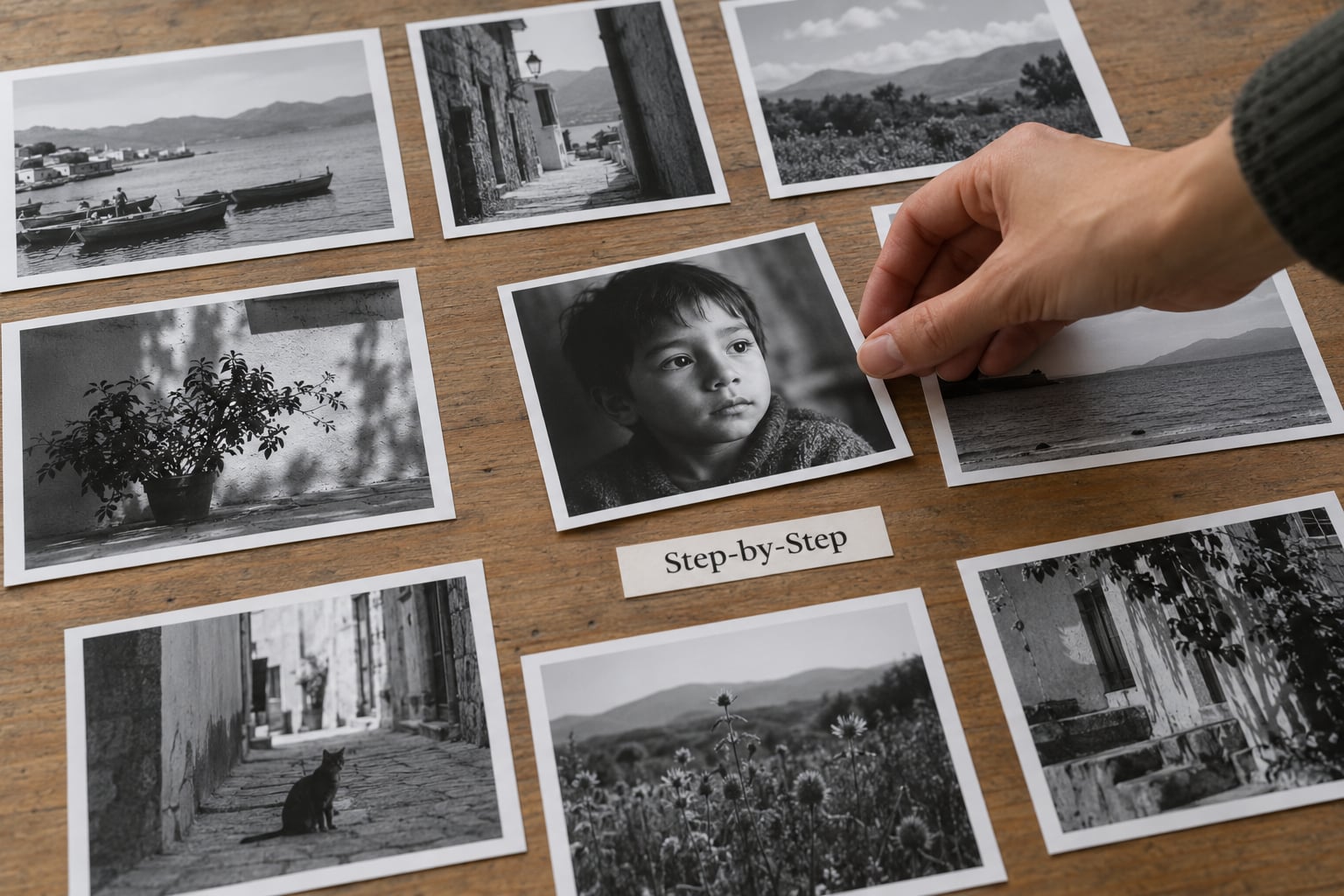
Here is the process I use, and the same order works whether the essay ends up in a portfolio, a printed gallery, or a scrolling web page.
How to sequence photos for a photo essay: build the working order first
Sort every selected frame into a narrative function before you look at aesthetics. Most essays need four buckets: opening context, the developing action, the people or character at the center, and closure. Lay out only the opening frames first, then the middle, then the ending. You will find the order twice as fast when you are placing pictures by role than when you are trying to feel the whole thing at once.
Keep the buckets loose. A frame that seems like a closing image may turn out to be a better opener, and moving it is cheaper now than after the whole sequence is built.
Create a strong opening image
An opening image has to tell the viewer where they are and what kind of story this is, without spending your best frame. A wide view with the subject small in it does that well, because it establishes place and leaves the details for later. The wrong choice is leading with the single most striking picture you made; it usually peaks at frame one and leaves nothing for the essay to do.
Ask whether the first image would make sense with no title and no caption. If it reads as a photograph of something specific and a little unresolved, it is working.
Build transitions between images
Adjacent frames feel connected when something repeats or answers. Matching gestures, a repeated shape, the same subject moving across the frame in the same direction, a color that carries across two pictures, or a wide shot followed by a detail from inside it all work. So does a deliberate jump in viewpoint, as long as it is a jump and not a stumble.
The practical test: cover the boundary with your thumb. The two images on either side of your hand should feel like they belong to the same breath. If they don’t, either move something or swap in a bridge frame from your wider select.
Use contrast to control pacing
Pacing comes from alternating. Close-up then wide, quiet then loud, still composition then restless one. Two similar frames in a row flatten the rhythm and readers start skipping, which is the most common reason a strong set feels weak.
Aim for contrast in scale and energy, not in subject. A whole essay of wide frames will still have rhythm if the composition and the light keep changing, and a run of close-ups works if each one shows a different texture or expression.
Test several sequence options
Make two or three legitimate arrangements and leave each one alone for a while. The order that felt obvious while you built it is rarely the order that survives a day. Moving five frames is a revision; rebuilding the middle is a new edit.
View each version at more than one scale. Thumbnails show you the arc, the rhythm, and whether any two frames look like duplicates. Full-screen shows you the frames that only work from a distance and fall apart up close. If a frame only survives in one of the two, it is a risk in print and on a phone.
Check the story without the images
Read only the captions, or say the sequence out loud as a spoken story, and see whether the story still stands. This catches the most common failure, which is a sequence that depends on your memory of the shoot to make sense.
If a caption has to explain what is happening, the frame is doing too little. Rewrite the caption shorter, or replace the image with one that carries its own meaning. A good photo essay reads on two levels: images alone for the visual story, captions for the detail a still frame cannot hold.
Finalize the edit and presentation
Once an order holds up, do the mechanical pass. Check that adjacent brightness shifts are gentle enough not to sting on a bright screen, that subject direction is mostly consistent so the eye travels one way, that aspect ratios do not jump between horizontal and vertical without a reason, and that the whole sequence survives being reduced for a phone screen.
Then decide how it will be shown. A web gallery and an Instagram carousel need faster pacing, because people scroll and the first three frames carry everything. A printed gallery or photo book can hold a slower rhythm, including a run of quieter frames, because the viewer stops and stands in front of it. Write one title that names the story, keep captions short, and cut any frame you are only keeping out of guilt.
Common Mistakes
- Ordering strictly by time. Chronology is a safe default, not a structure. Use time as the backbone only if the change in hour or place genuinely carries the story.
- Putting the strongest frame first. Your best image lands harder in the middle, where it has context to work against. Opening with it spends the payoff early.
- Changing pace in one jump. Going from very quiet to very loud with nothing between feels broken. Insert one intermediate frame before a dramatic shift.
- Making every frame compete. If nothing is quieter than anything else, the viewer has no entry point. Most essays need at least two calm images to make the active ones register.
- Ignoring brightness. A dark frame dropped between two bright ones feels like a cut in a film. Either re-edit it or use it as a deliberate break with something equally dark around it.
- Letting captions do the storytelling. Long explanatory captions usually mean the sequence has a hole in it. Fix the order before you write around it.
Frequently Asked Questions
Should a photo essay be sequenced chronologically?
Only when the passage of time is the story. If the essay is about a single afternoon, chronological order is honest and easy to follow. If the theme is a relationship, a process, or a mood, order by narrative function instead: opening context, developing action, character, then closure. Test both and watch where your attention drops. The version that keeps you reading is the right one.
How many photos should I include in a photo essay?
Ten to twenty is the range most working photographers land on for a portfolio essay or a gallery. Web and social carousels usually carry fewer, around six to ten, because scrolling audiences lose interest quickly. Printed sequences can run longer if the pacing supports it. Whatever the count, every frame should survive the question of what it adds.
What makes a good opening image for a photo essay?
It establishes place, subject, and mood while leaving something unresolved. A wide frame with the subject placed small inside it usually works better than your most dramatic picture, because it gives the rest of the sequence room to develop. Avoid leading with a shot that only makes sense once you have read the last caption.
How do I create transitions between photographs?
Repeat something and vary something else. Matching gestures, a recurring shape, consistent subject direction, or shared color all tie two frames together, while a change in scale or viewpoint keeps the eye moving. If two adjacent images feel unrelated, add a bridge frame from your wider edit, or move one of them next to a frame it answers.
Should captions explain every image in a photo essay?
No. Captions should add what the frame cannot show, like names, timing, or a piece of context, in one or two sentences. If a caption has to describe what is happening, the image is doing too little and the sequence needs work. Read the captions on their own as a test: they should still make sense as a short text.
How do I know if my photo-essay sequence works?
Check it three ways. View it as thumbnails to judge the arc and rhythm, view it full-screen to catch frames that only work from a distance, and read the captions alone to test whether the story holds without the images. Then leave it overnight. Most problems are obvious the next morning and invisible in the same session.
Conclusion
Start with the story, pick three candidate opening images, and lay out two different orders before you judge either one. Then let the sequence rest, view it small and large, read the captions alone, and cut whatever is not pulling its weight. Sequencing is a series of small revisions, not one right answer found on the first pass.