Most photographers who get stuck at the beginner stage are not stuck on gear. They are stuck because there is nobody in front of the lens. Learning how to find portrait models for practice takes less effort than people expect once you treat it as a process rather than a favour you are begging for.
The short version: define one achievable shoot, write one specific message that says what you are making and what you give back, then approach ten people who are already near you. Ten is not a wild number. One in four saying yes gives you a session this month and a contact who knows a friend.
This guide walks through the whole sequence, from picking your first concept to keeping a sitter for a year. It takes an hour of reading and roughly four weeks of real work to get your first session booked.
Table of Contents
- What You Need Before You Look for Portrait Models
- How to Find Portrait Models for Practice Step by Step
- Step 1: Define the portrait project
- Step 2: Decide what you can honestly offer
- Step 3: Build a shortlist of likely sitters
- Step 4: Write a specific outreach message
- Step 5: Confirm expectations in writing
- Step 6: Run a small test shoot
- Step 7: Review images with the sitter
- Step 8: Credit and thank every contributor
- Step 9: Build repeat relationships carefully
- Common mistakes that cost you sitters
- Frequently Asked Questions
What You Need Before You Look for Portrait Models
Six things make outreach easy. Without them you are asking strangers to do you a favour with no context, which is where most cold messages die.
A concept you can finish. One location, one outfit direction, one lighting setup. “A portrait project about ordinary people in their kitchens” is workable. “My first photo book” is not, at least not yet.
An honest offer. You decide up front whether money changes hands or not. A trade shoot, usually called TFP for time for prints or time for photographs, means the sitter receives finished edited images and you receive permission to publish them. No money moves either way.
A one-page model release. This is a short document where the person in the photos agrees to being photographed and to how you can use the results. Free templates exist and most are editable in a word processor. You bring it to the shoot and sign it on the day, not in advance over email.
A location that is easy for them. A blank wall near a window, a quiet room in a community centre, a park at golden hour. If the sitter has to drive far or carry heavy gear, you will lose them.
A short contact list. Fifteen names you would be glad to see in your images, sorted by reliability rather than looks.
A date and a duration. Ninety minutes. People say yes far more readily to a fixed window with an end.
The model release is the one item beginners skip, and it is the one that causes real problems later if you want to print, publish or license an image. Everything else on the list is cheap or free.
How to Find Portrait Models for Practice Step by Step
Here is the workflow I would follow, in the order I would follow it. Nine steps, and the ones that matter most sit in the middle where the awkwardness lives.
Step 1: Define the portrait project
Write the project down in three sentences: who is in the frame, where it happens, and what feeling the pictures should carry. “My neighbour, her kitchen, morning light, quiet and unposed” is finished enough to send to a stranger.
Then name the three things you actually want to practise. Narrow it deliberately. If the goal is to learn directing, you need a subject who will move when you ask. If the goal is window light, almost anyone works. Vague concepts attract vague people, and vague people make vague pictures.
How to tell it worked: you can describe the session to a candidate without hedging.
Step 2: Decide what you can honestly offer
Decide the terms before you message anyone, because you will be asked. Options include a set number of finished edited images delivered within a stated time, high-resolution files with no watermark, prints if you have the means, credit in your portfolio and on your website, and the images for the sitter’s own use or their agency’s books.
Some photographers also offer a copy of the setup they used, or a short behind-the-scenes set. Those cost you nothing but ten minutes of editing.
Be careful with language. Do not describe an unpaid practice session as a paid professional shoot. Models check portfolios and they talk to other models. Getting that wrong ends a relationship before it starts.
How to tell it worked: you can state the arrangement in one sentence without embarrassment.
Step 3: Build a shortlist of likely sitters
Work through sources in order of how comfortable they are for you. People you already know, then acquaintances and colleagues, then community and class groups, then local creative communities, then casting posts and social platforms.
Alongside that, look at places where people already enjoy being photographed: theatre groups, dance studios, drama schools, community centres, adult education courses and camera clubs. Forum regulars point out that community art centres and camera clubs have the highest trust level of any option, because you share a room with the same people repeatedly.
Craigslist still turns up trade shoots in some areas, but expect a mixed response and vet carefully.
Sort your list on four criteria before you judge appearances: are they free, are they comfortable on camera, will they actually show up, and would they be at ease with the location. Forums describe reliability as the flake factor, and it is the one thing that ruins practice sessions faster than bad lighting.
How to tell it worked: you have at least fifteen names and three sources you have never tried.
Step 4: Write a specific outreach message
Specificity is what separates a reply from silence. A message that works reads roughly like this:
Hi Marta, I shoot portraits as practice and I am putting together a short series in my flat on Thursday the 14th, roughly 90 minutes, natural window light, one simple outfit. I am looking for a sitter who is comfortable being photographed and happy with a relaxed, unposed result. It is a trade shoot, so no fee, and I will send you ten finished edited images within two weeks, full size and unwatermarked, and you can use them however you like. If you would rather not be published online, say so and I will keep them private. Interested, and if not no problem at all.
Notice what that does. It names the project, the place, the day, the length, the terms, the exit, and it accepts a no. The last line matters more than most people expect. Offering an easy way to decline is what makes the message read as an offer rather than a push.
Send by message or email rather than a random comment, keep it under about 120 words, and follow up once after a week. One follow-up is persistent. Three is pressure.
How to tell it worked: the reader can answer yes or no without asking a question.
Step 5: Confirm expectations in writing
Once someone agrees, send a short confirmation covering the date and start time, the address, roughly how long it runs, clothing and hair guidance, what you are bringing, what happens with the images, when they will arrive and in what format, whether you want to publish, and how to cancel.
Attach the model release so they can read it in advance. Reading it at the door is when people hesitate.
Say clearly that either person can stop at any point, for any reason, with no explanation needed. That sentence does more for a first-time sitter’s nerves than any amount of reassuring tone.
How to tell it worked: they reply confirming, and neither of you has an unanswered question.
Step 6: Run a small test shoot
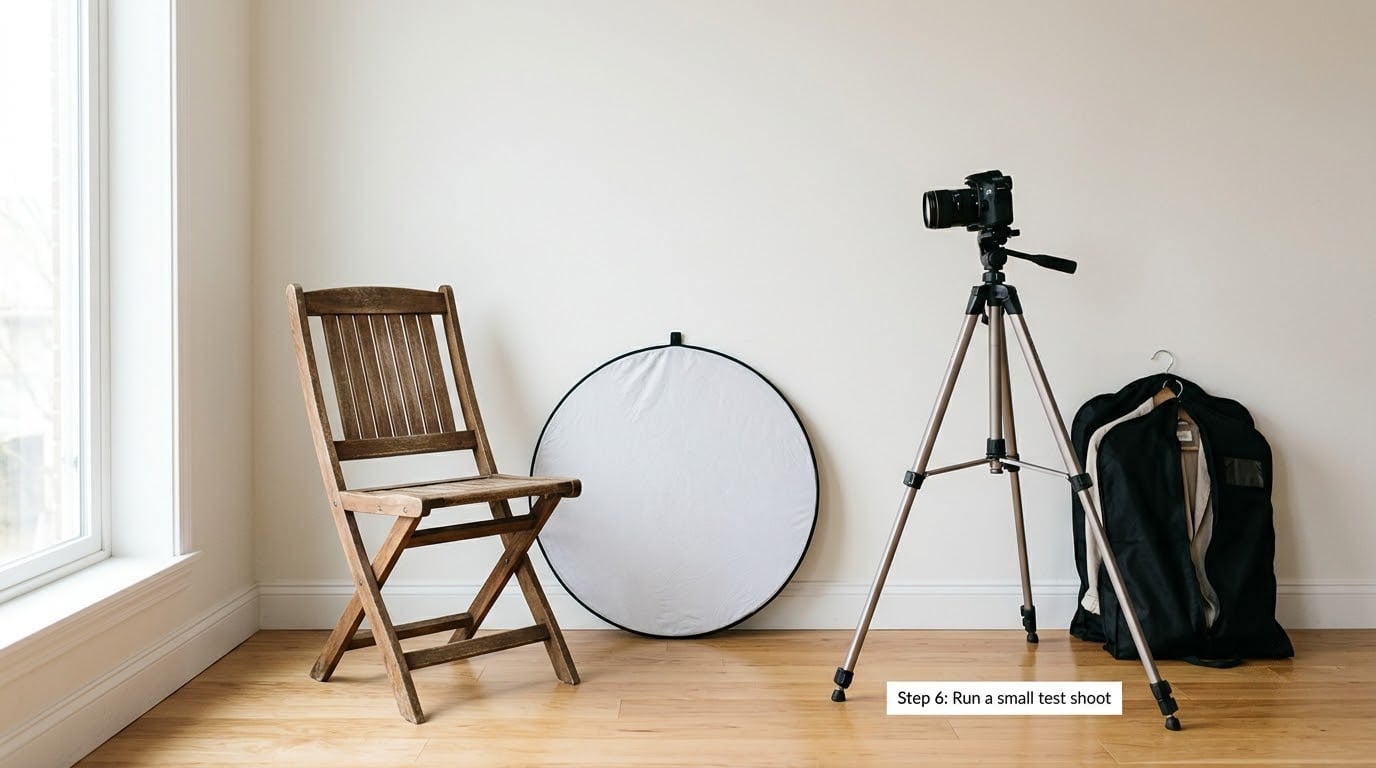
Treat the first ten minutes as a test. Set up, take a few frames, and ask how it feels before you commit to a long sequence. A short session with one setup teaches you more than a long one you rush through.
Ask for feedback out loud as you go, and mean it. Most first sitters are sitting still because nobody told them what to do, not because they are unwilling. Give them movement first, then stillness.
Build breaks into the plan. Offer water, food if it runs long, and stop on time. Overrunning is the fastest way to be described as difficult by the one person who tells everyone.
Stop the shoot if either of you feels uncomfortable. That applies to you too.
How to tell it worked: you finish inside the time you promised, and the sitter has at least one image they like.
Step 7: Review images with the sitter
Send a small selection rather than everything. A curated set of fifteen frames says more than four hundred unedited files, and it lets you explain your choices.
Split the conversation in two. First, technical feedback, which you control: exposure, focus, colour, background. Second, personal preference, which is theirs: which images they would want shared, and whether any of them misrepresent them. If someone is not comfortable being in a published frame, honour that and take it out of your public set.
Agree on an editing timeline and stick to it. Models tell each other about delivery speed more than anything else you do.
How to tell it worked: files land on schedule and nobody had to chase you.
Step 8: Credit and thank every contributor
Name your models wherever you publish, on the image caption and on your site, the way a film credits its cast. Send private copies first when the agreement was not to post publicly. If you printed anything, hand it over.
Say thank you properly, in a message, within a few days. It takes one paragraph and it is the thing most beginners skip, right before they wonder why the referrals stopped.
How to tell it worked: people accept your next invitation.
Step 9: Build repeat relationships carefully
Keep a consented contact list with a note of what each person enjoyed, what they declined before, and how they prefer to be contacted. Propose a follow-up project that suits them rather than the same pitch again.
Ask occasionally whether they still want opportunities at all. Someone who stopped enjoying it should leave the list without guilt, and that question is what keeps it voluntary.
Treat contacts as people, not a free labour pool. A community where people feel used gets quieter fast, and one well-treated sitter brings three others.
How to tell it worked: you are booking second sessions without starting from zero.
Common mistakes that cost you sitters
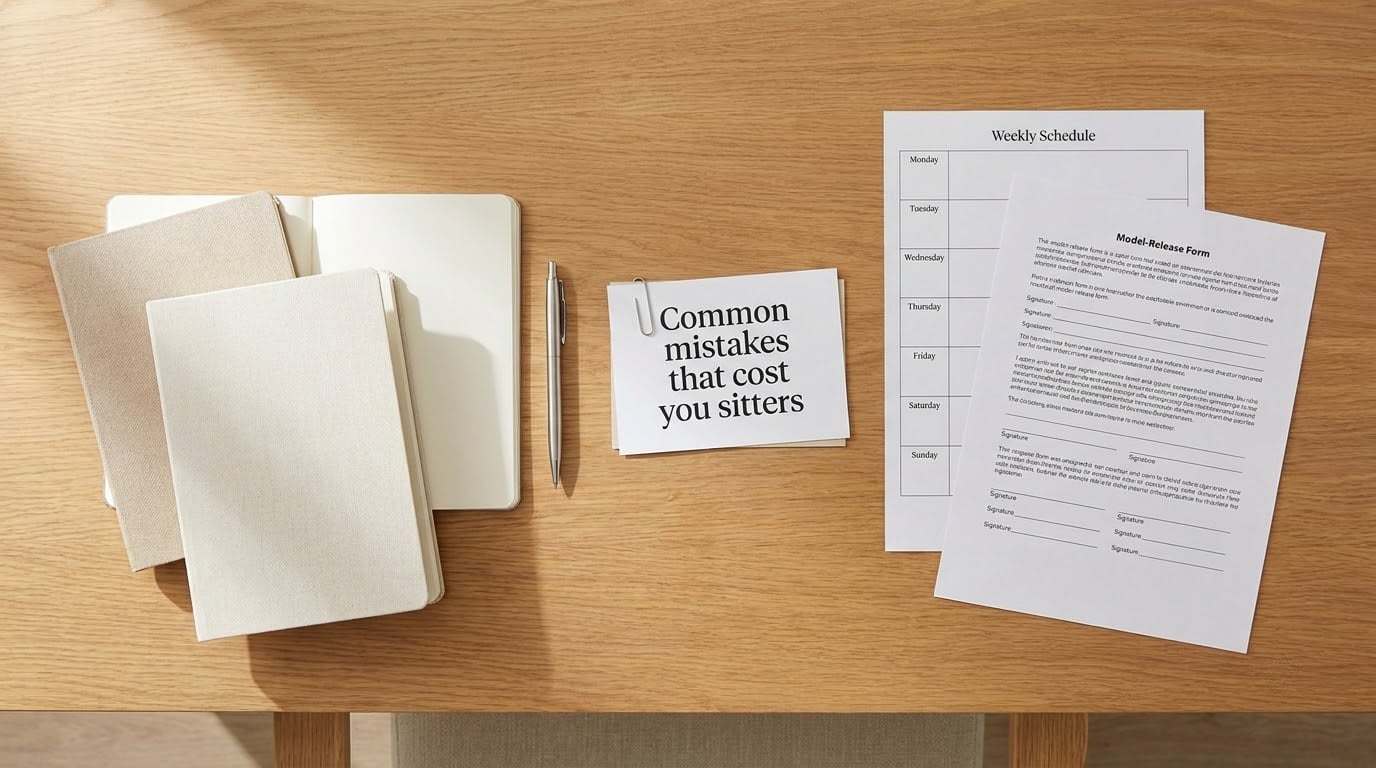
Almost every wasted session traces back to one of these. Each has a small fix.
- Vague requests. “Need a model, will trade photos” gets ignored. Fix: name the concept, date, place and length.
- Promising payment you do not have, or implying pay when there is none. Fix: state the terms in the first message, plainly.
- Shoots that are too ambitious for session one. A full location move plus a wardrobe change plus a lighting plan ends in a tired sitter. Fix: one setup, 90 minutes.
- No model release. Fix: bring a signed copy to every session, even a friendly one.
- Ignoring consent cues. A sitter goes quiet or stiffens. That is information. Fix: pause, ask, adjust, and have an agreed signal to stop.
- Disappearing after the shoot. Fix: set a delivery date before you start shooting and meet it.
- Treating sitters as props. Fix: ask what they want from the images, and shape the shoot around it.
- Meeting a stranger in private without thinking it through. Fix: public location, a shared live location with a trusted person, a code word for check-ins, and an opening offer to have a chaperone or assistant present.
Frequently Asked Questions
Do I need professional experience before I can find portrait models for practice?
No. Most people find their first sitters with a small portfolio of twenty images, often shot on a friend or on themselves. What matters is that your message is specific, your terms are clear and you turn up prepared. Experience builds after the session, not before it, and many experienced photographers still book friends and community members for practice work.
How do I ask a friend to model without making them feel obligated?
Give them a real out and make the request small. Say that a no is completely fine and that you will not be offended, offer a specific 90-minute window rather than a vague weekend, and describe exactly what you will give them at the end. Avoid framing it as helping you out; frame it as something you would like to make together.
Should I pay someone who models for me?
For genuine practice sessions, a trade shoot where no money changes hands is normal and widely accepted. Pay when the work is commercial, when it takes more of the sitter’s time than you can reasonably give back, or when the concept depends on a particular look you cannot get locally. Agree the terms before the shoot and put them in writing.
Where can I post a request for portrait models?
Local Facebook photography groups are the most consistently effective free option, followed by community and adult education classes, camera clubs and theatre or dance groups. Casting platforms and social media work too, though response rates are lower and you should expect a higher cancellation rate. Local groups also have the advantage that you can all meet somewhere familiar first.
What should I do if a portrait session goes wrong?
End the shoot politely, thank the person for their time, and send them the images you promised anyway. Then look at what actually went wrong: the concept was unclear, the timing was off, or the location was wrong. Write it down before you approach the next candidate so the same session is not repeated twice.
So here is the first week. Choose one concept with one location. Write the terms you can meet. Build a list of fifteen names from three different sources. Send ten specific messages, and contact your first five suitable prospects today rather than next month.
Year after year, the photographers who get better are not the ones with better cameras. They are the ones who asked, clearly and early, and then delivered what they said they would.