To interview subjects for a photo story, you research the person, explain the project, ask open questions that describe scenes rather than summaries, listen more than you talk, and photograph the room while they answer. The interview is not a separate step from the photography. It is where you find out what to photograph in the first place.
A set of photographs on its own leaves the viewer to decode everything. Add the subject’s own account and the same images start explaining themselves: why this place, why this person, what changed. Budget 60 to 90 minutes for the conversation, and expect the shoot to run longer than that.
Table of Contents
- What You Need
- How to Interview Subjects for a Photo Story
- Common Mistakes
- Frequently Asked Questions
- Do I need a release form for documentary photos?
- Should I record the interview if the subject does not want to be filmed?
- How do I get a subject to open up instead of giving short answers?
- How long should a photo story interview last?
- Should I interview before or after taking photographs?
- What if the interview does not produce a clear story?
- Conclusion
What You Need
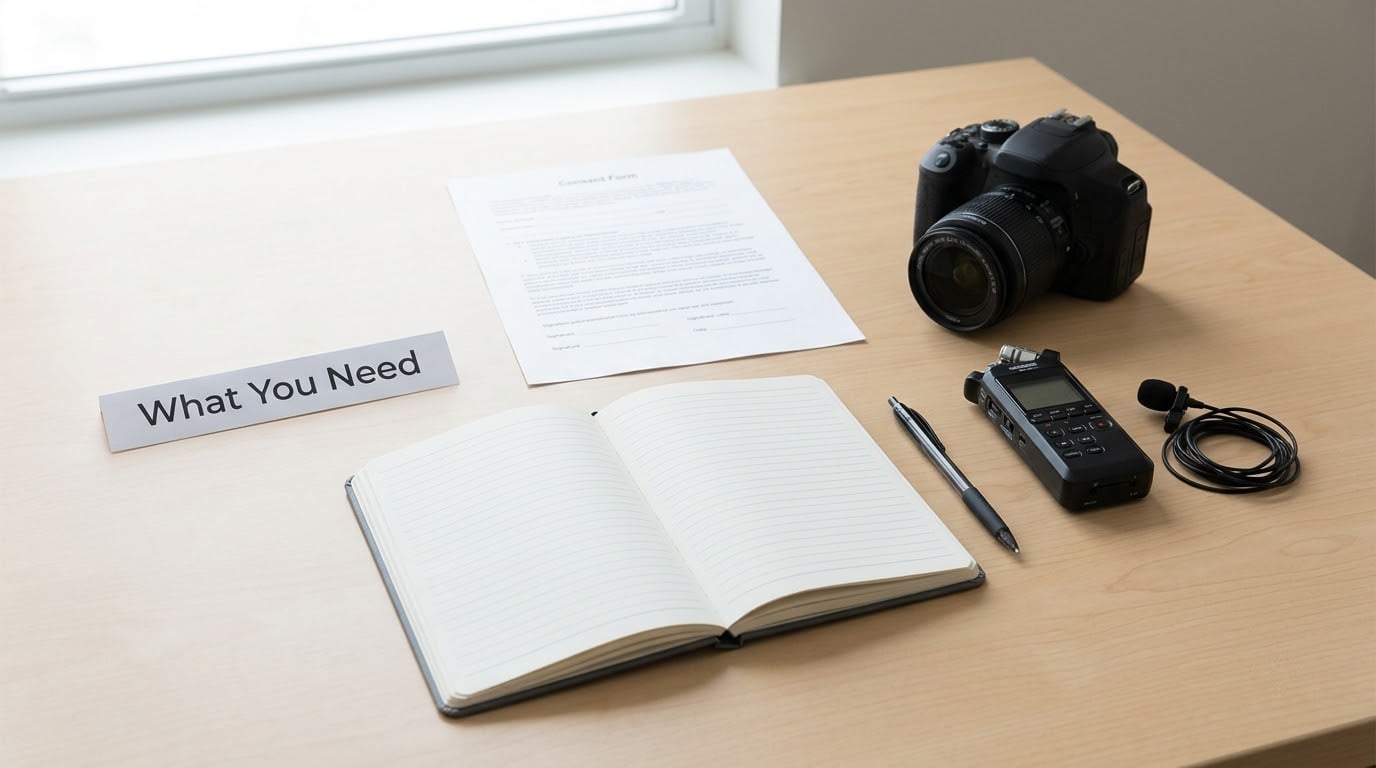
A clear story idea, written on one page, that you can say out loud in a sentence. If you cannot explain the project in a sentence, the subject will not understand what you want from them.
- Research. Reliable background reading, plus anything the subject has already published or posted about themselves.
- A small set of open prompts. Six to eight, not a questionnaire. They exist so you are never blank, not so you recite them.
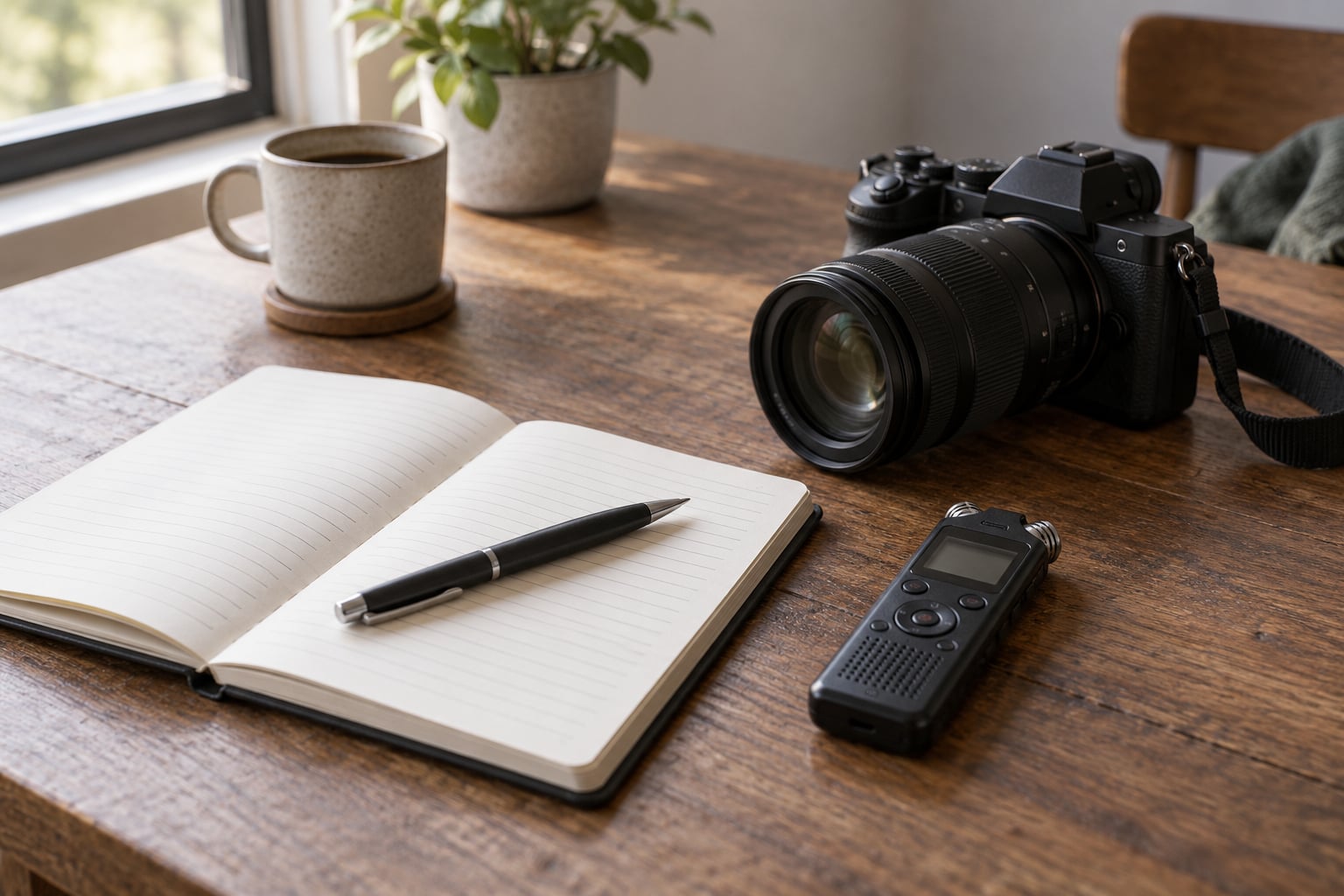
- Recording. A small voice recorder with fresh batteries, in your pocket or on the table. Ask permission before you start.
- Consent and release materials. A short written release and a plain explanation of where the images and quotes will appear.
- A notebook and pen for names, exact quotes and details you cannot photograph.
- Time. Enough of it that the conversation is not visibly racing the schedule.
Available light beats a bad setup. Sit with the subject facing a window if you can, and put the camera a few feet back with a mid-telephoto lens so you are not standing on top of them.
How to Interview Subjects for a Photo Story
Define the visual story you need
Decide what the pictures have to accomplish before anyone sits down. Write one central question, three or four moments you already know you want on record, and a note of anything sensitive that needs careful handling.
That page is your safety net, not a script. When the conversation wanders somewhere better, let it.
Research without over-scripting the conversation
Read enough that you can ask about specifics. If a subject mentions a workshop they ran for five years, you can ask about the first morning and the last one instead of settling for a summary.
Strong subject knowledge is what makes follow-up questions possible in real time. Beginners freeze at question three not because they forgot their list but because they have nothing behind the question.
Keep the prompts short enough to see at a glance, and never read them aloud in order.
Build rapport before asking sensitive questions
Explain what you are making, who it is for, roughly when it will run, and what they can decline. Then make the room easy: sit at the same height, put the camera down for the first five minutes, and let the conversation start with something that is not the hard part.
Softball openers work well here. “What does a normal Tuesday look like for you?” or “How did you end up doing this?” get people talking without committing them to anything.
Most people are unused to being asked about their own work at length. Signal that their particular version of it is worth an hour, and the answers get longer.
Ask open questions that invite stories
A closed question gets one word and ends the thread. “Where are you from?” produces a city name. “Can you describe the place where you grew up?” produces a room you can photograph.
Useful shapes:
- Describe it. “Walk me through the setup you use every morning.”
- Recall a moment. “What was the first time you realised this was going to work?”
- Relationships. “Who taught you, and what did they teach you first?”
- Objects and places. “What is the tool you would grab first if the power went out?”
- Change over time. “What did this used to look like before things shifted?”
- Sensory detail. “What does the room sound like at six in the morning?”
Then follow up on the interesting bit rather than moving down your list. “The part about the neighbor saying no, what happened after that?” pulls the story forward.
Connect the answers to things you can photograph
This is the step most people skip, and it is where a conversation turns into a photo story. As they talk, write down the concrete nouns: rooms, tools, times, weather, gestures, objects.
Every noun on that page is a potential frame. A described workshop means an establishing wide, the workbench at eye level, hands in frame, and a detail of whatever tool they named. A described relationship means both people, or the empty chair the other person used to occupy.
Take the contextual frames while they talk rather than after. The room looks different when a person is in it, and the frames you need most are the ones you would have forgotten.
Use silence, listening, and follow-up
Count to three after an answer before you speak. People fill the gap with the more honest version, and the gap is where the usable line usually sits.
Do not interrupt to fill it, including with “mhm” and “right,” which can bleed into a recorded take. Stay quiet and let the pause do its work.
Follow up with short prompts rather than new questions: “What happened then?”, “Can you say more about that?”, “Who else was there?” Once a subject is talking freely you barely need the page.
Close the interview and plan the visual coverage
Summarise what you heard back to them in two sentences and let them correct it. That is the easiest verification you will ever get, and it catches dates and names while they are still sitting with you.
Confirm what you will do with the recording, and how long you will keep it. Then, within the hour while it is fresh, write out the frames you still need and the pull quotes you can use.
If you were not permitted to record, take the notes faster and keep verbatim quotes in quotation marks, marked as exact wording.
Common Mistakes
Interrogating instead of talking. Read questions off a list in order and the subject will feel interviewed. Fix: keep one page of prompts, ask in your own words, and spend the first five minutes on something easy.
Leading the subject. “So it must have been really hard?” tells them what you want to hear. Fix: ask what happened before you ask how it felt.
Too many questions at once. A stack of prompts sounds like a form. Fix: one question, then follow up on the answer. Six to eight prompts is plenty for an hour.
Photographing and interviewing without a plan. You will follow the subject with the camera and lose the thread of the conversation entirely. Fix: split the time. Start with the recording and the conversation, then shoot, or alternate in blocks of several minutes.
Collecting information you cannot use. Facts without scenes give you captions but no pictures. Fix: at the end of every answer ask “what would that look like?” and write down what you’d actually be able to photograph.
Ignoring consent details. Ask about the images before the conversation is vulnerable, not after a difficult answer. If they are in a private home, on a hospital ward, or in a space where being photographed could expose them, offer to blur faces or drop the frame. Ask before you shoot, not in the edit.
Stopping too early. The best lines often come in the two minutes after the formal questions run out. Stay, keep the recorder running, let the conversation go soft.
Frequently Asked Questions
Do I need a release form for documentary photos?
Yes, as a matter of professional practice. Even where a signed release is not legally required for news or editorial use, a written agreement protects the subject and you. Keep it short: who you are, where the images and words will appear, how long you will keep the recording, and how to reach you later. Ask for it while the conversation is still relaxed, never right after a difficult answer.
Should I record the interview if the subject does not want to be filmed?
An audio recorder is a separate question from video, and plenty of subjects accept one and refuse the other. Ask each separately and accept either answer without pressure. If both are refused, take written notes and mark verbatim wording clearly so you do not quote from memory later. Frame the offer as an option for them, not a condition of you shooting at all.
How do I get a subject to open up instead of giving short answers?
Start with the easy stuff and follow up on detail rather than moving to the next topic. Ask for a description instead of a fact, wait three full seconds before you speak again, and let the silence do the work. Most short answers come from closed questions, not from a guarded subject. The quickest fix is replacing u0022Where do you work?u0022 with u0022Walk me through your morning.u0022
How long should a photo story interview last?
Sixty to ninety minutes is a reasonable target for a main subject, though the shooting usually extends the visit beyond that. Longer interviews produce deeper answers and more material to photograph, but attention fades after a while, so put your sharpest questions in the first half. Leave ten minutes at the end for verification and for the subject to add anything they think matters more than you do.
Should I interview before or after taking photographs?
Both orders work, and each one has a cost. Interview first and the subject is calmer and more forthcoming, but the story may point you at frames you did not shoot. Photograph first and you have coverage in hand, but the subject is tired and less articulate by the time you record. A good compromise is a few establishing frames at the start, the recorded conversation in the middle, and a working shoot once you know what matters.
What if the interview does not produce a clear story?
Go back to your one-page question and check whether you asked about scenes or only about facts. Then ask for the missing piece directly as a prompt: tell me about a day when this went wrong, or who else should I be talking to. If the subject genuinely has one flat story, build the photo story around process and place rather than event, and interview two or three supporting voices to widen it.
Conclusion
Start with one clear story question, write six to eight open prompts on a single page, and let the answers decide which frames you need. Photograph the room while they talk, stay quiet after they finish a sentence, and write the shot list down within the hour. Everything else in the process is bookkeeping.