Portraits look better at 85mm mainly because an 85mm lens is too narrow to frame a head-and-shoulders shot up close, so you have to step back about 6 feet. That distance removes the wide-angle exaggeration that makes a nose dominate a face, and it renders the background at a flattering size relative to your subject.
The surprise in that answer is that the lens is not really doing the work. Perspective comes from where the camera stands, not from which lens you mount. An 85mm simply makes the right distance the easy distance.
Four things happen at once when you frame a portrait at 85mm, and separating them is the fastest way to understand the whole look.
- You stand far enough away that nothing about the face is exaggerated by close-range perspective.
- You are far enough from the background that background elements read as part of the composition rather than as clutter.
- A short telephoto gives you a shallow depth of field at a wide aperture without dragging the camera uncomfortably close.
- The subject is several feet away, so nobody is performing for a lens pressed against their face.
Each of those is worth its own section, and the second one is where most arguments online go wrong.
Table of Contents
- What Is 85mm Known for in Portrait Photography?
- Why Do Portraits Look Better at 85mm?
- How Does Perspective Change the Look of a Portrait?
- What Does Compression Do to Portraits?
- Does 85mm Always Produce Better Portraits?
- How Can You Make 85mm Portraits Look Their Best?
- Frequently Asked Questions
- Conclusion: Start With Distance, Not Just 85mm
What Is 85mm Known for in Portrait Photography?
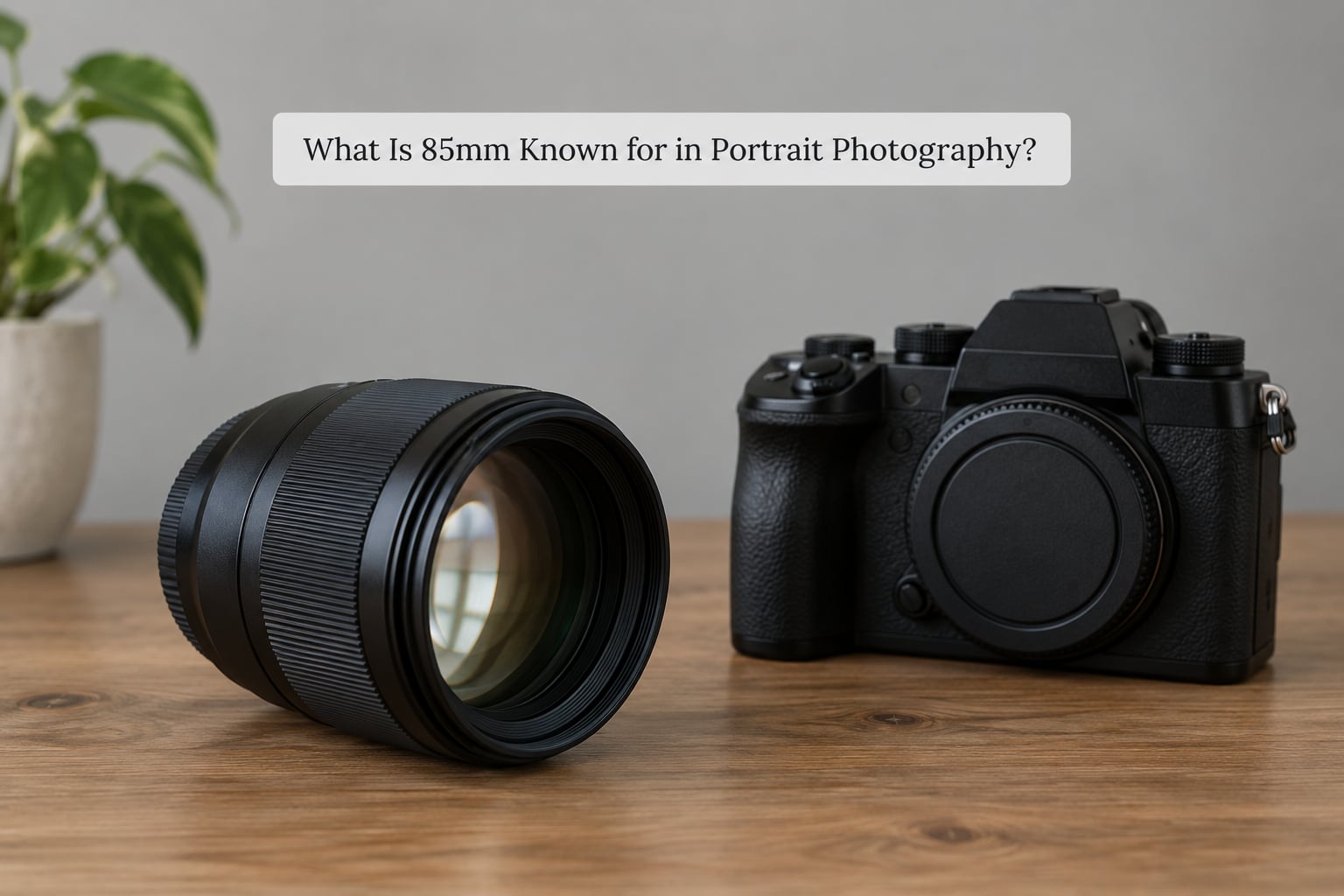
An 85mm lens on full frame is a short telephoto. Its angle of view is roughly 24 degrees on the diagonal, narrow enough that a normal head-and-shoulders portrait does not fit unless you stand back, wide enough that you are not holding a telescope.
That combination is unusual. Wide lenses force you close, and long lenses force you far away with no room to frame. The 85mm lands where a portrait sits comfortably between those two problems.
It is also a prime, almost universally. A single focal length means one rendering instead of a range, and it lets the designer build a fast aperture into a small, sharp optic. That is why 85mm lenses are sold with f/1.2, f/1.4, f/1.8 and f/2 openings when most 50mm primes stop at f/1.8.
Historically 85mm became the portrait lens because magazine and press work needed tight, undistorted headshots of faces that still looked like faces. A century of editorial portraits followed, and the focal length inherited a reputation it partly still deserves.
Two more habits come with it. A working distance of roughly 6 to 8 feet for a head-and-shoulders shot is far enough to remove distortion and near enough to keep directing and talking normal. And at f/1.8 or wider, the out-of-focus areas behind the subject turn into smooth, soft shapes, which is the isolation most portrait photographers are chasing.
Why Do Portraits Look Better at 85mm?
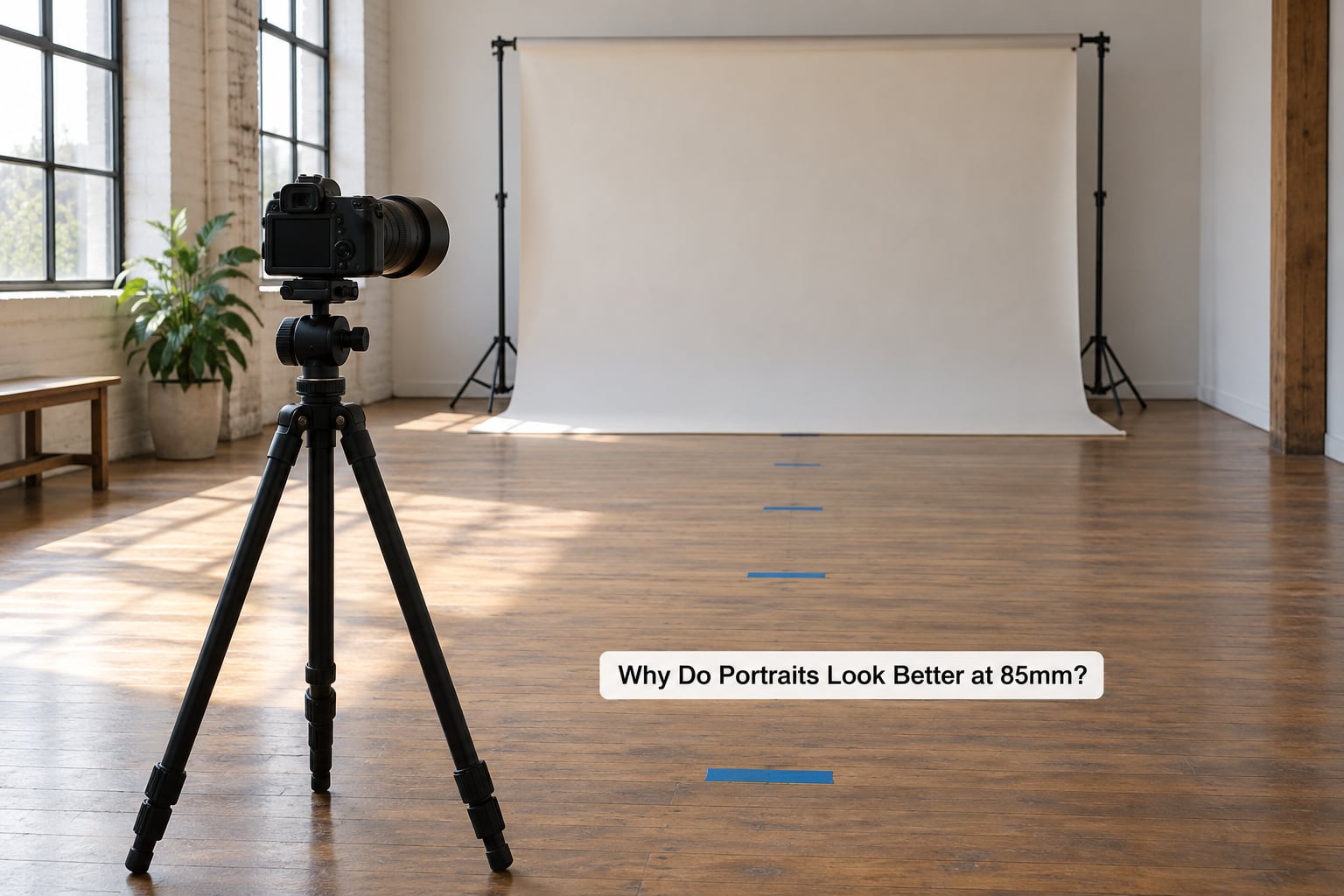
Short answer: the flattering look comes from distance, and the 85mm is the shortest focal length that reliably gets you there. Every framing you shoot at 85mm forces you to stand well back, and distance is what changes the geometry of a face.
Here is each factor on its own.
1. No close-range perspective distortion
Stand 18 inches from a face with a 35mm lens and the nose is a few inches closer to the sensor than the ears. Anything nearer the camera is magnified harder than anything farther away, so the nose and the centre of the face grow while the edges of the head shrink. Standing six feet back with an 85mm, that gradient all but vanishes, and the face settles into its natural proportions.
2. A working distance you cannot argue with
You cannot frame a head-and-shoulders portrait at 85mm from four feet. The framing itself sets the distance for you, which means the flattering option is also the only option. A photographer who shoots portraits mostly at 85mm slowly builds a habit of stepping back.
3. A background that plays the right size
Because the camera is several metres from the subject and further still from the wall behind, the wall fills more of the frame and any objects on it read at a natural size next to the person. Shoot the same framing from close in with a wide lens and the same objects shrink into the distance, and the subject ends up looking pasted on.
4. Shallow depth of field at a civil distance
An 85mm f/1.8 gives a genuinely thin slice of focus while still leaving room between you and the subject. A 50mm at f/1.8 gives a similar slice only if you stand close, and a wide lens gives one only when you get uncomfortably close. The distance is what lets the blur happen without the distortion.
Notice that three of the four reasons are about where you stand. That is the whole argument in miniature.
How Does Perspective Change the Look of a Portrait?
Perspective is determined by camera-to-subject distance, not by focal length. Mount any lens you like, stand in the same spot, and the perspective of the scene is identical; only the crop changes. Change the spot and the perspective changes, whatever is on the camera.
The rule behind it is simple magnification. Everything closer to the camera is recorded larger than everything farther away, and the size difference grows as you get closer to the subject. Back away and that difference shrinks until it disappears.
What Perspective Distortion Does to a Close Portrait
Fill the frame with a face from two feet away and the nose, the lips and the centre of the forehead sit several inches in front of the ears and the jaw. The result is a face that reads as wider, heavier and less like the person their friends know. Cheeks also spread toward the frame edges, which is why wide-angle close-ups tend to make people look fuller than they are.
The distortion is not the lens bending light. It is the shape of the room you are standing in, faithfully recorded. That is why moving back three metres fixes it even though nothing about the optics changed.
Why 35mm and 50mm Are Called Natural
On full frame, a 50mm viewed from about 1.5 metres gives roughly what a pair of eyes sees, which is why it is often called the natural perspective lens. A 35mm is only natural from further back, and it turns obviously dramatic when used up close.
So the useful scale runs from about 40mm to 50mm for natural, 85mm for a flattering, slightly compressed look, and past 100mm for a flatter, more formal one. All three can produce natural-looking faces. Only one of them is hard to shoot badly.
One more thing perspective explains. Photographers on PentaxForums and DPReview’s forums argue endlessly about whether compression is real, and the argument keeps circling because people test it while changing two variables at once. Fix the framing and hold the distance steady, and the two effects separate cleanly.
What Does Compression Do to Portraits?
Compression is the appearance of a narrower gap between the subject and the background than actually exists. A wall 20 feet behind your subject still looks 20 feet behind in the image data, but it appears closer because it is recorded at a larger size relative to the subject.
What changes size relative to what? The distance between the camera and each object, seen against a fixed frame. Move the camera back, and the far background takes up more of the frame while the subject, held at the same size by moving the focal length, stays put. The gap looks tighter.
The Compression Myth, Settled
Both camps in the forum argument are half right, and each can prove its half with a photograph. Writers on r/Photography_Gear argue that compression is a question of perspective plus framing, which is accurate: it is not an optical effect of the glass. Others point out that a 135mm background genuinely looks different from a 50mm background in the same frame, which is also accurate.
Both observations hold because the two effects come from different causes. Moving back with the same framing changes perspective and relative background size, which is the dominant effect. The focal length matters because it is what lets you move back while holding the subject at the same size. Focal length is the tool, distance is the cause.
Here is the test that settles it without an argument. Shoot one frame at 50mm from 3 metres. Shoot a second frame at 85mm from 5 metres, zoomed to match the first framing exactly. The faces match in size. The perspectives are different, so the second face is slightly flatter, and the background is different, so the second one is slightly larger in frame. Change the order of those two causes and you have the whole phenomenon.
Separation Is a Different Thing From Compression
Separation is about focus, not size. How much the background blurs depends on three things: how far the background is from the subject, how wide the aperture is, and how much you magnified the scene.
That last one explains something photographers find odd. At identical framing, a 50mm at f/2 and an 85mm at f/3.4 render almost the same background, because the extra distance the 85mm needs is cancelled by the stop-down. Multiply again and the rule holds: a 35mm at f/1.8 matches an 85mm at f/4.4.
Run the equivalence the other way and it explains why fast 85mm primes exist at all. An 85mm at f/1.2 is roughly equivalent to a 50mm at f/0.7, and no such 50mm exists. An 85mm f/1.8 beats the best blur any 50mm can produce at that framing, which is the optical reason the focal length grew its own class of fast primes.
Does 85mm Always Produce Better Portraits?
No, and the honest answer needs room. An 85mm needs about six feet of space for a head-and-shoulders shot and closer to twenty for a full body. A small living room, a narrow office and most stairwells simply do not offer that.
These are approximate full-frame distances for a typical adult, and they move with body build, sensor size and how much headroom your crop needs.
| Focal length | Head-and-shoulders | Waist-up | Full body | What you get |
|---|---|---|---|---|
| 35mm | 2 to 3 feet | 4 to 5 feet | 7 to 8 feet | Context, tight spaces, some distortion when close |
| 50mm | 3 to 4 feet | 5 to 7 feet | 10 to 11 feet | Natural perspective, moderate separation |
| 85mm | 5 to 7 feet | 8 to 11 feet | 17 to 20 feet | Flattering faces, soft backgrounds, good reach |
| 105mm | 7 to 8 feet | 10 to 13 feet | 21 to 24 feet | More compression, tighter background, less space |
| 135mm | 8 to 10 feet | 12 to 15 feet | 28 to 30 feet | Strong isolation, outdoors or long corridors |
Why Portraits Look Better at 85mm Than at 35mm
A 35mm is a better tool than people credit. It keeps context in the frame, it is the only option in a tight room, and it makes environmental portraits work because you can be part of the scene.
It also asks you to choose. Frame a head at 35mm from three feet and the face fills the frame with distortion you cannot remove afterwards. Step back to four feet and the face is the right shape but the frame has filled with room. The lens makes you compromise; the 85mm removes the choice.
85mm vs 50mm: Which One to Carry
Choose by space and by how much environment you want. The 50mm is more forgiving indoors, frames full bodies without a corridor, and matches what a person sees with their own eyes. The 85mm gives cleaner facial proportions, more background blur at the same subject size, and a natural pause between you and the subject that helps people relax.
If you can only carry one prime and you mostly shoot headshots outdoors or in a room with real space, take the 85mm. If you move between homes, small studios and events, the 50mm will save more sessions than the 85mm will improve.
85mm vs 105mm and 135mm: When Longer Wins
Longer lenses push the same three effects further: flatter faces, larger background, less context. A 105mm is the sensible compromise for someone who wants more compression than an 85mm gives but still wants to direct a subject without shouting. A 135mm is outstanding outdoors and in long hallways, and near-useless in a bedroom.
There is a real cost to pushing past 100mm. Faces start to lose depth, and the flattering geometry that makes people recognisable gets flatter with it. Past about 200mm the effect reads as stylised rather than flattering, and most subjects are not sure they like how it looks.
What 85mm Does Not Fix
An 85mm cannot rescue bad light, a cluttered background, or an uncomfortable subject. Compressed clutter is still clutter, and it now fills the frame instead of sitting far away.
It also does not rescue lighting placed like a spotlight. Any fast lens exaggerates the shadows a hard light creates, and at f/1.8 the transition from lit cheek to shadow can be abrupt. Most of the “85mm portraits look bad” complaints I have seen come down to that, or to a minimum focus distance closer than the photographer assumed.
On crop bodies the numbers change again. An 85mm behaves like roughly 127mm on a 1.5x APS-C body, 136mm on 1.6x, and 170mm on Micro Four Thirds. A 50mm on APS-C is about 75mm equivalent, which is much closer to the classic look, and a 56mm gives true 85mm-equivalent framing. This is the single most common surprise APS-C owners hit, and the reason a 50mm is often the more sensible first portrait prime on those bodies.
How Can You Make 85mm Portraits Look Their Best?
Most of the improvement comes from three decisions, in this order: how far you stand, how you frame, and how wide you open up.
Settings That Work Most of the Time
Start at f/2 or f/2.8. Wide open gives the thinnest focus plane and the most frequent focus misses, especially at f/1.2 and f/1.4 where a fraction of a millimetre matters. Stopping down one or two stops sharpens the eye and the iris and keeps most of the background softness.
Keep the shutter at 1/250 second or faster, or 1/125 when the lens or body has stabilization. The old rule of one over the focal length in seconds came from film-era sharpness limits and is too slow for a sharp eye on a modern sensor.
Set ISO to whatever holds that shutter in the light you have rather than pushing it. Add a little light, use a reflector, or move into shade; noise in the shadows costs more than grain in a portrait than a slightly darker file.
For focus, single-point or small-area eye autofocus, placed on the nearer eye. Face detection is good when it works and frustrating when it jumps to the far eye, so check which one your body does reliably before a paid session.
One habit worth building: shoot the same setup at 50mm and at 85mm from the same position, then compare them on your own screen. It settles arguments faster than any forum thread, and it teaches you to see distance rather than focal length.
Framing Details That Ruin Otherwise Good Portraits
Watch the hairline. Cropping tight through the top of the head is the most common 85mm error, and a little headroom fixes it in one second.
Turn the camera for full bodies and environmental work. A full-length frame at 85mm portrait orientation often leaves a thin strip of floor, while the same shot in landscape orientation gets breathing room on both sides.
Keep the background simple and choose it deliberately. At 85mm the out-of-focus area is large, so a plain wall works beautifully and a busy bookshelf becomes a smear of colour you cannot unsee.
And talk from six feet rather than shouting from four. A relaxed subject is the one thing no focal length can substitute for, and the distance is the thing that gets you there.
Frequently Asked Questions
Is 85mm always the best focal length for portraits?
No. 85mm removes close-range distortion and gives soft backgrounds, but it needs about six feet of space for a head-and-shoulders shot and closer to twenty for a full body. In small rooms, a 50mm gives more natural perspective and far more framing flexibility at the same quality level.
Why does 85mm make backgrounds look less distracting?
Two effects combine. Because you are further from the wall behind your subject, it occupies more of the frame, so clutter reads as a designed backdrop rather than distant clutter. And a fast short telephoto throws that wall out of focus. A slower wide lens used from the same spot would not get either advantage.
Does 85mm distort facial features less than 35mm?
It distorts less in practice, but the distortion is caused by distance, not the lens. At two feet, both lenses exaggerate the nose and shrink the ears. An 85mm simply cannot frame a head at that distance, so the framing forces you back to where the distortion disappears. Switch to a 35mm and step back to the same place and the perspective matches.
What aperture should I use for an 85mm portrait?
Start at f/2 or f/2.8. Wide open gives the thinnest depth of field and the most focus misses, and at f/1.2 or f/1.4 a millimetre of movement changes what is sharp. Stopping down one stop sharpens the eye and the iris while keeping most of the background softness. Use the widest aperture only when light forces you to.
Is 85mm better than 50mm for portraits?
For headshots where you have room, yes. The 85mm forces a flattering working distance and gives a softer background at the same subject size. The 50mm wins in small spaces, for full bodies, and for shots where you want the environment to stay readable. It also matches what a person sees with their own eyes, which many people prefer.
Can I use an 85mm lens on a crop-sensor camera?
Yes, and it will be much tighter than you expect. An 85mm frames like roughly 127mm on a 1.5x APS-C body, 136mm on 1.6x, and 170mm on Micro Four Thirds. Many APS-C photographers are better served by a 50mm, which behaves like about 75mm equivalent, or a 56mm for true 85mm-equivalent framing.
Conclusion: Start With Distance, Not Just 85mm
The look people mean when they say portraits look better at 85mm is made of distance, and the focal length is only the thing that obliges you to take it. Perspective is distance, compression is distance plus framing, and background blur is distance plus aperture plus magnification.
So the first thing to try costs nothing. Shoot your next headshot at 85mm from as far back as the frame allows, at f/2 or f/2.8, then take the same shot at 50mm from that same spot and compare. You will learn more from that pair of frames than from any argument about which lens is better, and you will end up with a preference you actually tested rather than one you inherited.