You avoid squinting in bright light portraits by keeping the sun out of your subject’s line of sight, then adding fill light so their face is still bright enough to expose for. Put them in open shade, or turn their back to the sun and bounce light back into the face. Never ask a subject to stare into the sun and deal with it.
That reflex is not a posing problem, so no camera setting fixes it. When direct sun reaches the eyes, the iris closes the pupil down to protect the retina and the eyelid comes with it. The expression reads as discomfort in every single frame, and no amount of editing brings the lids back without looking pasted on.
Most of the work is free. Positioning, shade, and how you give instructions fix the majority of squinting, and gear only matters once those are already handled. If you are learning how to avoid squinting in bright light portraits, work through the steps below in order and stop at the first one that solves your situation.
Table of Contents
- What You Need to Avoid Squinting in Bright Light Portraits
- Step-by-Step: A Field Workflow for Bright-Light Portraits
- How to avoid squinting in bright light portraits with shade
- How to avoid squinting in bright light portraits with angle and pose
- How to avoid squinting in bright light portraits with gentle prompts
- How to avoid squinting in bright light portraits by controlling exposure
- Common mistakes when shooting portraits in bright sun
- Frequently Asked Questions
- How do you prevent squinting in photos?
- Should I use a reflector or a flash to fill shadows on a backlit subject?
- Can you use flash to fill light in bright sunlight?
- Why do my subjects squint even when the sun is behind them?
- Are sunglasses a good way to stop squinting in portraits?
- Can I fix squinting eyes in editing?
- Conclusion
What You Need to Avoid Squinting in Bright Light Portraits
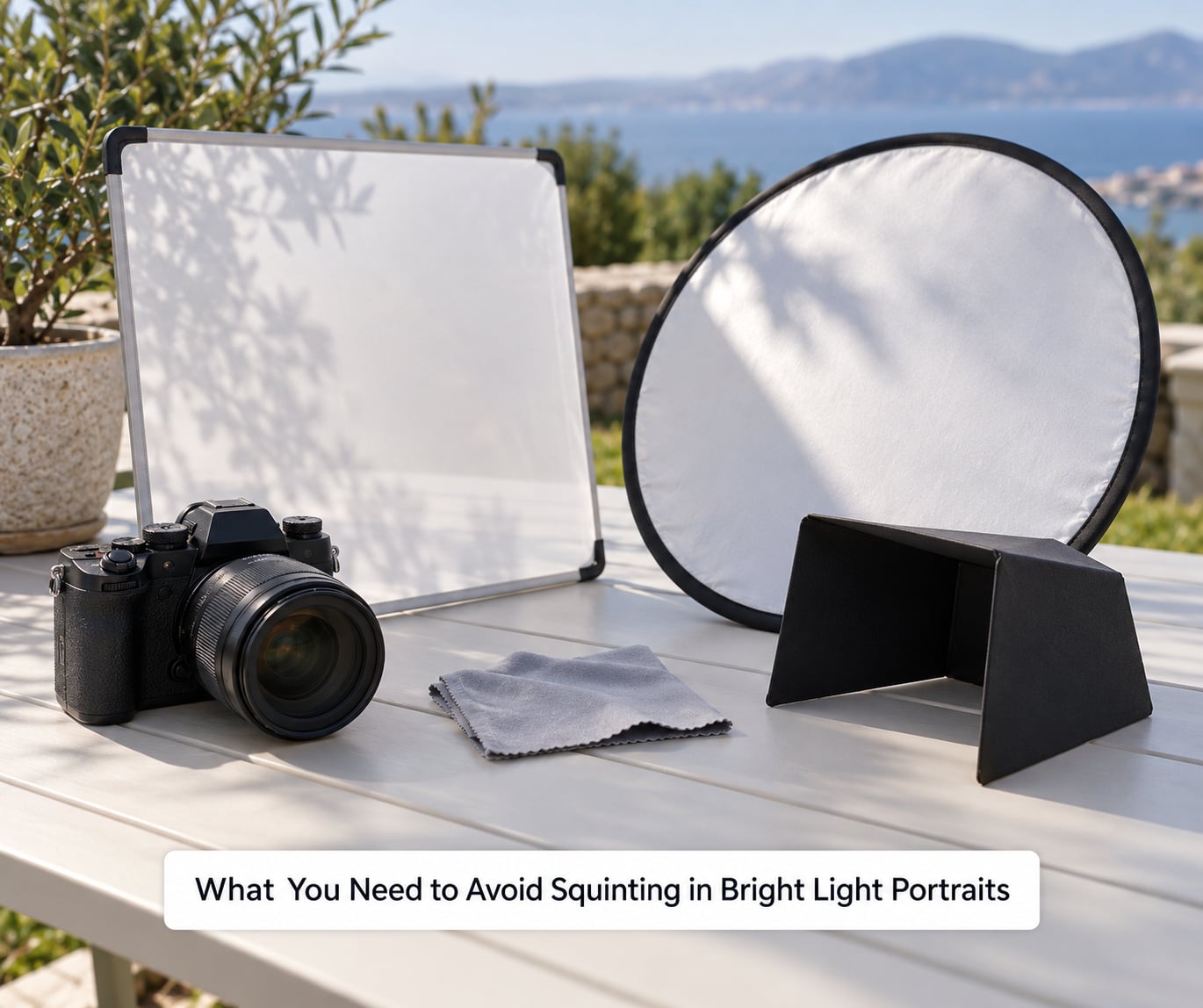
You need almost nothing. Here is the honest list, separated into what costs nothing and what helps when you have it.
What costs nothing
- A location with shade in it. A wall, a doorway, a canopy, a tree line, a car park with a north-facing building. Open shade beats anything you can buy.
- Ten seconds to scout the sun. Stand where the subject will stand and look at your own shadow. Short shadow behind you means the sun is in front of them. Long shadow sideways means you can turn them 90 degrees and it is gone.
- A camera you can stop down or pull wide. Bright sun gives you more light than you need, which is a problem for expression and a gift for exposure.
- A two-minute plan. Decide the sun angle, the face direction, and the fill before anyone arrives.
What helps when you have it
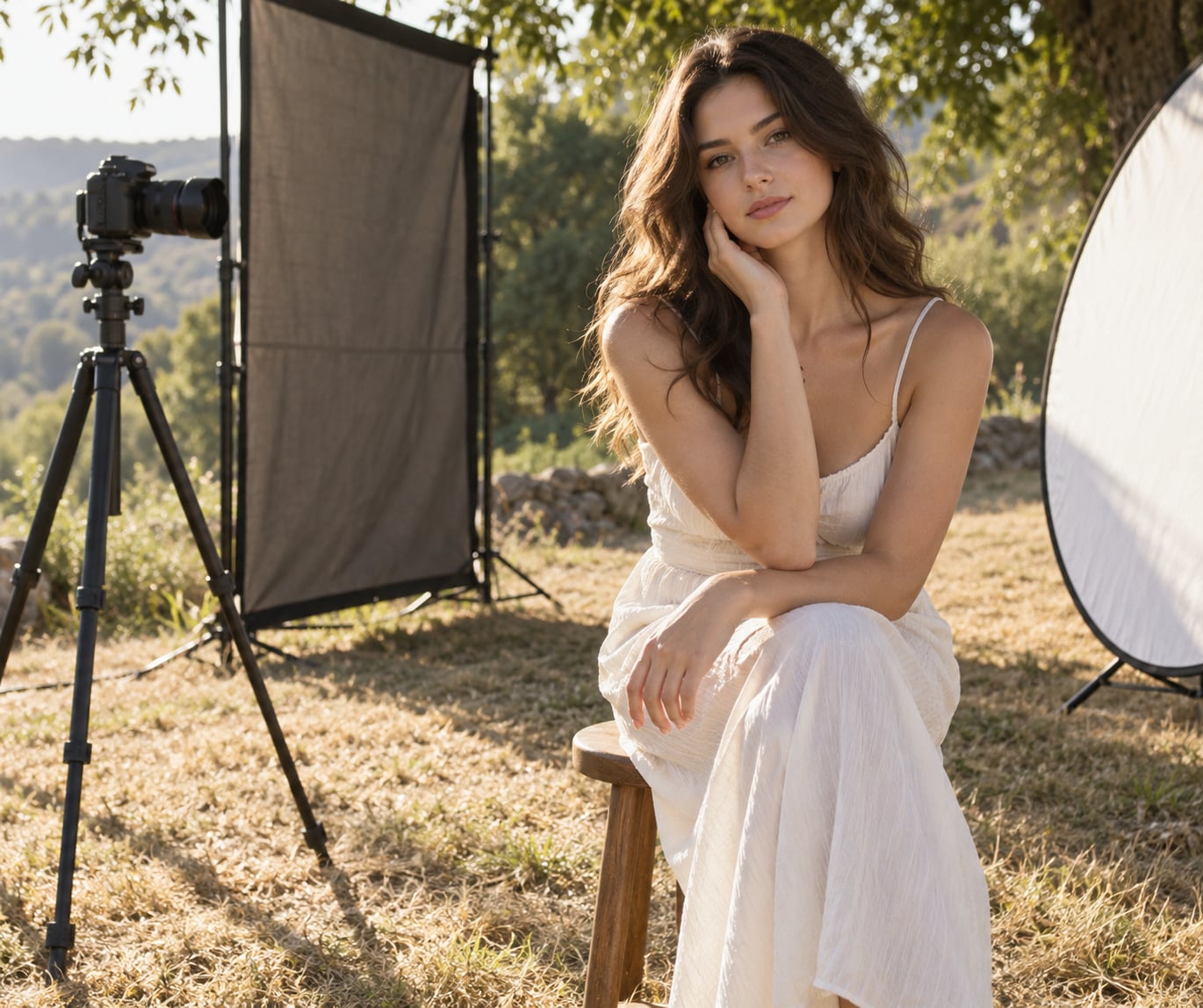
- A white or silver reflector. Five minutes and a folding disc solves more backlit faces than any flash setup.
- A translucent scrim or a white sheet on a frame. Turns harsh sun into a large soft source when you cannot move into shade.
- A hood and a lens cloth. Hood for flare and stray light, cloth for the sweat that comes with heat.
- Off-camera flash as a last resort. It works, but bright sun imposes a real ceiling on how much fill you can add. More on that below.
If you shoot outdoors on a schedule you do not control, the shade scouting is the item to spend your time on. Everything else is recoverable on the day. Shadow direction is not, because it moves.
Step-by-Step: A Field Workflow for Bright-Light Portraits
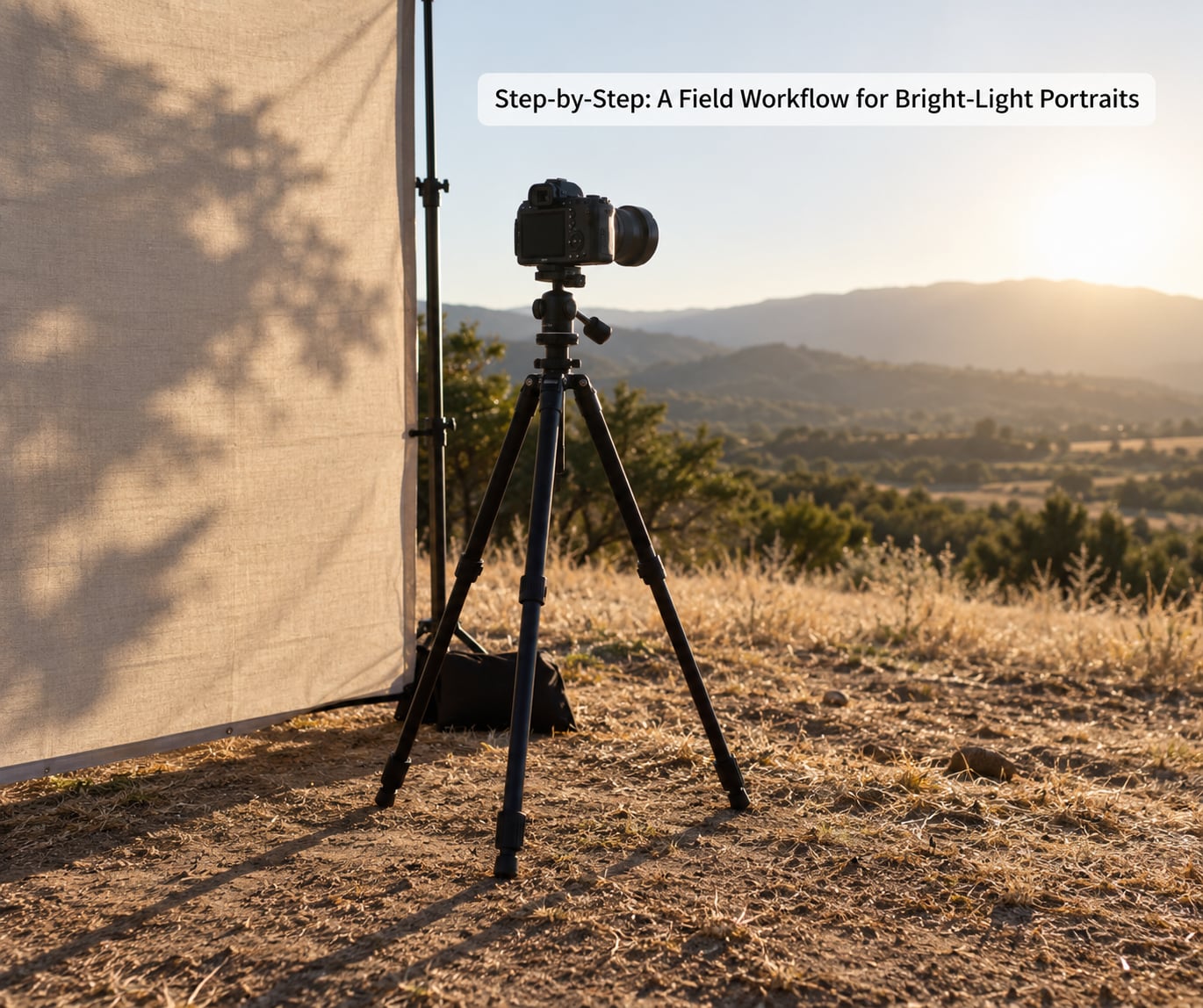
Run this in order. Each step solves a problem the previous one creates, which is why skipping ahead usually leaves you with a dark face or a squinting subject.
How to avoid squinting in bright light portraits with shade
Move the subject into open shade. Not the shade under a dense canopy, which is dark, green-tinged and full of dappled light. Open shade means a large, bright, unobstructed sky opening in front of your subject, with the sun behind or beside them.
What that sky does is act as the light source. The subject faces a whole hemisphere of bright sky instead of one small sun disc, so the iris has nothing to clamp down against. Skin tones even out, the shadows under the brow soften, and the squint usually disappears without you saying a word about it.
Two checks before you start. First, look at the shade edge. A hard line between sun and shade crossing a face is worse than either one alone, because the subject ends up half-lit and squinting into the bright half. Move the position until the transition falls behind the subject or well off to one side. Second, watch what the shade is reflecting. Green grass and foliage push green into skin tones, and shade light is cooler than sun, so check a white shirt or a grey card before you commit.
The photographers who post on the DPReview forums keep coming back to this for a reason. Same light, same colour temperature, far more forgiving face, and it costs nothing.
How to avoid squinting in bright light portraits with angle and pose
If you cannot get to shade, change where the sun is relative to the eyes. Here is how each angle behaves in direct sun:
| Sun position | What happens to the face | Squinting risk |
|---|---|---|
| Behind the subject (0 degrees) | Face in shade, bright rim on hair and shoulders | Low, but the face goes underexposed without fill |
| 45 degrees off axis | Split lighting, one side bright, one side dark | Low if they are not facing the sun |
| 90 degrees to the side | Full profile shadow across the face | Low, hardest lighting to expose |
| Behind the camera (front lit) | Flat, even, shadowless light | Highest. The subject looks straight into the sun |
Then work the face itself. Turn the head a few degrees away from the sun so the brow is not shielding the eyes at a squint angle. Ask for a slight chin down and forward, which relaxes the upper eyelids, then lift it back up a fraction so the jaw reads. Give them something to do with their hands, a shoulder shift, a turn toward you, because a body in motion gives the face permission to stop performing.
What to avoid is asking for a constant smile under direct sun. A held smile tightens the whole face, and tight faces squint. Break the smile, let the face reset, then shoot between smiles rather than during one.
How to avoid squinting in bright light portraits with gentle prompts
Once the light is right, the remaining squinting is about how you give instructions. Most of it is fixable with phrasing.
Give them a breathing cue. Ask for an inhale, then a slow exhale, and shoot on the out-breath. Exhaling drops the eyelids naturally into a relaxed, open position, and it takes about a second, so start shooting before the breath finishes rather than after.
Ask them to look just past the lens instead of into it. A distant focus point a few metres behind the camera removes the direct stare that makes people tense up their brow.
Then use the eye-rest break. Every few frames, tell the subject to close their eyes completely and hold it for fifteen or twenty seconds. On your count of three they open them wide and relaxed, and you shoot in that first second. This trick circulates widely on r/AskPhotography, where several photographers report it reliably beats talking people into a natural expression.
Keep talking between frames too. Conversation resets a face more effectively than any prompt, because people stop thinking about their expression the moment they are listening to you.
Subjects with blue or light-coloured eyes squint hardest in bright sun, and sunglasses are not always the answer. They hide the eyes, kill the catchlights, and add a hard reflection across lenses. Give them a hat with a brim instead, or place them where the sky is doing the lighting, which takes the sting out without covering the face.
How to avoid squinting in bright light portraits by controlling exposure
Exposure does not stop the squint reflex, but it decides whether you can keep the shot. Protect the face and the rest is negotiable.
Expose for skin tones, not for the background. In backlight the background will blow out long before the face goes too dark. Set the lowest native ISO your camera offers, use the fastest shutter your subject can hold still without motion, and open the aperture wide. The extra light you gain means you are not forced into a slow shutter that blurs them.
Watch for highlight warnings on skin. Bright sun plus pale skin clips easily, and once forehead or cheek highlights are gone, no amount of shadow recovery in editing brings the texture back. Pull exposure back a fraction and check the histogram rather than trusting the screen in daylight, where every screen looks washed out.
Fill the face and the squinting eases further, because a bright face is a face the subject stops protecting. In backlight that means a reflector held just below eye level and just off the camera axis, angled up. Rotate the subject, take a test frame, and move the reflector a few degrees until the shadow side of the face matches the lit side.
The fill ratio matters more than the fill source. Aim for roughly a one-stop difference between the two sides of the face. More contrast than that and the eyes read as dark slots, which reads as squinting even when the subject is perfectly relaxed.
Common mistakes when shooting portraits in bright sun
Front-lighting the subject because it is easier. The sun is behind you, the face is even and shadowless, and the subject is staring into the sun. Fix: turn them so the sun crosses to behind them, then fill. The extra minute is the whole job.
Asking for a permanent smile. Fix: shoot between smiles, and give a specific expression to hold, like a relaxed look just past the lens.
Leaving a hard shade line across the face. Fix: keep the subject fully inside shade or fully in sun. Half in and half out is the worst of both.
Trusting automatic exposure outdoors. The meter sees a bright scene and gives you a bright face that is one shade from clipping. Fix: check highlights on the camera back, not on the histogram alone, and expose for skin.
Picking shade that is too deep. Standing under dense trees looks like a solution and is not. The face goes flat, green bounce contaminates the skin tones, and dappled light gives you a background of blotches. Fix: open shade with a clear sky opening in front of the subject, then fill with a white reflector if the face is still dark.
Squinting in the viewfinder yourself. You press your eye to the camera, the sun is over your shoulder, and your own squint tells you the light is fine. It is not fine. Fix: turn yourself into the shade too and check the exposure on the back screen.
Rushing because the schedule is fixed. Fix: accept the light you have, shoot longer in the shade rather than burning the session on the sun, and set expectations that the images will be softer and more evenly lit than golden hour frames.
That last one is worth saying plainly. If a family tells you the only date that works is 1pm on a Sunday, you can produce good portraits at 1pm on a Sunday. You cannot produce golden hour light at 1pm on a Sunday, and pretending otherwise leads you into the failure mode most photographers fall into, underexposing the whole session and trying to rescue flat, processed skin tones later.
Here is how the techniques compare, from zero gear to full kit.
| Technique | Gear needed | Setup time | Fixes squinting | Works for kids |
|---|---|---|---|---|
| Move into open shade | None | 2 minutes | Almost completely | Yes |
| Turn the subject back to the sun | None | 1 minute | Almost completely, face needs fill | Yes |
| Rotate to 45 or 90 degrees | None | 2 minutes | Mostly | Yes |
| Hat or umbrella for the subject | One item | 1 minute | Partially | Yes |
| White reflector fill | Reflector | 3 minutes | Mostly, plus solves dark faces | Usually |
| Diffuse with scrim or sheet | Scrim | 5 minutes | Mostly | Yes |
| Watch them for 20 seconds, shoot on three | None | Ongoing | Partially | Yes |
| Reschedule to early or late light | None | Days of planning | Completely | Yes |
| Off-camera flash fill | Flash and trigger | 10 minutes | Partially, limited in bright sun | Hard |
Flash comes last for a reason. Bright sunlight forces a very fast shutter to keep the background rendered and the flash synced, and that caps how much fill power you can add without the background going dark. On many cameras the sync limit outdoors sits around 1/250 second, and pushing past it with high-speed sync costs real output. A light touch of flash, gelled a quarter CTO to match the sunlight, does help a backlit face. Full power flash on a subject standing in sun does not, and it changes the colour temperature of the portrait into something that no longer belongs to the scene.
Reflectors win for the same reason the photographers on the forums keep choosing them. The light is already in the scene, it matches the colour temperature of the sun, and it arrives for free. The catch is that a reflector also picks up the contaminated colour bouncing around the scene, so a little colour correction afterwards is sometimes needed.
Frequently Asked Questions
How do you prevent squinting in photos?
You prevent squinting by keeping direct sun out of your subject’s eyes. Move them into open shade, or turn their back to the sun and add fill light to the face with a reflector. Then prompt rather than pose: an exhale cue, a focus point just past the lens, or twenty seconds of closed eyes before you shoot on three. Camera settings cannot fix it, because the squint is an eye reflex, not a posing habit.
Should I use a reflector or a flash to fill shadows on a backlit subject?
Use a reflector first. The light is already present, it matches the colour temperature of the sun, and it takes about three minutes to place. Flash is the fallback when there is no surface to bounce off, but bright sunlight forces a fast sync speed that limits how much power you can add without losing the background.
Can you use flash to fill light in bright sunlight?
Yes, but with limits. Your flash sync speed in bright sun is often around 1/250 second, and everything above that either darkens the background or loses power to high-speed sync. A light touch gelled a quarter CTO blends acceptably. Full power flash on a sunlit subject changes the colour temperature of the portrait and rarely looks natural.
Why do my subjects squint even when the sun is behind them?
Three usual reasons. The background is bright, so the iris still clamps down even though the sun is not visible to them. The face is underexposed, which makes the subject strain and push their face forward. Or the light is bouncing off a pale wall or pavement straight back at them. Check the brightest thing the subject can see from where they stand, not just where the sun is.
Are sunglasses a good way to stop squinting in portraits?
They stop the squint and cost you the eyes. Sunglasses flatten the face, kill the catchlights, and often throw a hard reflection across the lenses. A hat with a brim, or simply relocating to open shade where the sky does the lighting, keeps the eyes open and visible. If the subject insists on glasses, shoot one frame in and one frame out.
Can I fix squinting eyes in editing?
Barely. You can lift the upper lid slightly, brighten the sclera, and reduce the crow’s feet around the eye, but heavy-handed work on a squint reads as plastic and is obvious up close. Treat it as insurance on a frame that was already close, never as the plan. The fix belongs in the light, not the edit.
Conclusion
Move the subject into open shade first, and check the shadow direction while you are still scouting. If there is no shade, turn their back to the sun and put a white reflector below the eye line. Soften whatever light you cannot move past with a scrim or sheet, and protect the skin tones on the camera back.
Only after the light is handled does the direction matter: breathe, look just past the lens, rest the eyes, shoot on three. Buy the flash last, if at all. Learning how to avoid squinting in bright light portraits is mostly a matter of changing what the sun does to a face, not of changing equipment.