If you shoot people and you are choosing between formats, the short version is this: full frame makes background separation and dim-light shooting noticeably easier, while APS-C costs less, weighs less and reaches further. Neither one decides whether your portraits are good. Light, lens choice and getting close to your subject matter far more than sensor size, and this guide on crop sensor vs full frame for portraits breaks down exactly where each format wins.
I have shot weddings and headshots on both formats and swapped between them more than once, and the honest answer keeps surprising people. The gap that used to exist in image quality has mostly closed. What is left is shallow depth of field, high-ISO cleanliness, and the freedom to frame a portrait the way you want without stepping backwards into a wall.
Table of Contents
- Crop Sensor vs Full Frame for Portraits at a Glance
- Field of View and Portrait Framing
- Which Sensor Gives Better Portrait Images?
- Depth of Field and Background Blur
- Autofocus and Low-Light Portrait Performance
- Lenses, Camera Bodies, and Cost
- Which Should You Choose?
- Frequently Asked Questions
- Is a full-frame camera better for portraits?
- Can a crop sensor create the same background blur as full frame?
- Do crop-sensor cameras use the same lenses as full-frame cameras?
- Does full frame always produce sharper portrait images?
- What focal length should I use for portraits on a crop sensor?
- Is upgrading from a crop sensor to full frame worth it?
- Conclusion
Crop Sensor vs Full Frame for Portraits at a Glance
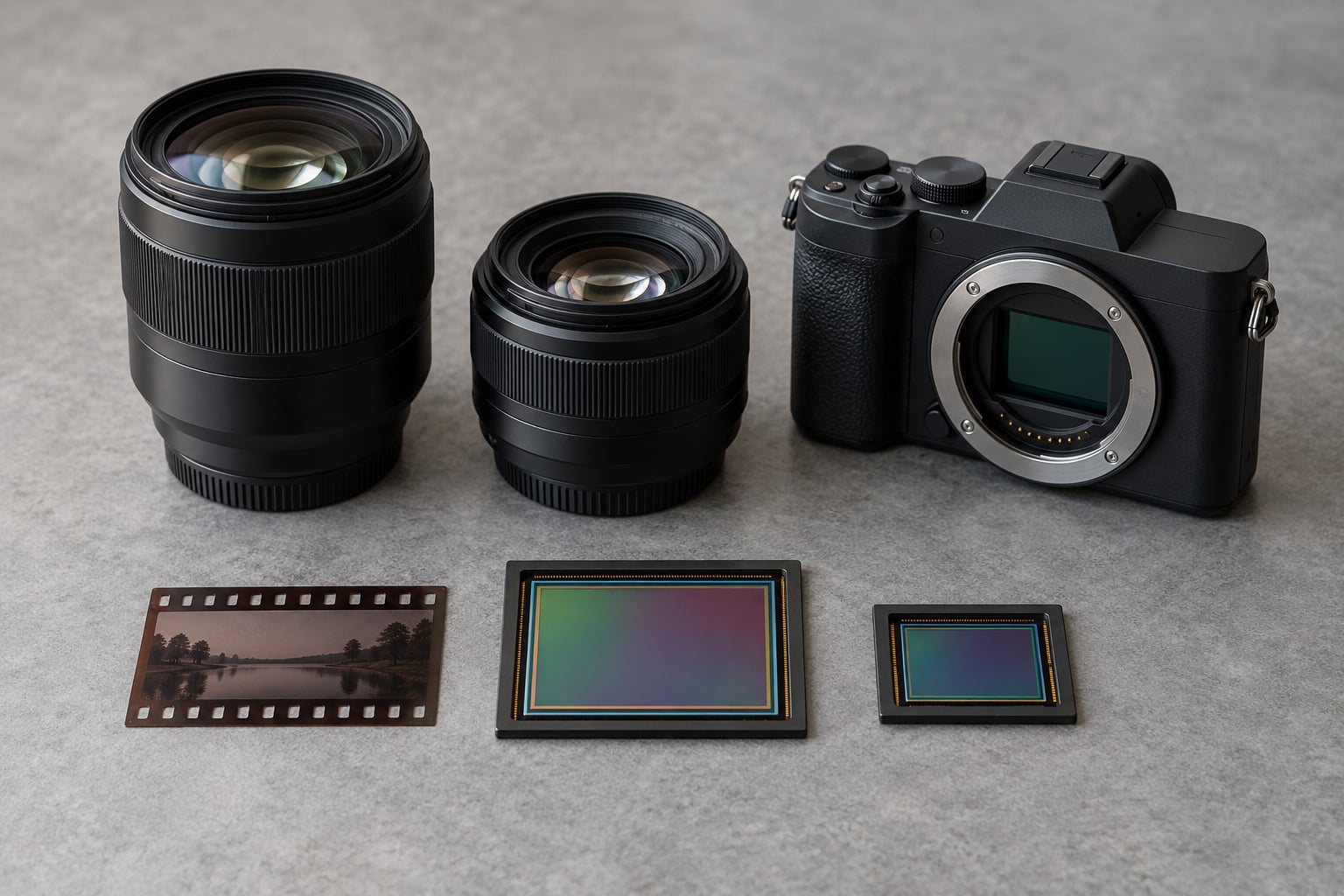
Two definitions first, because everything else depends on them. A full-frame camera uses a sensor about 36 by 24mm, the same dimensions as a single frame of 35mm film. A crop sensor, almost always APS-C, is about 23.5 by 15.6mm, so it records a narrower slice of what the lens projects. Micro Four Thirds sits further down the scale at roughly 17 by 13mm.
Because the sensor shows less of the image circle, the same lens gives a tighter field of view on a smaller sensor. That multiplier is called the crop factor: about 1.5x for Nikon, Sony, Fujifilm and most others, 1.6x for Canon, and 2x for Micro Four Thirds.
| Portrait consideration | Full frame | APS-C crop sensor |
|---|---|---|
| Sensor size | About 36 x 24mm | About 23.5 x 15.6mm |
| Crop factor | 1x | 1.5x, or 1.6x on Canon |
| Field of view from the same lens | Wider | Tighter, roughly 1.5x narrower |
| Background blur at the same framing | Easier to make shallow | Needs a wider aperture for the same look |
| Light-gathering area | A little over 2x APS-C, about 1.2 stops | Smaller, so higher ISO for the same exposure |
| High-ISO cleanliness | Cleaner files, roughly a stop of headroom | Cleaner than older generations, noisiest at the top end |
| Depth of field for the same look | f/2.8 | Around f/1.9, so f/1.8 in practice |
| Working distance for the same portrait | Shorter lenses, stand closer or similar | Longer lenses, you stand further back |
| Telephoto reach for the money | More background blur per mm | More compression and reach per mm |
| Body and lens cost | Higher across body, fast primes and zooms | Noticeably cheaper in every category |
| Portability | Bigger bodies, heavier fast primes | Smaller bodies and lighter kit |
| Upgrade path | Nothing to upgrade to | Full-frame glass works on these bodies |
One row deserves a flag. Reach is the one place crop genuinely wins: a 90mm on APS-C frames like a 135mm does, which helps when you are working in a tight room or shooting a headshot from across a venue.
Field of View and Portrait Framing
Here is the myth that causes more confusion than anything else in this topic: a 50mm lens does not become a 75mm on a crop body. The focal length stays 50mm. The angle of view changes, because the smaller sensor only uses the central part of the image the lens projects, and a 1.5x crop factor means you see a 1.5x narrower slice.
So a 50mm on full frame and a 50mm on APS-C at the same distance produce two different framings: the crop version is tighter. To get the same framing, you either move closer, or you use a 33mm lens on APS-C to match a 50mm on full frame.
Which focal length matches which framing
This table is the one I taped inside my camera bag. The middle column is the full-frame lens, the last column is the crop-sensor lens that frames the same shot from the same position.
| Full-frame focal length | What it is used for | APS-C equivalent (1.5x) | APS-C equivalent (Canon 1.6x) |
|---|---|---|---|
| 35mm | Environmental portraits with context | 23mm | 22mm |
| 50mm | Natural-looking head and shoulders | 33mm | 31mm |
| 85mm | Classic flattering portrait length | 57mm | 53mm |
| 135mm | Tight framing, compressed backgrounds | 90mm | 85mm |
Working distance is the part people forget. With an 85mm on full frame you stand back and the background compresses behind your subject. Trying to get that same compression from a crop body means an 85mm lens, which puts you much further away. In a small venue that can put you against a wall, or make your subject feel watched, which matters more to clients than a technical spec ever will.
The flip side is the one I use constantly. On APS-C I can photograph a head-and-shoulders frame with a 33mm from about a metre away, which is a conversation-friendly distance. Full frame at that distance needs something like a 50mm, and then the perspective flattens slightly. Neither is wrong. They are different pictures, and the format quietly pushes you toward one of them.
A note on perspective: the flattering look people attribute to longer lenses comes from camera position, not focal length. If you move your feet, you change perspective. If you only zoom, you change framing. Crop sensors make you move your feet more often, and that is a real effect on portraits.
Which Sensor Gives Better Portrait Images?
In daylight with good light, a modern crop sensor produces files most clients could not separate from full frame. Detail, colour and edit latitude are all strong enough that the sensor is no longer the limiting factor. Anyone telling you a 24MP APS-C body cannot deliver a professional portrait is working from ten-year-old experience.
There are still measurable differences. Dynamic range at a given ISO runs about a stop wider on full frame, which means you recover more from a bright window or a blown highlight before the shadows turn to mud. Colour depth is a shade smoother on the larger sensor, particularly in the low-contrast shadow areas that make skin look muddy.
Skin tone rendering is the quiet differentiator nobody talks about. Full-frame files tend to hold separation in the mid-tones, which is where skin lives, and they give you a little more room to warm the highlights and cool the shadows before you break the colour of a face. On a crop sensor the same edit works, but with less margin, particularly in dim light.
What sensor size does not tell you: autofocus behaviour, burst rate, viewfinder quality, stabilisation, battery life and menu design. A modern crop body with subject-detection autofocus will beat an old full-frame body in every one of those. If you are comparing a current camera against a five-year-old one, put the sensor size in the least important column.
For portraits where the subject fills the frame and prints large, resolution starts to matter again. A high-resolution full-frame body gives you room to crop a group shot down to a single face without losing detail, which is a real workflow benefit if you shoot events.
Depth of Field and Background Blur
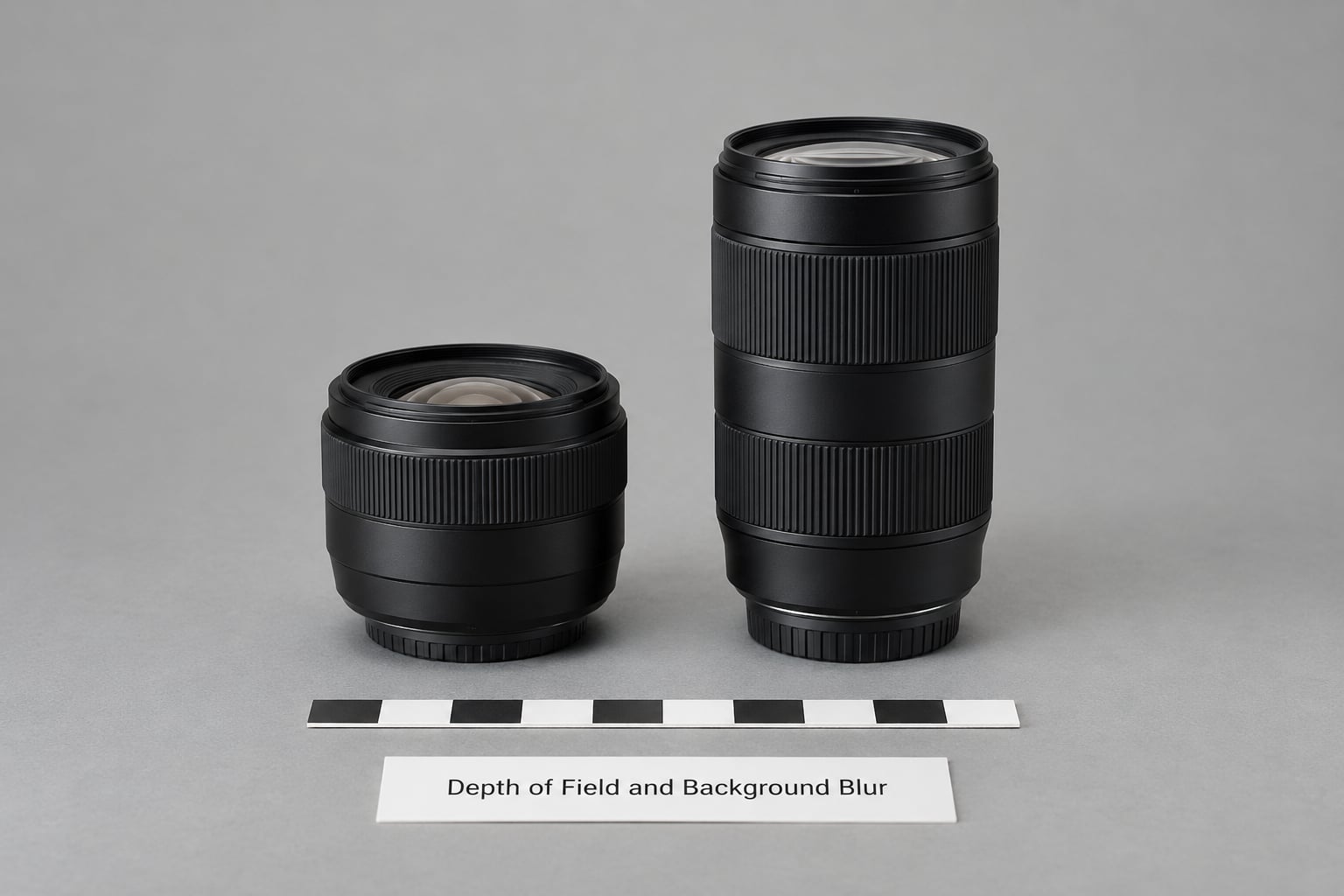
This is where full frame earns its money, and it is also where most comparisons go wrong. Comparing formats at the same focal length and the same f-number tells you nothing useful, because the two cameras are not framing the same portrait.
Compare at the same framing instead. Same subject, same distance, same head size in frame. Full frame gets there with a longer lens at the same aperture, which gives it a shallower depth of field at the identical composition.
| Setup | Framing | Depth of field |
|---|---|---|
| Full frame, 85mm f/2.8 at 2m | Head and shoulders | Shallow, blurred background |
| APS-C, 56mm f/2.8 at 2m | Head and shoulders | Noticeably deeper, more background in focus |
| APS-C, 56mm f/1.8 at 2m | Head and shoulders | Roughly matches the full-frame f/2.8 look |
| Full frame, 85mm f/1.4 at 2m | Head and shoulders | Very shallow, eyes and ears sharp |
| APS-C, 56mm f/1.4 at 2m | Head and shoulders | Very shallow, close to the full-frame f/1.4 look |
The arithmetic is simple: divide the full-frame f-number by the crop factor. 2.8 divided by 1.5 gives f/1.9, which in real lenses means f/1.8. On Canon with a 1.6x crop, it is f/1.75, so f/1.4 territory. That is the entire gap, and it is the gap an f/1.4 prime on APS-C exists to close.
This is why the lens matters more than the sensor. A 56mm f/1.8 on APS-C gives you a portrait that looks close to an 85mm f/2.8 on full frame, at a fraction of the cost and in a much smaller lens. The wide-open f/1.8 does give slightly harsher bokeh with distracting bright edges, which is the one visible tell if you compare them closely.
Depth of field and bokeh are also not the same thing. Depth of field is how much is sharp, and that is arithmetic. Bokeh is how out-of-focus areas render, and that is lens design: how many aperture blades, how the elements are arranged, how the lens handles bright points against a dark background. A good f/1.8 crop prime can out-blur a mediocre full-frame lens.
And the cheapest way to blur a background has nothing to do with either format: move your subject further from whatever is behind them. Stepping the subject two metres forward does more for separation than any sensor upgrade.
Autofocus and Low-Light Portrait Performance
Ask working portrait photographers what actually stopped them from upgrading, and the answer is almost never the sensor. It is autofocus. Eye detection that locks on and holds while a subject turns, tracks a child running across a lawn, or stays with one eye in a group of three. That single feature affects your usable frame rate far more than the number of stops between sensors.
Current crop bodies are excellent at it. Subject-detection autofocus on this generation holds an eye through head turns at f/1.8 in dim light, and that used to be a full-frame feature. If you are buying today, weight the autofocus system above sensor size unless you specifically shoot receptions and indoor events.
Low light is where full frame still wins plainly. The larger sensor gathers about 1.2 stops more light and spreads that light over more pixels, so at ISO 3200 a full-frame file holds detail and colour that a crop file renders grainier. In practical portrait terms, ISO 100 to 800 is window-light territory for both, ISO 1600 to 3200 is where they separate, and above ISO 6400 you will want to check both before you commit.
That difference changes your shutter speed budget. A reception shot at 1/250s needs ISO 6400 on full frame to expose correctly, and the same frame on APS-C might push ISO 12800. Below 1/125s, movement starts to spoil faces, so the stop of extra light is effectively an extra stop of sharpness you can afford to spend.
Stabilisation helps on both formats but does not change this. In-body stabilisation steadies your hands, not your subject, so a walking subject at 1/60s is still going to blur.
Autofocus and low light are where sensor size genuinely shows up in client work. Everywhere else, it mostly shows up in the spec sheet.
Lenses, Camera Bodies, and Cost
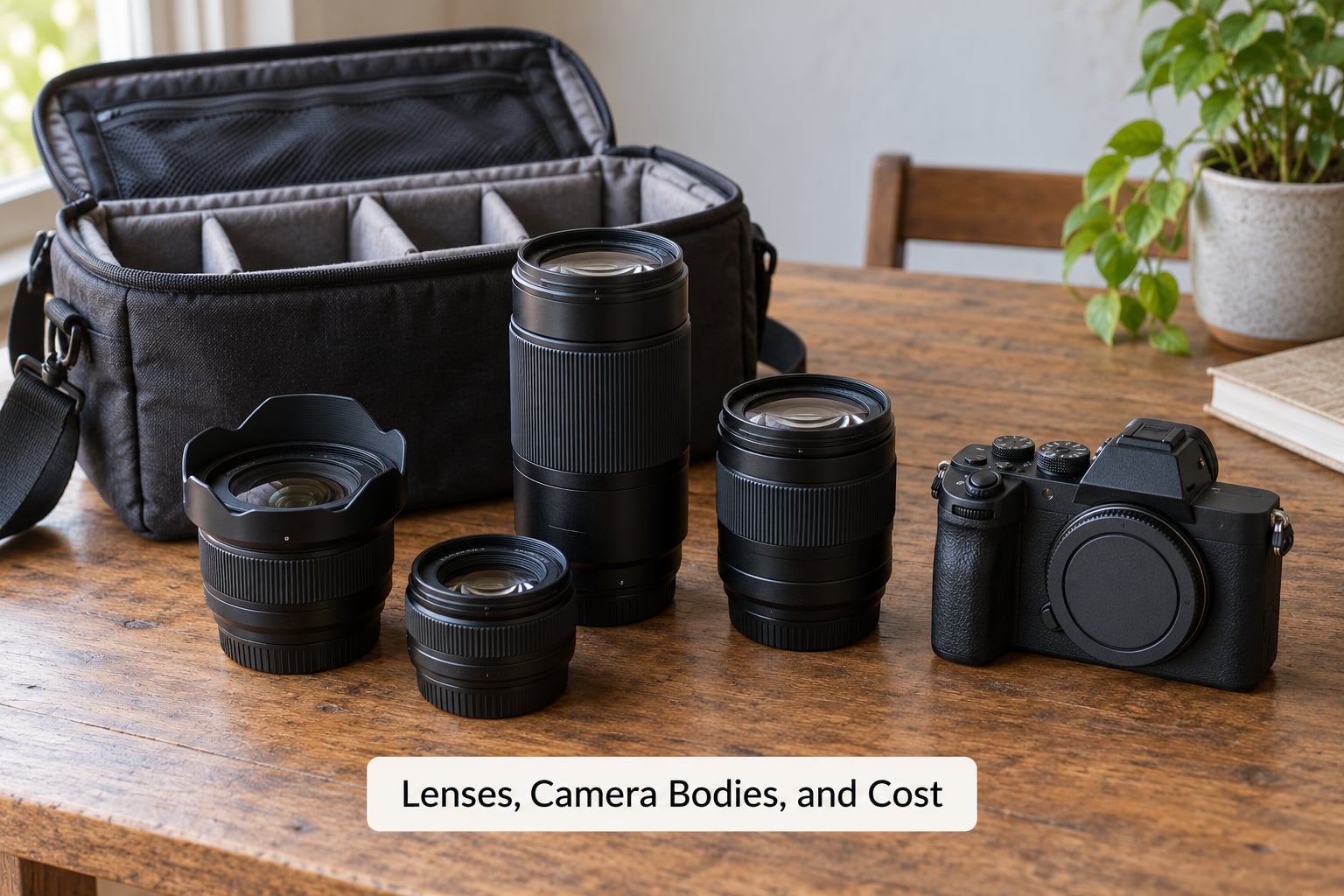
Buy the body last. The body is the cheapest part of a portrait kit, and the reason most photographers regret a format choice is that they spent the budget on the sensor instead of the glass.
Fast primes are where the money goes. An f/1.4 portrait lens costs far more on full frame than the compact f/1.4 available for APS-C, and you will want two of them plus a short zoom. Add lighting, a reflector, a stand and a decent tripod, and the body is a line item. A crop setup lets you put that saved money into lenses and light, which changes the photographs far more.
| Budget priority | Crop sensor | Full frame |
|---|---|---|
| Body | Lower | Higher |
| Fast portrait prime | Lower, smaller options | Higher, larger glass |
| Standard zoom | Lower | Higher |
| Lighting and modifiers | Same cost either way | Same cost either way |
| Battery count for a long day | Fewer bodies to carry, but check the rating | Heavier kit to carry all day |
Used bodies are where format switching gets cheap. Full-frame cameras from five or six years ago are common on the used market at a fraction of new cost, and they pair perfectly with modern fast primes. That makes a used full-frame body a reasonable way to test the format before committing to lenses.
Lens compatibility works in both directions, and it is more useful than most people realise. Any full-frame lens mounts on an APS-C body and uses only the central part of the image circle, with the sides cut away and the field of view cropped by 1.5x. This is often called crop mode. A 50mm on a full-frame body becomes an 85mm equivalent, handy for portraits on a hybrid camera.
The reverse does not work. An APS-C lens will not cover a full-frame sensor, so on a full-frame body it either refuses to mount or is forced into a restricted mode with heavy vignetting and an electronic crop. Several brands now allow a limited crop mode, which is useful for video framing, but it is not the same as mounting the lens normally.
Weight is a genuine factor. A full-frame body plus a fast prime is a heavier bag, and on a twelve-hour wedding day that shows up in your back. Plenty of professionals carry an APS-C body for travel and street work and a full-frame body for the ceremony, treating the two as tools rather than a ladder of progress.
On the upgrade path, crop is not a dead end. Full-frame lenses mount on crop bodies, so anything you buy for the future works now. The reverse trap is real: lenses bought for a crop-only system often cannot be used on full frame at all.
Which Should You Choose?
Start from the portrait you want to make, then work backwards to the format that makes it easier, then buy the lens before the body.
| Portrait style | Better fit | Why |
|---|---|---|
| Studio headshots | Either | Controlled light means either format exposes cleanly |
| Environmental portraits | Either | Deep depth of field is not a problem you have |
| Low-light receptions | Full frame | About a stop of cleaner files at ISO 6400 and above |
| Tight indoor spaces | Crop sensor | Reach helps you frame without backing into a wall |
| Window-light lifestyle | Crop sensor | Comfortable working distance and cheaper fast primes |
| Travel and street portraits | Crop sensor | Smaller, lighter, cheaper kit to carry daily |
| Outdoor location with big backgrounds | Full frame | Easier separation at the same framing and aperture |
| Video portrait work | Either | Decide on stabilisation, colour and your delivery format |
By photographer type, the answer narrows further.
- Beginners: crop sensor. Buy the lens and a light, learn the craft, and you will not have spent the money where it does nothing.
- Travel and street portraitists: crop sensor. You carry what you buy, and reach at 1.5x is a gift indoors.
- Studio portraitists: full frame if the budget allows, because control means you will use the shallow end of depth of field, but crop is not a compromise in a studio.
- Wedding photographers: full frame for the reception and low-light work. Many still carry a crop body as a second body for weight and reach.
- Wildlife and sports shooters: full frame, or crop if the reach is the priority. This is the one genre where the crop factor is the main event rather than a side effect.
- Anyone shooting in low light regularly: full frame. The stop of extra light is the argument that keeps holding up.
If your portraits look bad, sensor size is rarely the reason. Most of the time it is a slow lens, flat light, or the subject standing a metre from a busy background. Fix those first; they cost nothing to diagnose.
Frequently Asked Questions
Is a full-frame camera better for portraits?
For portraits, full frame makes shallow depth of field easier to achieve at the same framing and aperture, and it holds about a stop more detail in dim light. Neither format decides portrait quality on its own. Lens choice, lighting and subject-to-background distance usually make a bigger difference than sensor size.
Can a crop sensor create the same background blur as full frame?
Yes, with a wider aperture and a longer lens. At the same framing, an APS-C body needs roughly 1.5 stops more aperture to match full-frame blur, so f/2.8 on full frame compares to about f/1.8 on APS-C. A fast f/1.4 prime on a crop body gets very close, and background separation also depends heavily on distance between subject and background.
Do crop-sensor cameras use the same lenses as full-frame cameras?
Full-frame lenses work on crop-sensor bodies, though only the central part of the image circle is used and the field of view is cropped by the crop factor. The reverse fails: an APS-C lens cannot cover a full-frame sensor, so it either will not mount or shoots in a restricted crop mode with heavy vignetting.
Does full frame always produce sharper portrait images?
No. In good light both formats resolve plenty of detail for print, and a modern crop body with a good lens will look sharper than an older full-frame camera with a kit zoom. Full frame shows its advantage at high ISO, in very shallow depth of field, and when you crop hard into a high-resolution file.
What focal length should I use for portraits on a crop sensor?
Use 35mm for environmental portraits, 56mm for the classic head-and-shoulders frame, and around 90mm for tight portraits and compressed backgrounds. Those match the full-frame 50mm, 85mm and 135mm framings from the same position. On Canon bodies use roughly 31mm, 53mm and 85mm instead.
Is upgrading from a crop sensor to full frame worth it?
It is worth it if you shoot low light regularly, need maximum background separation at the same framing, or are replacing crop-only lenses you cannot move to full frame. If you mostly shoot in daylight and want to spend money on better lenses and lighting, a fast prime on your current body will improve the pictures more.
Conclusion
If you shoot people in dim light or want the strongest separation at a given framing, full frame is the right call. If you are building a kit on a budget, value reach, or want a camera you carry every day, crop sensor is the right call. Buy the lens first, because in crop sensor vs full frame for portraits the lens and the light decide the picture far more than the sensor does.