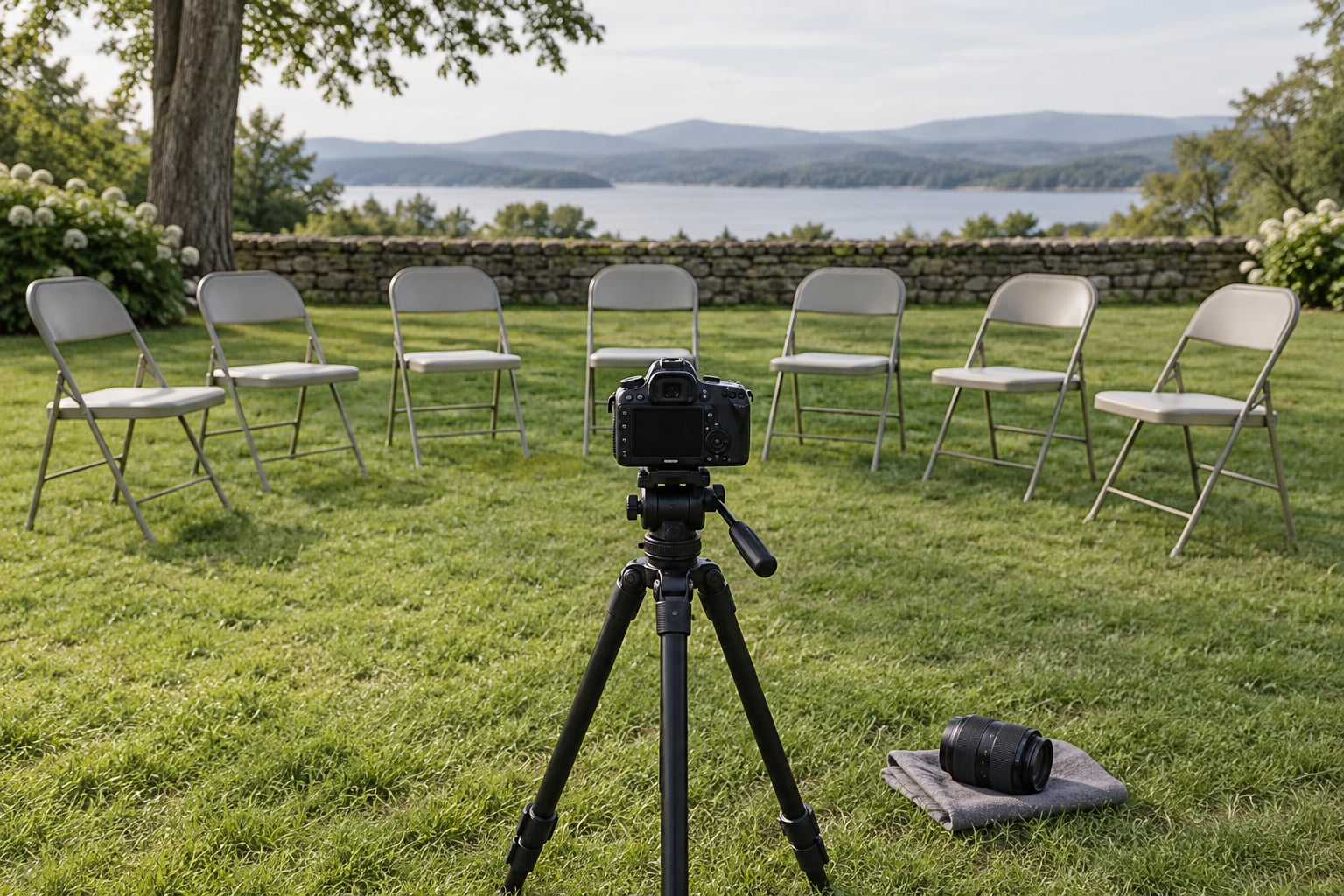
If you shoot one frame and everyone in it needs to look sharp, start at f/5.6 for a small group and f/8 once the people are stacked two or three rows deep. That is the short version of what aperture to use for group photos: aperture sets the depth of field, and depth of field decides how much of your group the camera can hold in focus at once.
The honest answer is that no single f-stop is correct for every group. Light level, how the people are arranged in depth, how fast they move and whether you care more about a clean background than edge-to-edge sharpness all pull the answer in different directions. What follows is a set of dependable starting points, plus the reasoning behind each one so you can adjust when the situation changes.
It helps to have the exposure triangle straight before going further: one setting controls depth of field, one controls motion, one controls brightness. This guide assumes you know what each one does.
Table of Contents
- What Aperture to Use for Group Photos as a Starting Point
- How Group Size Changes the Best Aperture
- What Aperture to Use in Bright Light
- What Aperture to Use Indoors or in Low Light
- How Focal Length, Distance, and Aperture Work Together
- How to Choose Aperture Without Losing Sharpness
- When to Use f/2.8, f/4, f/5.6, or f/8
- Common Aperture Mistakes in Group Photos
- A Quick Setting Recipe for Different Group Photos
- Frequently Asked Questions
- The Short Answer for Your Next Group Photo
What Aperture to Use for Group Photos as a Starting Point
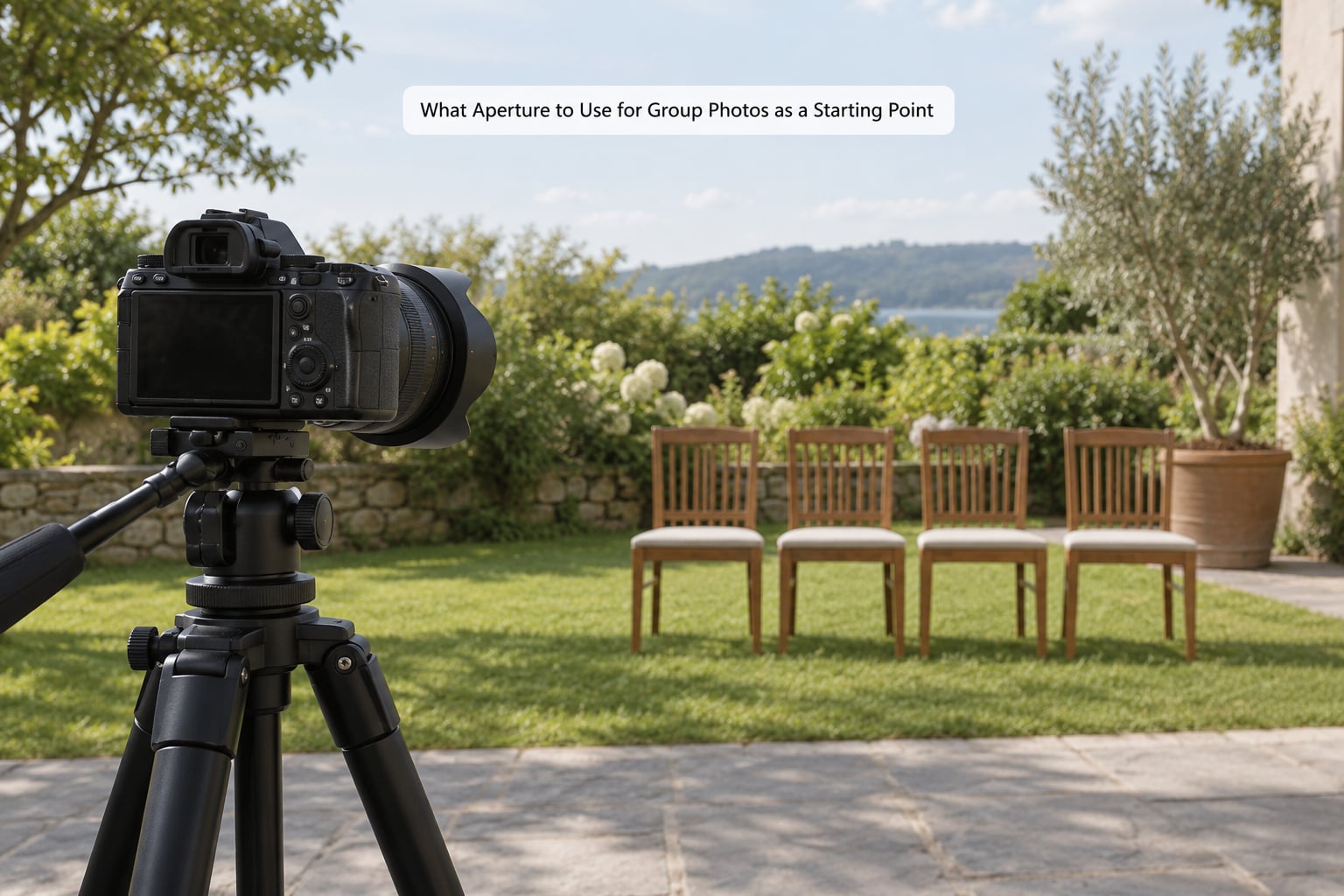
Three numbers cover most situations. For one or two people standing shoulder to shoulder, f/4 to f/5.6 is plenty. For a group arranged across two rows, open up to f/5.6 and often f/8. For three rows or more, or any arrangement where the nearest and farthest person are more than about a metre apart, f/8 to f/11 is where I usually land.
Aperture is only one corner of the exposure triangle, though. Every step you close the iris costs you light, and that light has to come from somewhere: a slower shutter speed, a higher ISO, or more illumination. That trade is the whole game. Close down to f/11 in a dim living room and you will be pushing ISO high enough to get grainy files, or your shutter slow enough that nobody stays still.
Two other factors sit alongside aperture. Focal length changes how much of the scene fits and how much background blur you get at the same f-number. Subject distance does the same, often more dramatically. Get those two right and you can stay at f/5.6 for more people than you would expect.
How Group Size Changes the Best Aperture
Depth of field is the slab of the scene that looks acceptably sharp. Its thickness grows as you close the aperture down, and it also grows if you pull back from the group or use a shorter lens. For group work, the number that matters is not the headcount but the depth the group occupies.
Two people standing side by side are effectively a single plane. Even f/2.8 can hold both faces sharp. Six people on a bench are still close to one plane, but children at the ends lean, sit down or turn, and the depth grows fast. Thirty people on three risers span several metres front to back, and no lens at a fun f-number will hold that together.
Here is a practical reference table. Treat the numbers as starting points, then check the far face on your camera screen before you shoot.
| Group arrangement | Aperture to start at | Where to focus | Minimum shutter speed |
|---|---|---|---|
| 2 people, single row | f/4 to f/5.6 | Between the two faces | 1/250s |
| 3 to 5 people, one row | f/5.6 | Middle of the row | 1/250s |
| 6 to 10 people, two rows | f/5.6 to f/8 | Front row, centre | 1/320s |
| 10 to 20 people, staggered | f/8 | Front row, centre | 1/320s |
| 20 plus, three rows or risers | f/8 to f/11 | Middle of the front row | 1/500s |
Notice what changes between rows: not only the aperture but the focus point and the minimum shutter speed. Beginners often fix the shutter speed and aperture and then change the ISO, and they forget that a group with children in it needs a faster shutter than the group standing still outside a church.
How many rows should you actually use?
Fewer rows is almost always the better answer. If twelve people can be arranged in one slightly curved line, you can shoot at f/5.6 from a longer distance with a clean background. The same twelve in three rows needs f/8 or f/11, and the front row may start losing light that the back row is getting. Arrangement beats aperture every time.
What Aperture to Use in Bright Light
Outdoors on a sunny day, f/4 to f/8 is comfortable. You have more light than you need, so you can close down for depth of field without touching ISO, and if the sun is high and hard you will usually want to anyway because the contrast between sunlit faces and shaded ones is brutal.
The risk in bright light is running out of shutter speed. Once you are at f/8 in full sun, a fast lens at ISO 100 can push you past 1/1000s, which is more than most group portraits need but not so fast that it becomes a problem. Neutral density filters solve this when you want f/2.8 in daylight for a soft background, since they let you use a wide aperture without overexposing.
Bright indoor spaces with big windows behave similarly to outdoors, with one difference: light falls off fast. A group lined up parallel to a window has bright faces at one end and soft faces at the other. Rotate the group so they face the window instead of standing beside it, or move everyone several metres back.
If the background is busy and you are stuck at f/5.6 because of the light, change position rather than aperture. A few steps to one side usually removes a distracting sign or a railing, and it costs nothing.
What Aperture to Use Indoors or in Low Light
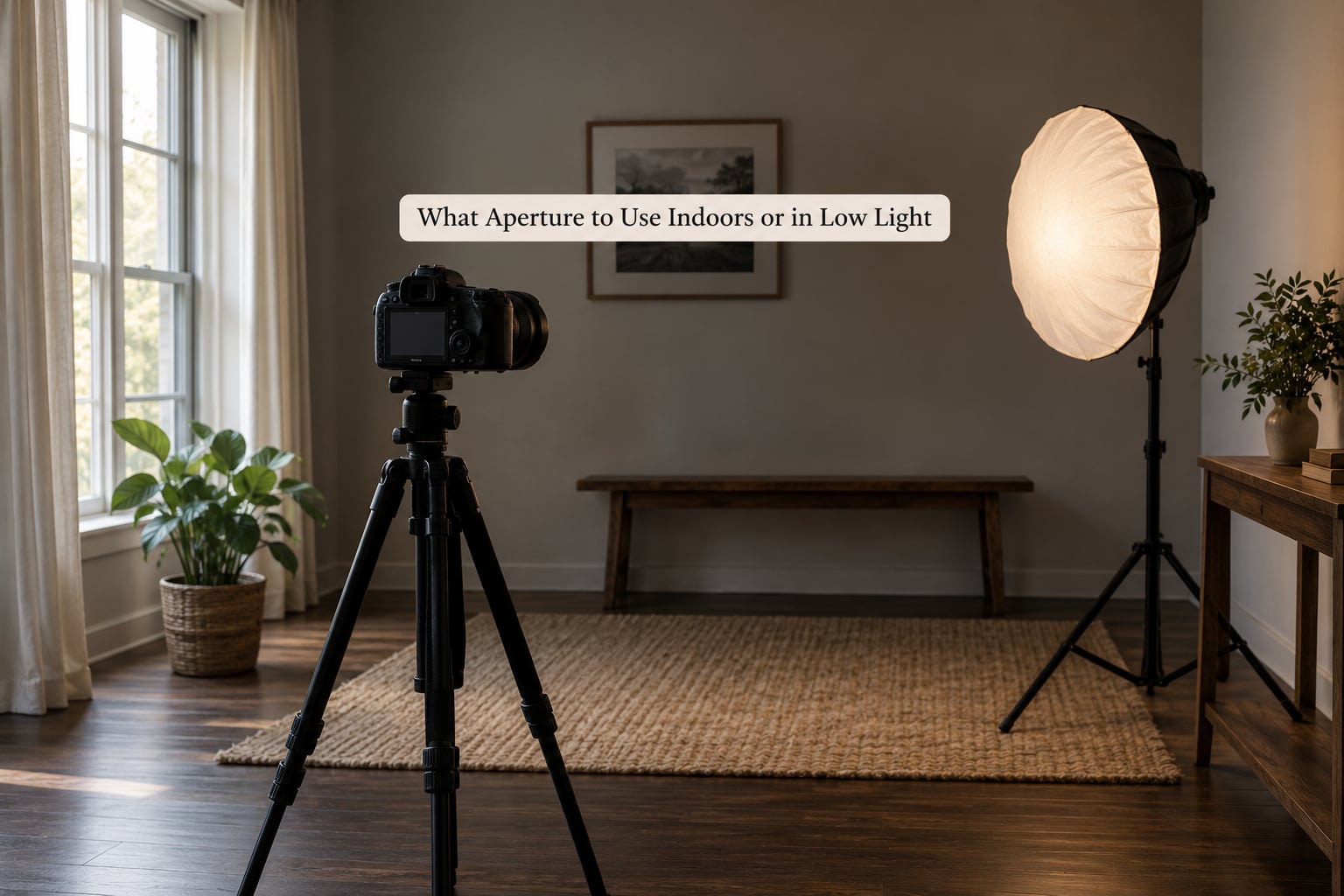
Indoors, shutter speed is the constraint. People blink, sway and turn heads constantly, and below about 1/125s you start losing eyes and smiles to motion blur no matter how good the focus is. So indoors the aperture is whatever you can afford after you have set the shutter speed you need.
For a small group near a window, f/4 to f/5.6 at 1/200s or faster and an ISO in the range of 800 to 3200 is a realistic starting point depending on how dark the room is. When light drops further, open to f/2.8 rather than dropping the shutter speed. A little background blur and a clean ISO are a better photograph than a perfectly sharp frame at 1/30s.
Going past f/5.6 indoors has to be earned. At f/8 you lose roughly a third of the light compared with f/5.6, which usually means either ISO 6400 and visible noise or a shutter speed your subjects cannot hold. Past f/11 you also start losing corner sharpness to diffraction, the softening that happens when light passes through the very edge of the aperture opening.
Adding light is the fix that photographers skip. A bounced flash pointed at the ceiling from beside the camera gives soft, even illumination across a whole group at f/8, which is the classic indoor workflow. A small diffuser or a white bedsheet over a window does the same job with more subtlety, and it is usually the cheapest fix available in a room you do not control.
How Focal Length, Distance, and Aperture Work Together
The same f-number gives a different result in different situations, which is why advice that ignores focal length and distance gets argued about online. A 35mm lens at f/4 held four metres from a group of five behaves like a much smaller aperture would on a longer lens. Swap to a 70-200mm at f/4 from six metres and the background melts away while the front and back faces fall outside focus.
The rule of thumb photographers use: your safe shutter speed is roughly one over twice your focal length. A 50mm lens wants 1/100s or faster, a 200mm lens wants 1/400s or faster. That is also why moving back with a longer lens is often the single best adjustment you can make in low light. You gain background separation and you can afford a slower shutter, both at once.
Sensor size changes the arithmetic too. An APS-C or Micro Four Thirds camera sees the same framing from a wider lens on full frame, and because the focal length is shorter, depth of field is deeper at any given f-number. Practically, a full-frame body needs roughly one stop more open than an APS-C body to match depth of field at the same framing and viewing angle.
| Sensor | Crop factor | Equivalent to reach the same depth of field |
|---|---|---|
| Full frame | 1x | f/4 |
| APS-C | 1.5x | f/6.3 |
| Micro Four Thirds | 2x | f/8 |
That is why someone shooting a family of six at f/4 on a full-frame camera gets soft back rows, while the same framing on a smaller sensor looks acceptably sharp. It is the same scene, and neither photographer is doing anything wrong.
Two habits cause most of the trouble. The first is stepping close with a wide lens, which stretches faces at the edges and exaggerates noses. Moving back and using a longer lens fixes both the distortion and the depth of field. The second is letting a group curve into a shallow U shape, which spreads the outer people far deeper than the middle. A slight arc is fine; a strong curve is what ruins a shot.
How to Choose Aperture Without Losing Sharpness
Here is the workflow I run through before every group frame. It takes about fifteen seconds.
- Measure the group depth. Look at the nearest and farthest person and judge the distance between them. Headcount is a proxy; actual depth is what the camera has to cover.
- Pick the aperture that covers that depth. Use the table above, then open up one stop if the light is poor and you can accept softer edges.
- Set the shutter speed. Choose a value based on movement, not on the aperture. Kids and pets need 1/320s or faster. Still adults can hold 1/125s.
- Raise ISO to fill the rest. Modern sensors handle ISO 3200 well. Noise in the shadows is far less noticeable than a blurred face.
- Focus on the middle of the front row. Not the closest face, and not the nearest edge of the frame.
- Zoom in on the farthest face. Check it at 100 percent on the rear screen before you shoot. If it is soft, close down one stop and re-check.
When the depth of field is narrow and you cannot afford to stop down, focus placement matters more. Manual focus with a single point set slightly behind the middle of the front row puts the middle of the group on the focal plane and lets the outer edges fall either side of it. Zone focusing on a prime lens works the same way, with the marked depth zone aligned to the group.
Shoot in burst mode too. It does nothing for focus, but it solves blinking, which ruins more group frames than bad aperture ever will.
When to Use f/2.8, f/4, f/5.6, or f/8
f/2.8 is for separation and low light. Use it for two people, for a couple, or for any indoor group when the shutter speed you need cannot be reached at f/4. The trade is explicit: you are accepting that only a thin slab of the group is sharp, so keep everyone close to one plane or the edges will disappoint you.
f/4 suits small to medium groups, typically two to five people on one plane, and it is a reasonable indoor choice when light allows. It still softens the background enough to separate a group from a busy room.
f/5.6 is the most versatile setting for group work. It holds a modest family group on one row sharp, it lets in enough light to hold a workable shutter speed indoors, and it sits close to the sharp zone of most lenses.
f/8 is for wide arrangements, two rows and up, and bright outdoor light. It costs about a stop of light against f/5.6, so indoors you pay for it in ISO or shutter speed. Many photographers also find f/8 to f/11 the sweet spot where a lens renders its finest detail, though results vary lens by lens.
Beyond f/11 you are trading real sharpness for depth of field you rarely need. Past f/16, diffraction softens the whole frame, not just the corners. If a group of thirty genuinely will not fit in focus at f/11, the answer is distance and arrangement rather than f/22.
Common Aperture Mistakes in Group Photos
Only the front row is sharp. You focused on the closest face and opened up too far. Move back, close down one stop, and focus in the middle of the front row rather than the person nearest the camera.
Faces at the edges of the frame look soft. This is a corner sharpness issue, not a depth of field issue. Stop down one stop and check the corners again on the screen. If they stay soft at f/5.6, the lens is the problem and no aperture setting will rescue it.
The background is distracting. Do not open the aperture. Move the group, change your angle, or step closer to put more distance between the group and the background. A wider aperture only softens clutter if you are also far enough away for it to blur.
Everyone is blurry from movement. Aperture was too closed for the light. Raise the shutter speed and ISO before you stop down further, and ask people to hold still for a beat rather than trying to freeze them mid-sentence.
The file is noisy. You bought depth of field with too much ISO. Bounce a flash or move to open shade instead, and check whether you can rearrange the group onto one plane.
The lens hunts for focus repeatedly. That is usually a low-contrast scene, not a settings problem. Turn on continuous autofocus, add light to give the camera something to lock onto, or switch to a single autofocus point placed on a face. A flare shooting across the front of the lens causes the same behaviour, so keep the hood on.
A Quick Setting Recipe for Different Group Photos
Adjust these for the light in front of you, but they are reliable places to begin.
- Two to three people, outdoor portrait. f/4, 1/320s, Auto ISO capped around 400, single-point autofocus on the nearest face. Lens: 85mm or 50mm from several metres back.
- Family of four to six, outdoors in shade. f/5.6, 1/250s, Auto ISO, focus on the middle of the front row. Lens: 35mm or 50mm.
- Family session indoors by a window. f/4 to f/5.6, 1/200s, ISO 800 to 3200, focus on the centre of the row closest to you. Keep the group within a metre or so of the focal plane, or use a bounced flash at f/8.
- Wedding or event group, two rows. f/5.6 to f/8, 1/320s, Auto ISO, focus on the front row centre, burst mode on.
- Large assembly, three rows or risers. f/8 to f/11, 1/500s, Auto ISO with a sensible ceiling, tripod and a two-second timer so you can be in the frame yourself.
Stabilisation helps with camera shake but does nothing when your subject moves. If a group contains children, spend your light budget on shutter speed rather than assuming in-lens stabilisation will save the frame.
Frequently Asked Questions
What is the best aperture for a group of people?
For a group standing on one plane, f/4 to f/5.6 holds everyone sharp and keeps some background blur. Two rows usually need f/5.6 to f/8, and three rows or risers need f/8 to f/11. Check the farthest face at full size on your screen before shooting, and remember that closing down costs light you will pay for in shutter speed or ISO.
Is f/2.8 better than f/5.6 for group photos?
f/2.8 is better when you want the background to disappear or when you are short on light and need a faster shutter speed. f/5.6 is better when you need more of the group sharp front to back. With children moving around, f/2.8 at 1/250s often produces a sharper result than f/5.6 at 1/60s, because motion blur ruins a frame faster than shallow depth of field does.
Should I use f/5.6 or f/8 for a large group?
For a group across two rows, f/5.6 is enough if you shoot from far enough back. For three rows, risers, or any arrangement spanning several metres, go to f/8. The cost is roughly one stop of light, which in bright outdoor light is free, and indoors means a higher ISO or a bounced flash. Focus on the middle of the front row rather than the closest face.
How do I keep everyone in a group photo sharp?
Four things do most of the work. Close the aperture enough to cover the depth the group occupies, step back so the depth shrinks, arrange people in a shallow arc instead of a curve, and focus on the middle of the front row. Then zoom in on the farthest face on your camera screen to confirm. Burst mode fixes blinking, which sharpness settings cannot.
What shutter speed should I use for group photos?
Use 1/250s as a floor for adults standing still, 1/320s to 1/500s for groups with children or pets, and 1/500s or faster for large assemblies where people keep shifting. Stay near or above one over twice your focal length as a minimum. If the required speed forces ISO very high indoors, add light with a bounced flash rather than slowing down.
Does aperture determine background blur in group portraits?
Aperture contributes, but it is only one of three factors. Focal length and shooting distance do most of the work: move closer or use a longer lens and the background separates far more than opening up the iris alone. At the same framing, a wide lens at f/4 can blur less than a long lens at f/4, which is why stepping back is often the better move.
The Short Answer for Your Next Group Photo
On arrival, look at how deep the group actually is rather than counting heads. One row means f/5.6, two rows means f/5.6 to f/8, three rows means f/8 or wider. Then set the shutter speed for the least still person in the frame, let ISO take up the slack, focus on the middle of the front row, and check the farthest face at full size before you shoot.
If the frame is not working, change your position before your settings. Stepping back two metres or turning the group slightly often solves more group photo problems than any aperture choice.