Learning how to apply for a photography grant comes down to four things a panel can check: a project that is genuinely unfinished, a budget that shows real research, images sequenced as an argument, and a clear reason you are the person who should make it. Most applications fail on logistics rather than on the pictures — a missed eligibility line, an oversized file, a statement promising far more than the budget funds.
Set aside two to six weeks for a serious application, assuming the project already exists in draft form. The workflow below is the same one grant writers and photo editors use when they sit down with a deadline.
- Define the project and the audience it serves.
- Research funders and check every eligibility line.
- Write a short narrative that states what the work is.
- Build an itemized budget and a month-by-month schedule.
- Sequence images that demonstrate the approach you plan to use.
- Re-read the guidelines and remove every contradiction.
- Submit early, keep records, and follow up once.
Table of Contents
- What You Need
- Step-by-Step: How to Apply for a Photography Grant
- 1. Define the project and its public value
- 2. Research grants and verify eligibility
- 3. Develop a strong project narrative
- 4. Build a realistic budget and work plan
- 5. Prepare a relevant portfolio and sample images
- 6. Revise for clarity and grant requirements
- 7. Submit, track, and follow up professionally
- Common Mistakes
- Frequently Asked Questions
- Who is eligible for a photography grant?
- How long should a photography grant statement be?
- Do emerging photographers without a track record stand a chance?
- Does offering matching funds make an application stronger?
- What should I do after a photography grant rejection?
- What happens after you win a photography grant?
- Conclusion
What You Need
Grant panels score documents, so prepare these before you open the application form. Anything you assemble in advance turns a writing task into an assembly task.
- A project concept in two sentences. The subject, the place, and the gap your work fills.
- Research that proves the topic matters. Field notes, interviews, prior reporting, existing coverage of the subject.
- A body of sample images that shows the visual language, not just your personal favorites.
- An itemized budget with quantities, day rates and a contingency line.
- A timeline showing production, post-production and dissemination phases.
- Eligibility details: where you live, where you shoot, your career stage, and any registration or nonprofit status a funder requires.
- Supporting documents: a short CV, an artist statement, and one or two recommendation letters.
Step-by-Step: How to Apply for a Photography Grant
1. Define the project and its public value
Start with the honest state of the work. Grant makers fund completion, not exploration, so a project you finished five years ago is a hard sell unless the funding extends its reach.
Write one paragraph naming the audience, the change or record the project produces, and why a photograph is the right instrument for it. If you cannot name who reads or stands to benefit from the work, the proposal will feel thin no matter how strong the images are.
2. Research grants and verify eligibility
Search by subject and by funder, not just by the word photography. Foundations fund environment, migration, health, labor and community stories; arts councils fund individual artists; photo nonprofits fund documentary and human rights work.
Before you write a word, check the eligibility section line by line. Age caps, residency requirements, geographic limits on where you may shoot, tax status and prior-award restrictions will disqualify more applications than weak writing does.
Read two or three years of that funder’s past recipients. You are looking for overlap between your subject and theirs, and for the scale of projects they actually fund. An application that matches their history lands better than a more beautiful one that ignores it.
3. Develop a strong project narrative
Keep the project summary short and factual: what happens, where, when, how many shooting days, and what comes out the other end. Grant panels read quickly, and the first two sentences of a statement get the most attention.
Then explain why you. Cite access you have earned, relationships with subjects, language skills, prior work on the same issue, or a track record of finishing. Funders are investing in a person as much as an idea, so credibility counts as heavily as concept.
4. Build a realistic budget and work plan
Itemize everything. Round numbers across the whole sheet read as guesswork; researched figures read as planning.
- Travel: flights, ground transport, accommodation, per diems, and the number of days.
- Production: fixers, translators, assistants, local guides, permits and location fees.
- Equipment: rental bodies, lenses, lighting and hard cases, with a stated ownership position.
- Post-production: editing hours, retouching, color grading, transcription and translation.
- Permissions and insurance: model releases, property releases, equipment insurance, and any fee a site requires.
- Dissemination: printing, book or layout costs, exhibition framing, shipping, a website or platform fee.
- Contingency: a percentage you can justify in one sentence.
Pair the budget with a month-by-month schedule. Panels judge feasibility, and a schedule that shows shooting, editing and outreach overlapping sensibly answers the question before they ask it.
5. Prepare a relevant portfolio and sample images
Sequence images as an argument rather than a timeline. A useful frame opens with an establishing view that sets place and scale, moves into specific detail that carries the story, then closes on a reframe that shows what changed. That shape reads as deliberate editing to anyone scanning quickly.
Include captions with names, dates and locations, and cut anything that does not advance the argument. Follow the funder’s file count and file size exactly; oversized uploads fail silently and cost you the application.
6. Revise for clarity and grant requirements
The most common rejection reason is a contradiction. Your statement describes a national story while your budget covers three days of travel. Your timeline ends in four months while dissemination is scheduled for month seven. Read the two documents side by side and fix every mismatch.
Also check word limits, question order, required naming conventions, file formats, and whether the form asks for a short answer in a box that holds two lines. Answer in the order asked, using the funder’s own terminology back to them.
7. Submit, track, and follow up professionally
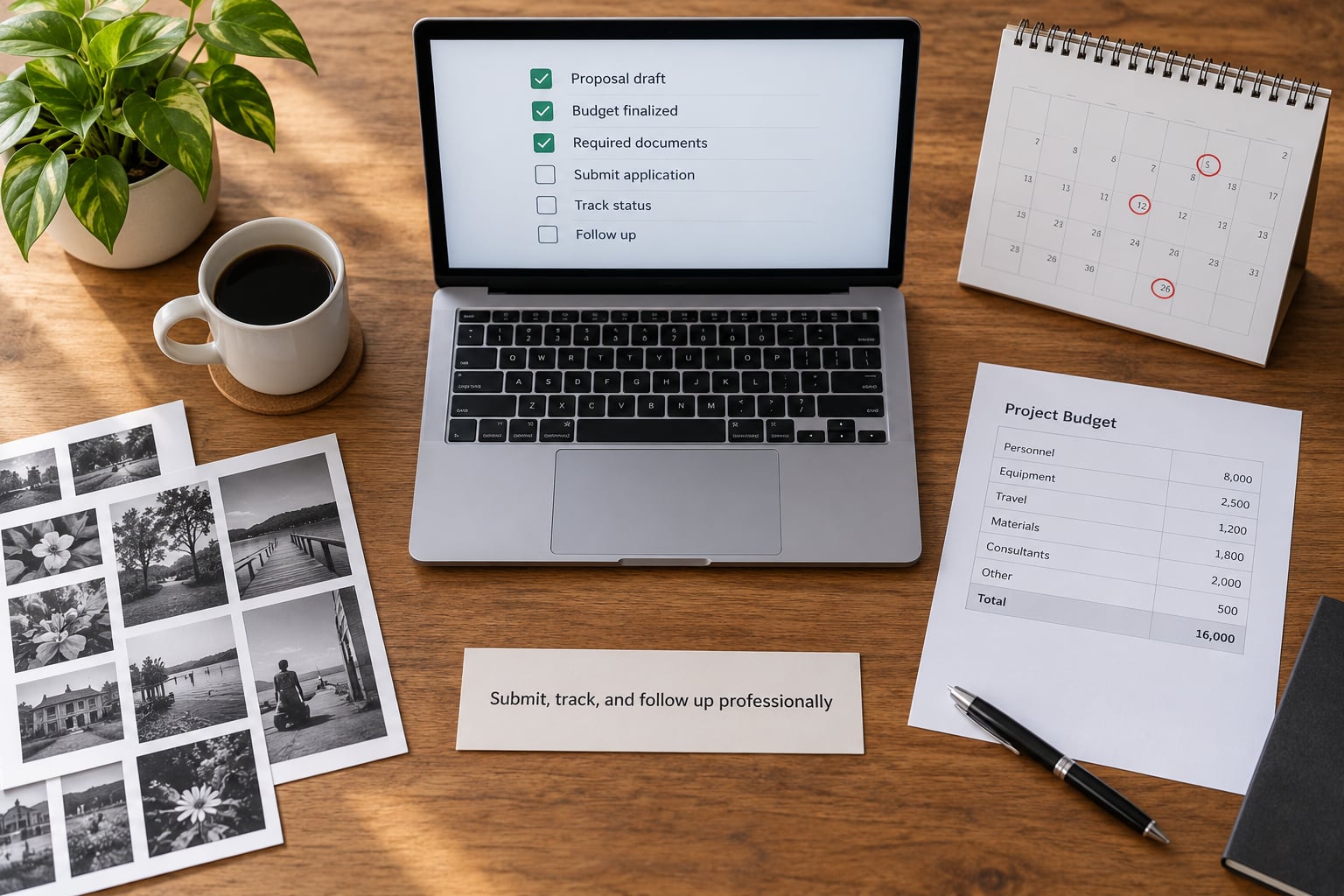
Submit at least a day before the deadline and save the confirmation email. Panels sometimes close a portal early, and a technical failure on the final evening is a common and avoidable loss.
Log each application in a calendar with the funder name, deadline, amount requested and decision date. If you receive a decision you did not expect, one polite follow-up is acceptable. Asking what would have strengthened the project is better received than asking why you lost, and asking twice is not acceptable.
Common Mistakes
Treating the whole finished archive as the proposal. Funders pay for what is left to do. Cut work you already completed and describe the next chapter.
Writing in curatorial language. Panels include program officers, not critics. Prefer plain sentences about place, access and outcome over phrasing that hides the idea behind atmosphere.
Budgeting a round trip with a round number. Break costs into days and units. Precision is evidence of research.
Leaving out permissions, insurance and transcription. These are the line items reviewers notice as missing most often, especially for work involving vulnerable subjects.
Submitting images in chronological order. A narrative sequence says you planned the argument. A date order says you opened a folder.
Copying a proposal between funders. Tailor the subject, scale and outcome to each mission. Panels can tell, and it reads as mass application.
Saying you will photograph a community without explaining how they participate. Grants increasingly ask how subjects are engaged and how consent is handled. Two honest sentences beat silence.
Stopping after the first rejection. Treat a no as information. Many working photographers apply repeatedly before a first award, and each resubmission should carry one specific change.
Two habits help more than any trick: write the first two sentences last, once you know the whole proposal, and build the deadline backwards from the day the project finishes, not forwards from today.
Frequently Asked Questions
Who is eligible for a photography grant?
Eligibility depends on the funder, and most rules are narrow. Common conditions include living or working in a specific country, state or region, being at a set career stage such as emerging or mid-career, holding a nonprofit or tax-exempt status, and shooting inside a designated country. Some funds also cap prior awards or exclude applicants who received another award in the same cycle. Read the eligibility section first and confirm you meet every line, since panels often discard applications that fail a single condition.
How long should a photography grant statement be?
Follow the limit in the guidelines exactly, and assume the panel is reading on a phone between other applications. Most forms want a short project summary of roughly 150 to 300 words plus a longer statement of 500 to 800 words when space allows. Panels rarely read past the first two sentences carefully, so put the subject, the place and the outcome there. If no limit is given, keep the summary under 250 words.
Do emerging photographers without a track record stand a chance?
Yes, and many funds exist specifically for that stage. What matters is whether you can show finished bodies of work, access to your subjects, and a credible plan for the funded phase. Build the case with a small, tight portfolio, a short CV, and two recommendation letters that speak to reliability and commitment rather than talent in the abstract. Applying early to emerging-photographer programs and regional funds tends to work better than aiming at national programs with a very thin record.
Does offering matching funds make an application stronger?
Sometimes, and only when the match is documented. Panels want to see that the project is not dependent on one award, so a confirmed match from a partner, in-kind support or saved personal funds can strengthen a proposal. Weak matches weaken it: vague pledges, unattached letters and figures you cannot explain tend to read as padding. State what each matching amount covers, who provides it and whether it is secured. If the funding is not yet confirmed, say so plainly rather than presenting it as committed.
What should I do after a photography grant rejection?
Read the decision letter carefully, even when it is short, since panels often note a specific weakness such as a thin portfolio or a mismatched budget. Wait the stated period before resubmitting to the same funder, and change one thing rather than rewriting everything. Keep the version you submitted and note what you would cut or sharpen next time. Then apply elsewhere with the same project, because a rejection from one panel is weak evidence about the work itself and a useful signal about the packaging.
What happens after you win a photography grant?
Expect paperwork and reporting duties before you touch the camera. Most funders require a signed agreement, proof of insurance, sometimes a fiscal sponsor or nonprofit host, and a bank account in the correct name. You will normally submit progress reports, deliver images or files on a schedule, keep receipts for every expense, and return unused funds. Many programs also expect dissemination, such as a publication, exhibition, workshop or teaching outcome. Read the agreement carefully before spending anything, because the conditions are part of the award.
Conclusion
Start by picking one funder whose past recipients resemble your subject, then write a 200-word project summary before anything else. If that summary cannot explain the subject, the audience and the outcome in plain language, the rest of the application will not rescue it.