Teens do not hate photos. They hate being told what to do while a camera points at their face, and they hate performing a smile on command. Learn how to photograph teenagers who hate photos by taking the control away: agree on the rules, give them a job to do instead of a pose to hold, and let the session end before they want it to end.
That reframe matters more than any gear. Parents who beg their kid to smile get a grimace. Parents who hand over the plan get a kid who wanders back into frame ten minutes later, which is usually where the good frame lives.
A full session with a resistant teenager takes about 20 minutes of setup and 15 minutes of shooting. No experience is required, and a phone is genuinely enough.
Table of Contents
- What You Need
- Step-by-Step: How to Photograph Teenagers Who Hate Photos
- Common Mistakes
- Frequently Asked Questions
- What if a teenager refuses to smile during a photo session?
- How can I take good photos of my teenager at home with just a phone?
- Should I photograph a teenager without letting them choose what is shown?
- How long should a portrait session with a teenager last?
- What poses work for teenagers who dislike being photographed?
- How do I give a teenager space without making them feel ignored?
- Conclusion
What You Need
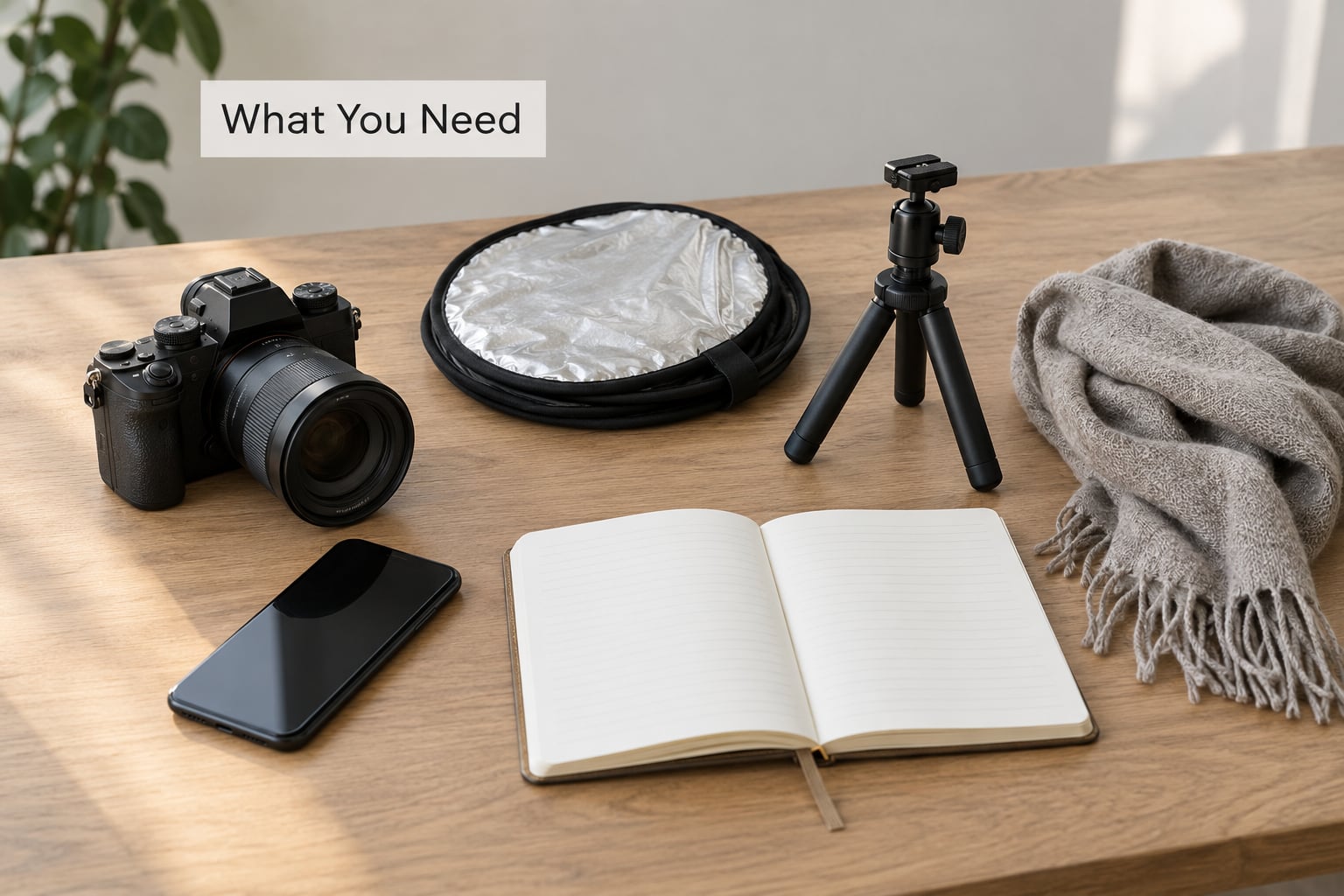
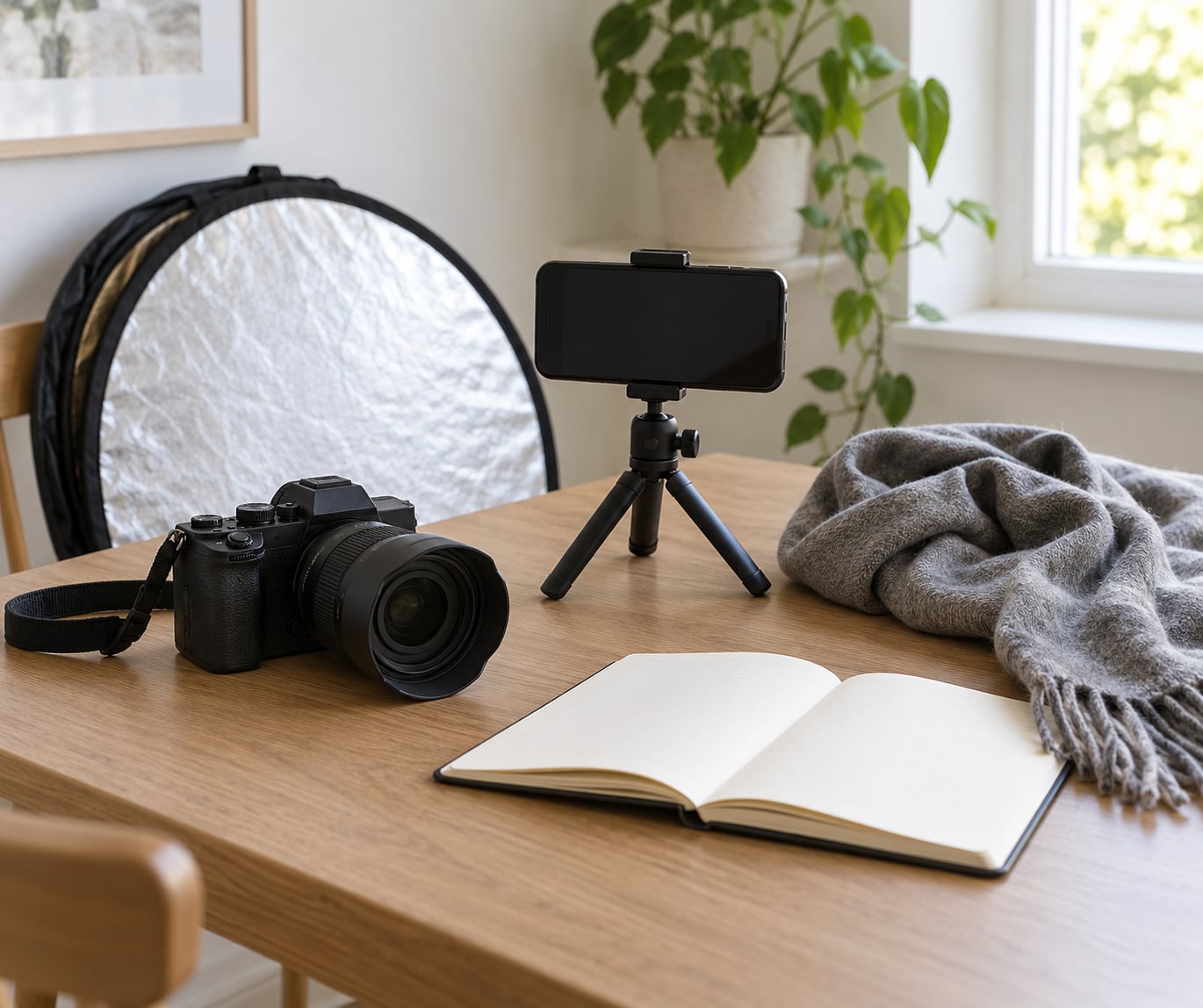
You need far less than a gear list suggests. The camera matters far less than the light and the agreement you make before you lift it.
- Any camera that starts fast. A phone with a recent phone-camera app or a mirrorless body with eye-detect autofocus both handle movement. The second you spend fiddling with menus is a second the teenager spends looking at the ceiling.
- Open shade. The wall of a building at 4 p.m., the edge of a carport, a bright room two steps back from a window. Open shade flattens skin and lets them move without squinting.
- A familiar location. Their room, the driveway, the kitchen table, the trail they already walk. Novelty reads as a photo shoot. Familiarity reads as an ordinary afternoon.
- Two or three props. Their actual headphones, a skateboard, a coffee mug, a dog. Props they chose and already own feel like them. Borrowed props feel like a school assembly.
- A reflector or a pale wall. Optional, and usually the wall behind you. A white sheet held by someone who is not the photographer is the budget version.
- A spoken agreement. Two things, out loud: how long it lasts, and what happens to the pictures afterwards. This is the item people skip and the one that decides whether the session works.
Skip the reflector if the light is already even, and skip the tripod if you intend to move with them. A tripod you leave behind is a tripod they lean against to look at your screen.
Step-by-Step: How to Photograph Teenagers Who Hate Photos
The process below runs in order, and each step has a sign that it is working. Skip ahead and the teenager feels managed again.
1. Ask Permission and Set the Agenda
Start before the camera comes out. Ask, not assume: do you want to try this for fifteen minutes, and you can say stop at any point?
Hand them real choices rather than empty permission. Would they rather be at home or outside. Should it be quick and loose or a bit more careful. Do they want their face in most of the pictures or is it fine if some frames are hands, shoes, and the back of their head.
That last one matters. Offering non-face frames is the single most effective move for a teenager who is anxious about their appearance, and many of them will take it.
How you know it is working: they answer with specifics, or they negotiate. A teenager who argues about the details is a teenager who has decided to participate.
2. Start With Conversation, Not the Camera
Put the camera down for the first few minutes and talk about something that is not the session. Their week, a show they are watching, a game, a friend, a complaint about a teacher.
Photographers on portrait photography forums describe the same pattern: teens open up once you stop directing and give them a task instead. The camera staying on the table is what makes the task land.
Watch how they hold themselves before you change anything. Shoulders already dropped and hands busy means you barely need to direct later. Shoulders up and arms crossed means the first prompt should be movement, not a closer portrait.
How you know it is working: you catch them laughing at something that is not about the camera. Photograph immediately, from further back, and do not announce it.
3. Use Familiar Places and Simple Compositions
Choose somewhere they already spend time and keep the background boring. A busy wall competes with a face, and a teenager who feels like the frame is against them will read that too.
Keep the lens at a normal or slightly tight focal length, roughly 50mm to 85mm equivalent on a phone, because wide lenses stretch the edges of the face. This is not flattering, and it is one of the few technical facts worth knowing here.
For light, three conditions cover most of it.
| Light | Settings to start | Why it works with teens |
|---|---|---|
| Open shade | f/2 or f/2.8, 1/500s, eye autofocus, burst | Even light means no squinting and no fixating on brightness, so they can keep moving. |
| Golden hour | f/2, 1/500s, back button focus, burst | Warm side light and a little rim light on hair; it also gives them somewhere interesting to look. |
| Overcast | f/2, 1/250s, eye autofocus | The sky acts as a giant softbox. Fewer settings to change means less time off-task. |
Turn on burst mode and hold it during movement. Half the battle with an active teenager is catching the two seconds where they stop being self-conscious, and burst is what catches it.
How you know it is working: you are taking fewer than twenty frames a minute. If you are firing continuously, something about the set-up is wrong.
4. Replace Poses With Gentle Prompts
A pose is a fixed shape they hold until it looks stiff. A prompt is a small task they perform, and they forget the camera while they do it. Say the prompt once, let it play out for ten seconds, then move on.
These are the prompts photographers actually use, with the situation each one suits.
| Say this | Use it when |
|---|---|
| “Walk toward me and stop when I say.” | You need a walk-in sequence; it produces natural foot placement. |
| “If this was your Instagram post, what would you do?” | You want them to direct you. Teen photographers, designers and skaters light up here. |
| “Show me how you’d fix that headphone cable.” | Hands are busy and eyes are down. Great for hands, jewellery and moody frames. |
| “Lean in and tell me the worst thing on the menu here.” | They are out with friends and you want a real expression instead of a camera stare. |
| “Look at that sign and tell me if it’s a bad sign.” | Eye contact with the lens feels performative; looking at an object does not. |
| “Throw the ball at the wall. Again.” | Sport or skate session, or anyone who owns a ball. |
| “Put the hoodie on. Slowly.” | Wardrobe changes look staged; movement through clothing does not. |
| “Show me your most recent project.” | They have a hobby, a game, a track, a drawing. Let them explain it. |
| “Just breathe. I’m not taking anything for a second.” | They froze up. Put the camera down, wait ten seconds, lift it slowly. |
| “C’mere, hug me for two seconds.” | Only if they are the ones who initiated physical contact in the last five minutes. |
Two rules with prompts. Never stack three instructions in one sentence, because the third one is the only one they hear. And never keep repeating a prompt that already produced good frames; move on and the good ones usually reappear later.
Physically moving them is a separate decision and deserves its own consent. A hand on the shoulder to reposition someone reads as instruction to most adults and as pressure to most fifteen-year-olds. Ask instead: can I move the chair and you stay where you are.
How you know it is working: they start supplying their own ideas, or they start ignoring the camera entirely. Both are good signs.
5. Review Together and Stop Before Fatigue
Check in every few minutes. Not “is this okay” every ten seconds, which becomes its own pressure, but one honest look after a good sequence: that one works, want to keep this or try something different.
When you do show images, show three or four on the back of the camera. Not the full gallery. Selecting forty frames for a teenager to reject is a job you are handing them.
Photographers repeatedly report that the best frame arrives at the end of a session, after the subject has stopped performing. So plan the ending: shoot your safe frames first while energy is high, then let the last five minutes run with minimal direction.
Stop while it is still going well. A teenager who says “that was fine, actually” at minute fifteen will cooperate again next month. One who is asked to keep going at minute forty tells their friends.
Finally, ask about the pictures. Where they go, whether anything gets posted, who sees them. Agree on that before you shoot, not after.
How you know it is working: you end with more frames than you need and a teenager who did not visibly brace at the mention of a camera this morning.
Common Mistakes
Asking for a smile and then complaining about the result
“Smile for the camera” followed by “come on, smile properly” is the loop that teaches a teenager to associate the camera with being managed. Ask for an action instead and let the face do whatever it does in the middle of it.
Firing off forty near-identical frames
Volume does not create variety, it just makes the review worse later. Shoot short bursts, change one thing each time, and move to a different prompt every few seconds.
Commenting on appearance mid-session
Do not say you look great, do not say you have acne today, and do not compare them to a sibling or to what they looked like in March. Every appearance comment tells them their face is being evaluated, which is the exact thing they came in braced for.
If they ask if a photo is good, answer the photograph rather than the face. That lighting is nice, or you like the expression there, not you look great in that one.
Promising deletion you cannot control
If you take photos on a phone, do not promise you will delete everything. You will have sent some to a cloud account, and a discovered broken promise costs more trust than the original session earned. Instead offer control where you actually have it: the originals stay on your phone, nothing gets posted, and you can delete them together before anyone else sees the gallery.
Over-directing every second of the session
Constant instruction gives a teenager no room to breathe, and a person who is being spoken to constantly cannot relax. Direction works best in short doses with silence afterwards. Count to fifteen in your head after every prompt.
Quick tips that smooth out a session
- Put a small speaker on something playing music they chose. It covers camera noise and does more rapport work than any conversation tip.
- Photograph siblings or a friend separately first, then together. A one-on-one frame is the hardest shot for a self-conscious teen and the easiest once they have seen a frame they liked.
- Give them a job: you fetch ten shots of them from this distance, they choose the best five. Choice changes how they stand in the next ten seconds.
- Save the hardest shot for the middle, not the end. If they hate it, there is still time to recover.
- Keep a list of frames you owe them. Blowing past ten minutes is the fastest way to lose a teenager for the next year.
- For an introverted or anxious teen, shoot while they are absorbed in something, and talk about that rather than about the shoot.
- Age matters. Around 10 to 12, treat it as play and let movement do the work. Around 13 to 15, choices and privacy talk matter most. At 17 to 18, they often start directing the session themselves, which is a good problem to have.
Frequently Asked Questions
What if a teenager refuses to smile during a photo session?
Stop asking for the smile. A smile on command is a performance, and asking twice makes the resistance stronger, not weaker. Give them something to do with their hands or their eyes instead: read a sign, tie a shoe, throw something, look at a friend off-camera. Faces relax in the middle of an action, and that is the frame you want. If they stay flat-faced the whole session, take the pictures anyway, then show three frames and ask which one they like best.
How can I take good photos of my teenager at home with just a phone?
Put them near a window with open shade behind them, step back until their face is around half the height of the frame, and turn on burst mode and the timer or the rear camera. Ask for an action rather than a pose, shoot short bursts, and stay quiet for ten seconds after each instruction. Shoot more than you think you need, then pick the three frames you would keep before you show them anything.
Should I photograph a teenager without letting them choose what is shown?
No. Consent to be photographed and consent to publish are two different permissions, and a teenager who feels backed into the first one rarely gives you the second. Agree before you start: how long it lasts, whether the camera can be put down, and who sees the pictures afterwards. Offering frames with no face in them gives anxious teens a real way to participate without exposing themselves. Keeping those terms is what makes the next session easier.
How long should a portrait session with a teenager last?
Fifteen minutes of actual shooting is plenty, and twenty minutes is a good ceiling for a hard session. Tell them the number before you start and hold to it, because an unkept time limit is what turns one session into a refusal next year. Break longer sessions into two parts instead: ten minutes of structured portraits, then something unrelated that still leaves the camera within reach. The best frames often come in the last few minutes, so stop before they are exhausted rather than after.
What poses work for teenagers who dislike being photographed?
Skip the fixed pose entirely and give prompts that create movement: walk toward the camera, adjust a hoodie, throw something, look at an object and read it aloud. Offer standing close to a wall or a window and putting a hand in a pocket rather than an arranged stance. Let them hold their own props. Frame some shots from the side or from behind so there is no camera stare at all. Short bursts of these read as candid and hold up better in print.
How do I give a teenager space without making them feel ignored?
Give them a task and then stay nearby but quiet, rather than hovering with instructions. A teenager absorbed in something with the camera a couple of metres away will forget it is there, while a teenager standing under a parent’s attention will not. Do the looking yourself for a minute first, then check in once with a specific note about the photograph rather than the face. Silence during a session reads as patience, not as being ignored.
Conclusion
Start by asking, then set the time limit, then pick somewhere they already spend time. Give them one small task and stay quiet while they do it, and take the good frame that follows.
Trust is the whole technique. A teenager photographed without pressure today is a teenager who cooperates at seventeen, and the photographs are better for every minute of it.