A beginner portrait photographer can usually charge about $150 to $400 for a standard one-hour session, with larger families, multi-location shoots or commercial usage pushing a job to $600 or more. If you have never set a rate, that number is a starting point, not a decision. How to price a portrait session as a beginner comes down to four inputs: your real costs, the hours the job actually takes, the income you want from it, and what the local market pays.
These are typical US ranges. They vary a lot by region and they change over time, so treat every figure here as an example to test rather than a promise.
Most beginners get the arithmetic wrong in the same way. They price the hour on camera, ignore the four hours of culling and retouching that follow, and end up working a full day for what should have been a full day of pay. The fix takes about an hour of spreadsheet work, once.
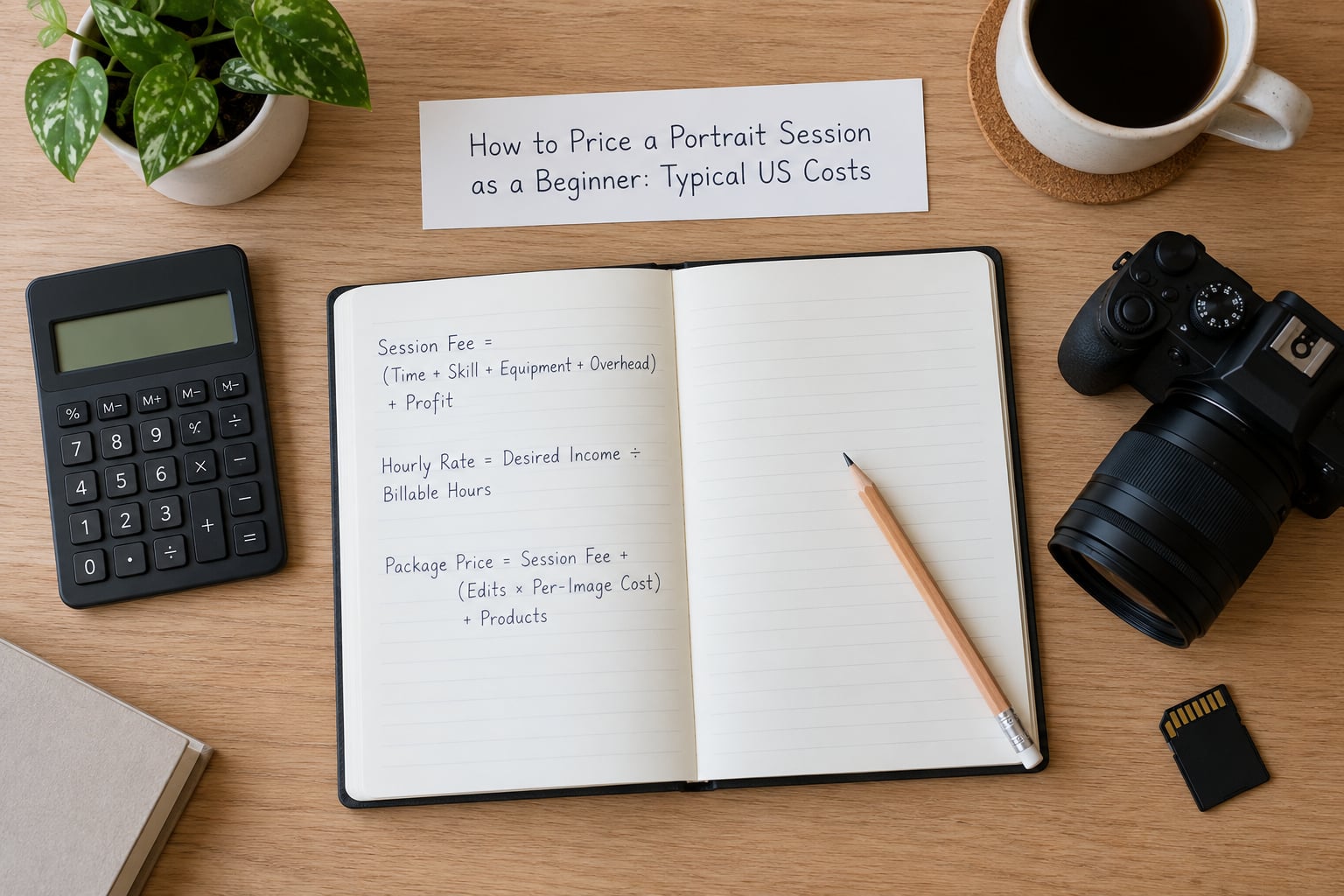
How to Price a Portrait Session as a Beginner: Typical US Costs
Here is what actually moves the number. Session length is the biggest lever, because a two-hour session is not twice the work of a one-hour session once prep, culling and delivery are counted.
| Factor | Typical range | Effect on price |
|---|---|---|
| Session length | 20 min mini to 2 hour full session | Each extra hour of shooting adds roughly 1.5 to 2 hours of editing |
| Number of people | 1 to 6 or more | Each additional person adds 15 to 30 minutes of shooting and culling |
| Location | Client home, outdoor, studio | Studio rental runs $40 to $150 per hour in most US markets |
| Usage rights | Personal use to full commercial | Commercial licensing can double or triple the base fee |
| Retouching level | Batch optimized to fully retouched | Fully retouched images take 4 to 6x longer than batch work |
| Turnaround | Standard 2 weeks to next day | Rush delivery usually carries a 30 to 50 percent surcharge |
| Travel distance | Local to 2 hours each way | Billing travel time as session time is standard practice |
Notice what is not on that list: how many photos the client ends up with. Beginners obsess over image count because it feels concrete. What clients actually buy is the session, the guidance, and the finished gallery, so image count matters far less than the time you spend on the file.
How to price a portrait session as a beginner
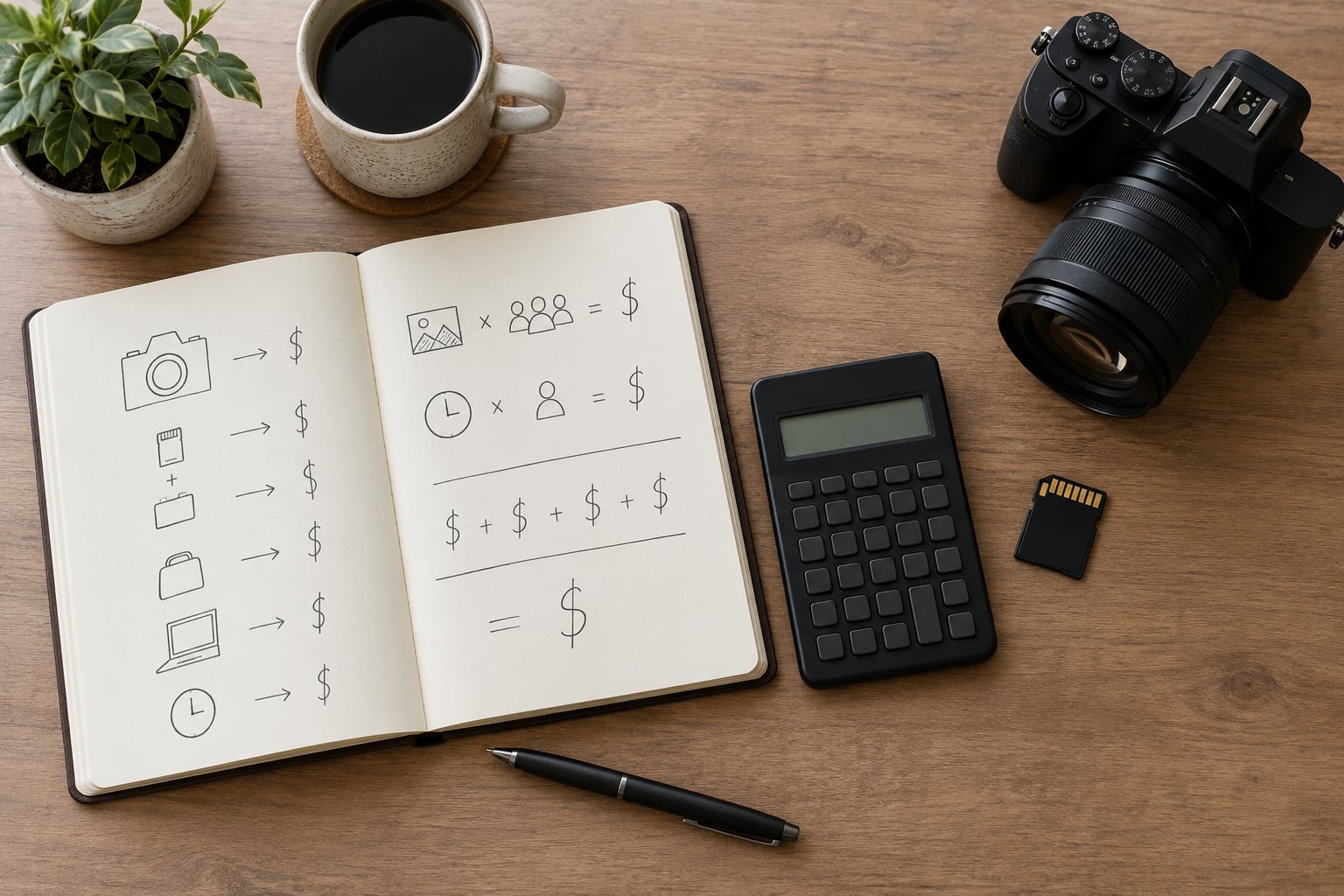
Here is a five-step formula you can run in an afternoon. It is deliberately boring, and boring is what makes it hold up when a client asks why you cost what you cost.
Step 1: Calculate your annual business costs. Write down everything you spend to keep photographing: camera and lens payments, insurance, software subscriptions, storage, portfolio hosting, printing, phone and internet, accountant fees, marketing, repairs, and a piece of your gear’s replacement value set aside each year. Add a percentage for self-employment tax. Most part-time beginners land somewhere between $6,000 and $12,000 a year once gear replacement and tax set-aside are included.
Step 2: Set an earnings goal. Decide what you want the business to pay you before tax. A part-time photographer aiming to replace a part-time salary often starts at $20,000 to $30,000 a year. This is the number that justifies your rate, not the number your gear cost.
Step 3: Count billable days, not calendar days. Assume 60 to 100 shoot days a year if you work part time, and 100 to 140 if you are full time. Marketing, admin, editing blocks and slow seasons all eat into those days. Add a 20 to 30 percent profit margin on top of costs plus salary, then divide by your billable days. That gives your minimum day rate.
Step 4: Price the job for total working time. A one-hour family session with 400 frames typically becomes 1.5 hours of prep and travel, 1 hour of setup and shooting, 4 to 6 hours of culling and retouching, and 1.5 hours of proofing, delivery and follow-up. That is a 9 to 10 hour job. Price it as one.
Step 5: Round it into a package. Multiply total hours by your target effective hourly rate, add the direct job costs, then round to a clean number that is easy to say out loud.
Worked example: a part-time photographer targets $25,000 a year in earnings, has $8,400 in annual costs, and works about 90 billable days. Salary plus costs plus a 25 percent margin comes to roughly $41,850, which is about $465 a day. With 9.5 total hours in a standard family session, that lands near $250 before travel and add-ons. Quote $250 as the base session, bill travel at your hourly rate, and add a printed gallery if you want a session to earn closer to $300. Nothing in that calculation came from a competitor’s website.
Run the same math with your own numbers before you quote anyone. The formula is the answer to how to price a portrait session; the number it produces is only right for your costs.
Choose a Simple Pricing Package
Three tiers work better than one price, because two out of three clients will pick the middle one and feel good about it. Four or more tiers just make people ask questions you have to answer in person.
Portrait Essentials covers the quick booking: a 20 to 30 minute mini session, 15 to 20 optimized images, a single retouched hero image, delivery in 10 days, and personal use. Most beginners start here at $110 to $160.
Signature Session is your baseline full session: 60 to 90 minutes on location, 40 to 60 images with 10 to 15 fully retouched, a styled gallery, two-week turnaround and personal use. Most beginner pricing lives between $225 and $325, and this is the tier you want most of your clients in.
Premium Story handles families who want more: two hours, two locations, up to six people, 80 to 100 images with 25 retouched, a printed album, and a rush option. $450 to $700 is a normal band for this tier, and it makes the middle tier look reasonable by comparison.
Keep the difference between tiers something the client can feel, like more time on location or more retouched images, rather than a random price jump. If a client cannot explain to their partner why the top tier costs more, rewrite the description.
Set Fees for Your Time and Deliverables
Beginners lose money on the parts of the job that never appear on camera. Pre-session planning, gear charging, memory cards, scouting a location, setup and teardown, culling, retouching, proofing, delivery, invoicing and revisions are all real work, and all of them should be inside your number.
A simple way to handle it: set an hourly rate internally, then multiply by every hour the job takes, not just the ones your client can see. If a 90-minute session only gets quoted as 1.5 hours, you are working the rest for free.
For longer sessions, price by the half hour. A two-hour session is not double a one-hour session because your culling doubles, but nearly. Pricing time in 30-minute blocks stops you from absorbing extra time without notice.
For turnaround, keep one standard window and one rush window. Rush is your highest-margin add-on because it costs you nothing but sleep, and clients will pay for it precisely on the days they need it. Set a revision limit of two rounds of minor adjustments on the retouched set, then say what happens after that. Unlimited revisions is the fastest way a profitable session becomes a month-long project.
Add Extras Without Confusing Clients
Add-ons should be things a client actively wants and would be disappointed to lose. If a fee exists mainly to pad the invoice, drop it.
| Add-on | Typical US starting range |
|---|---|
| Each additional family member | $25 to $60 per person |
| Second location or extra hour | $100 to $200 |
| Rush delivery (under 5 business days) | 30 to 50 percent of the session fee |
| Extended retouching (10+ extra images) | $25 to $75 per image |
| Commercial usage upgrade | 50 to 200 percent of the base fee |
| Printed album or wall gallery | $150 to $600 |
| Print release (client prints elsewhere) | $50 to $150 |
| Second shooter | $200 to $500 |
One rule keeps this clean: prep, standard culling, the agreed retouched set, the online gallery and delivery are never add-ons. Charge for going beyond the package, not for doing the job as sold.
Build Your Pricing Page and Proposal
A beginner-friendly proposal has ten parts. Package name, session length, number of images delivered and how many are retouched, what preparation is included, the delivery date, your travel policy, the revision limit, cancellation terms, the payment schedule, and what usage rights the client receives.
Here is a template you can copy and fill in.
“Thank you for booking. Your session is scheduled for [date] at [time] at [location]. This is the [package name]: [length] on location, [number] delivered images with [number] fully retouched, delivered to your private online gallery by [date]. Please wear [suggestion]. Travel within [radius] is included; beyond that I bill [rate] per hour plus mileage. Your session includes two rounds of minor adjustments on the retouched images. The remaining balance is due [terms], with [percentage] as a non-refundable deposit at signing. Your images are licensed for personal use; commercial use requires an upgrade. If you need to cancel, [policy].”
Sending that document is what turns a price into a professional quote. Clients push back far less on a fee that is attached to written deliverables than on an open number thrown out over the phone.
What Affects the Price
The biggest variable is your portfolio. A photographer whose gallery shows consistent work with good light gets quoted $300 for the same hour a photographer without one gets quoted $150 for, and neither of them is wrong.
After that come local market rates, travel and parking time, studio rental fees, equipment and insurance costs, how long your editing actually takes, the number of people in the frame, how tight the client’s deadline is, and whether the images are for personal or commercial use.
Consider two hypothetical photographers. Maya shoots in a high-cost metro area, drives 40 minutes to each job, and edits everything by hand, so her one-hour session takes 11 hours total. Jordan shoots in a small town, works mostly from a home studio with no rental fee, and uses batch presets plus a few hand-retouched images, so the same session takes them 6 hours. Maya’s $325 and Jordan’s $200 are both defensible. The client paying less is not getting a worse job, they are getting fewer hours of a photographer’s labour.
Seasonal demand matters too. Holiday card sessions, graduation season and June family bookings fill fast, and photographers with full books in those windows can charge more without hurting their pipeline. That is the easiest raise available to a beginner, and it requires no new skill at all.
Review and Raise Your Prices Safely
Review rates after a set number of bookings, not after one bad client. Ten sessions is a reasonable sample, and one difficult email is not data.
Track paid hours and unpaid hours separately, your profit per job, how many inquiries turned into bookings, how often clients ask for revisions, how often you miss your delivery date, and which leads go quiet after seeing your rates. If inquiries are healthy and bookings are healthy but your profit is near zero, the problem is your price. If inquiries are low, the problem is your portfolio or your communication, not your rate.
When you test an increase, raise one tier by about 10 percent and leave the entry tier alone so you keep a cheap option in the market. Run it for three months. Then, for existing clients, keep the old price, offer the new tier as an upgrade, and stop negotiating. A price that moves on request was never a price.
One last signal: if you resent a session you shot, your rates are behind. That feeling is reliable, and it usually arrives before the spreadsheet does.
Ways to Save
Most of these lower your costs or raise what the client gets without lowering what you earn.
Batch your retouching into two or three blocks a week instead of editing in fragments. Preset the first pass and hand-retouch only the images that need it, which cuts hours of work and is the single biggest lever on your effective hourly rate. Offer weekday availability at a slightly lower rate; a Tuesday afternoon session costs the client nothing but flexibility and costs you nothing but a quieter calendar. Let clients choose the location within a set radius, and bill travel time as session time when you do travel. State the revision limit on the proposal rather than in the final invoice, where it feels like an argument. Request a deposit at signing; it filters out price-first clients better than any pricing change. Sell prints, albums and digital files after delivery, when the client is already looking at the finished gallery. And keep the tier structure, since a clear middle option does more for conversion than a discount ever will.
Two things do affect quality. Retouching by formula instead of by hand, and paying for the location fee on the client’s behalf without passing the cost on. Discount those last, or better, price them honestly and let the client decide.
Frequently Asked Questions
How much should a beginner charge for a portrait session?
Most beginner portrait photographers charge $150 to $400 for a standard one-hour session, and $110 to $160 for a 20 to 30 minute mini. Start from your own arithmetic rather than a market average: add annual costs plus your target earnings plus a 20 to 30 percent margin, divide by your realistic billable days to get a day rate, then multiply by the 8 to 10 hours a one-hour session really takes. Whatever that produces is your floor. Check it against local competitors so you know where you sit, but never copy a number whose math you have not seen.
Should portrait photographers charge by the hour or use packages?
Use packages for portraits, and keep an hourly rate internal. An open hourly rate invites clients to watch the clock and ask you to trim the session, which pushes you toward the kind of quick work that undervalues you. A fixed package with clear deliverables, a set session length and a stated image count gives the client something to say yes to and gives you a guaranteed hourly rate once you have counted editing time. Publish an hourly rate anyway, because clients ask, but quote sessions by the package.
How do I raise my prices if I am just starting out?
Wait until you have about ten paid sessions, then look at the numbers instead of your mood. Track unpaid hours, profit per job, inquiry-to-booking conversion and missed delivery dates. If bookings are healthy and profit is near zero, you are priced too low. Test the increase by raising one tier about 10 percent while keeping the entry tier unchanged, and run it for three months before deciding. Keep old prices for existing clients and offer them the higher tier as an upgrade rather than repricing work already booked.
Should I offer a free mini-session to attract clients?
Limit free work to a small number of portfolio sessions a year, ideally with people whose look matches the work you want to be known for, and agree in writing that it is a portfolio session, not a discount. Free shoots for exposure teach clients that your work is available at no cost, and the clients who come for free work rarely book you later. If you do a free session, ask for nothing in return beyond the gallery rights, deliver the same quality you would deliver for a paying client, and count the time as marketing in your business costs.
How much should I ask as a deposit for a portrait session?
Ask for 30 to 50 percent at signing for portrait sessions, taken before any work is scheduled. That deposit covers the session date you are holding and part of the editing time that follows, which means a cancellation stops costing you a full day. For larger jobs such as family sessions or premium packages, a larger deposit is easier to justify because the calendar block is worth more. Put the amount, the balance-due trigger and the cancellation policy in the proposal, and deliver the gallery before the final payment is due rather than after.
Conclusion
Here is the whole method in three moves. Calculate your real time and your real costs, pick one baseline package and two surrounding tiers, then send one test proposal to a client who is not important to you before you publish a wider range anywhere.
That test proposal is the part beginners skip. It tells you more about whether your number holds up than another week of reading pricing guides will.