Planning a documentary photo project comes down to six decisions made on paper before you lift a camera: one central question, a clear scope, real access to your subjects, a shot and story plan, a consent and backup routine, and an editing sequence. Most beginners skip the first two and end up with 4,000 photographs of nothing in particular.
Budget roughly a quarter of your attention on planning and research, and the rest on shooting and editing. The project can be as small as one person over one afternoon or as long as a community followed across seasons. The process scales; the discipline doesn’t.
Below is the process I use, in the order I use it, with the practical detail that trips people up at each stage.
Table of Contents
- What You Need
- How to Plan a Documentary Photo Project Step by Step
- How to plan a documentary photo project: define the central question
- How to plan a documentary photo project: research the subject and build access
- How to plan a documentary photo project: choose a manageable visual scope
- How to plan a documentary photo project: create a shot and story plan
- How to plan a documentary photo project: prepare the fieldwork
- How to plan a documentary photo project: shoot, observe, and document ethically
- How to plan a documentary photo project: edit for sequence and meaning
- How to plan a documentary photo project: present, publish, and reflect
- Common Mistakes
- Frequently Asked Questions
- How long should a documentary photo project be?
- Do I need a professional camera to document a story?
- How do I ask to photograph someone for a documentary project?
- Should a documentary photo project have a strict shot list?
- How many photographs should I include in the final sequence?
- What is the best way to organize photos from a documentary project?
- Conclusion
What You Need
The list of tools matters far less than the list of permissions. Gear is replaceable in an afternoon. Access to a person who trusts you is not.
Essential preparation
- One written central question. Not a subject, a question. “Bakery workers” is a subject; “what does a night shift change in the way bakers talk about their hands?” is a question you can actually answer with photographs.
- A one-page project brief. Who it’s for, how many images you think you’ll end up with, where they might run, and what you will absolutely not do. This is the document you reread when a subject asks what you’ll do with a picture.
- Named access list. Every person you need an introduction to, every organization, every gatekeeper. Assume you’ll need one intermediary for every three direct contacts.
- A consent plan. Written agreement on how images will be used, kept for how long, and under what name. Some subjects will want a signed release, some want a verbal agreement, some want nothing at all — ask each one rather than guessing.
- A backup routine. Two copies in two different places before you leave each location. Long projects lose work to a dead laptop more often than to anything else.
- A realistic calendar. Named dates for first contact, first shoot, midpoint, and last shoot, with slack between them. Weather, illness, and work will move dates you didn’t pad.
Useful but optional
Two bodies are practical for documentary work because you cannot always put the camera down and still follow. A 35mm or 24-70mm covers most situations where you need to be close, and a second body with a longer lens covers the moments where being in the room changes what people do. That’s enough. The rest is preference.
Shoot RAW if you want latitude in post, and check that your card reader and backup drive work before the first session rather than after. A small audio recorder matters more than people expect if you plan to record short conversations alongside the frames. Spare batteries, a rain cover for the body, and a lens cloth are not optional in the field even though they cost nothing to pack.
What actually slows projects down
Getting permission takes longer than shooting. So does finding the right person to introduce you. Schedule those conversations first and the photography becomes the easy part.
How to Plan a Documentary Photo Project Step by Step
How to plan a documentary photo project: define the central question
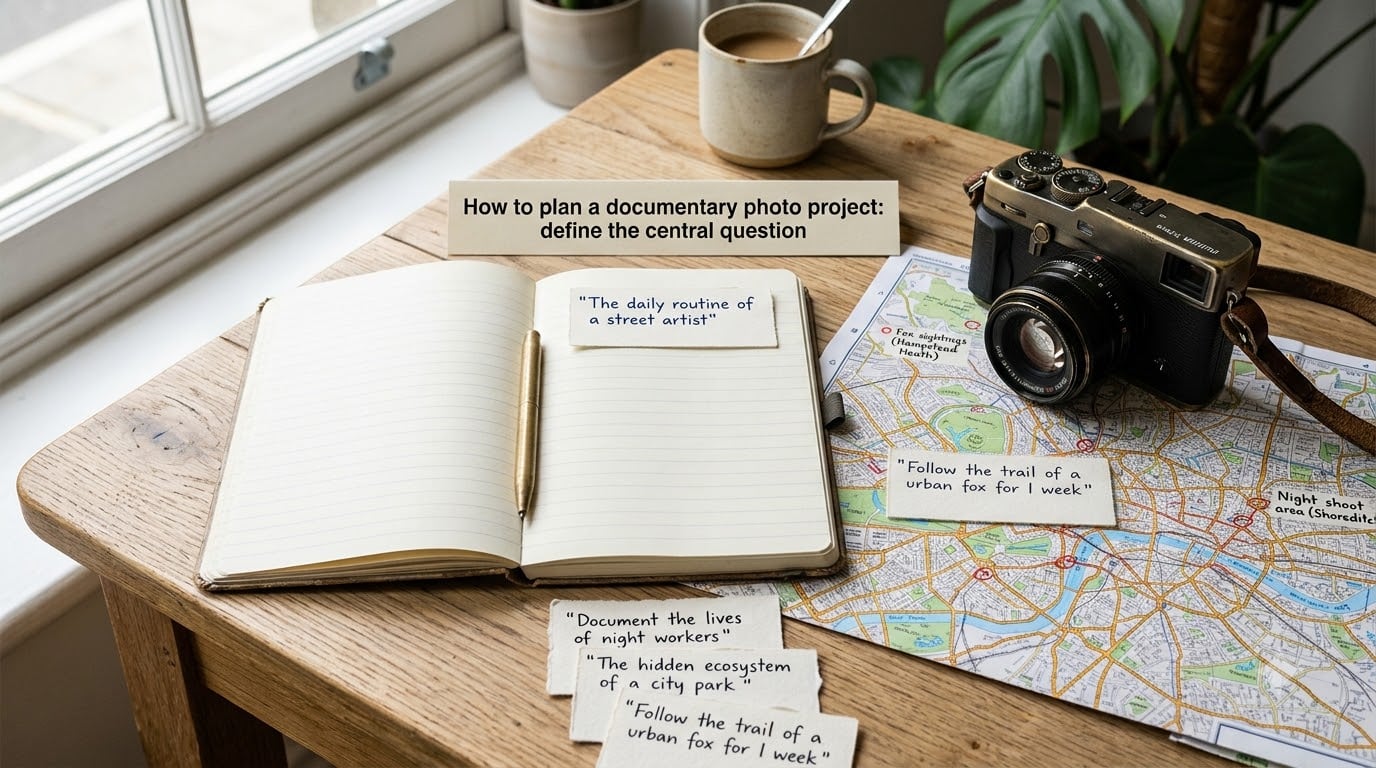
Start by writing the question in one sentence, in the form of a question. If you can’t, your project is a mood, not a plan, and it will wander.
Then write what success looks like. Twelve photographs that let a stranger understand one person’s working day is a finishable target. “Document youth culture” is not. Naming the number and the audience is what makes the rest of the planning decisions easier.
Write the brief while the question is fresh: audience, boundaries, the outcome you’re aiming for, and the things you’ll leave alone. Keep it to one page. You will send versions of it to potential subjects, and a page reads as honest while a manifesto reads as evasive.
How to plan a documentary photo project: research the subject and build access
Read before you look through a viewfinder. Local news archives, council meeting minutes, trade press, and existing photo essays tell you what the story already looks like from outside — which is exactly the view you need to avoid repeating.
Then approach people. Photographers on photojournalism and photography forums describe the same pattern repeatedly: an introduction from someone already inside the community does more than a month of cold approaches. Find your facilitator. If there isn’t one, write to the people who organize the place, the shift, or the club, and say who you are and why you want to spend time there.
Say what the project is in two sentences, how long it will run, where the images might appear, and that the person can decline any request to photograph them. Photographers who are clear about purpose get more access, not less, and the people who say yes are usually the ones who want to be photographed well.
Spend time with no camera in hand on the first visit. Handshakes, coffee, the ordinary conversation that establishes you’re a person who will be back next week. Documentarists consistently rate long-term presence as the thing that unlocks honest frames.
How to plan a documentary photo project: choose a manageable visual scope
Draw boundaries on four axes: place, time, people, and sessions. One workplace, one shift, three people, four sessions is a project with an end. Three workplaces across a year is a project you’ll abandon in March.
Write the boundary down where you’ll see it. Scope creep usually starts with a generous, “while I’m here, let me also photograph…” moment, and it’s the single most reliable way to end up editing someone else’s archive instead of your own story.
Set a session count as well as a date range. Sessions give you stopping points, and stopping points are what keep a long project honest about what it is really about.
How to plan a documentary photo project: create a shot and story plan
Turn research into a working plan: required scenes, recurring visual motifs, environmental detail, interaction, observation, and fallback options. A plan in this form tells you what you need and leaves the frame itself open.
A useful minimum set covers an establishing view of the place, the body and hands at work, one detail that explains the labor, the relationships between people, and at least two images that carry the emotional turn of your central question. That’s five ideas, not five frames — each one might take a dozen attempts.
Write the motifs down. Doors, aprons, a particular hour of light, the same hallway photographed at three different points in the day. Motifs are what make a sequence feel like one project rather than a folder of good pictures, and they’re cheaper to plan than to find.
Skip the rigid shot list. A fixed checklist is fine for the frames you know you must have, and harmful for everything else, because it turns you into someone looking for pictures instead of someone watching a person.
How to plan a documentary photo project: prepare the fieldwork
Confirm each session the day before, including the people you’ll be photographing and the facilitator who introduced you. Send a short reminder describing what you’d like to focus on, and ask whether there’s a moment you’d rather skip.
Logistics are where small projects quietly fail. Plan transport both ways, charge every battery the night before, pack the rain cover regardless of forecast, and know the nearest café or public space in case you need to work for two hours without interrupting anyone. Tell one person where you’ll be and when you expect to be back.
Prepare a decision process for surprises. Mine happens; a subject is unavailable; the light is wrong. Decide in advance that you’ll make at least twenty frames before judging a session, and that you’ll write two sentences about what happened the same evening while you still remember it.
Back up before you leave the location, not after you get home. Two copies, two media, one of them somewhere that isn’t your camera bag.
How to plan a documentary photo project: shoot, observe, and document ethically
Work in cycles of arriving early, watching without the camera for a while, making frames, then putting it down again. The frames made after you put the camera down are usually the ones that hold up.
Ask before you photograph. Ask again before you change a light, move a chair, or reposition someone’s hands. The moment you stage something, the picture becomes about your arrangement instead of their day, and viewers sense the difference immediately.
Record context as you go — a line of voice, a name of the machine, what happened just before the frame. Notes written on location turn into captions later, and a caption is often the difference between a photograph that documents and one that just shows.
Give people their photographs. Showing a subject the images and listening to their reaction is both an ethical obligation and the best editing advice available. Some will tell you that a frame is not how the moment felt; that correction is data.
Protect the people who are most exposed in the story. Some will ask not to be named. Some will change their minds after publication, and you need a plan for what you do then, agreed before you start.
How to plan a documentary photo project: edit for sequence and meaning
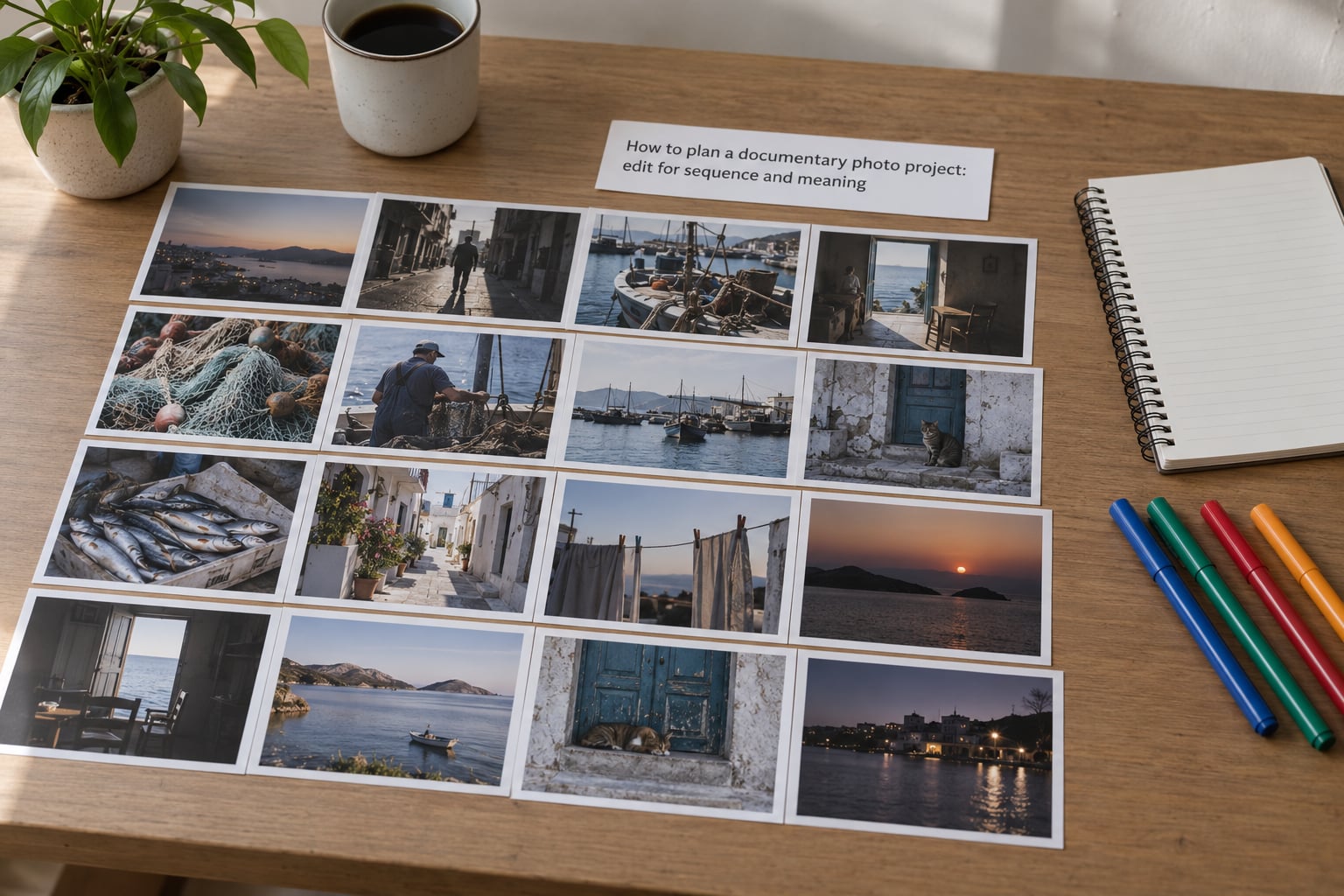
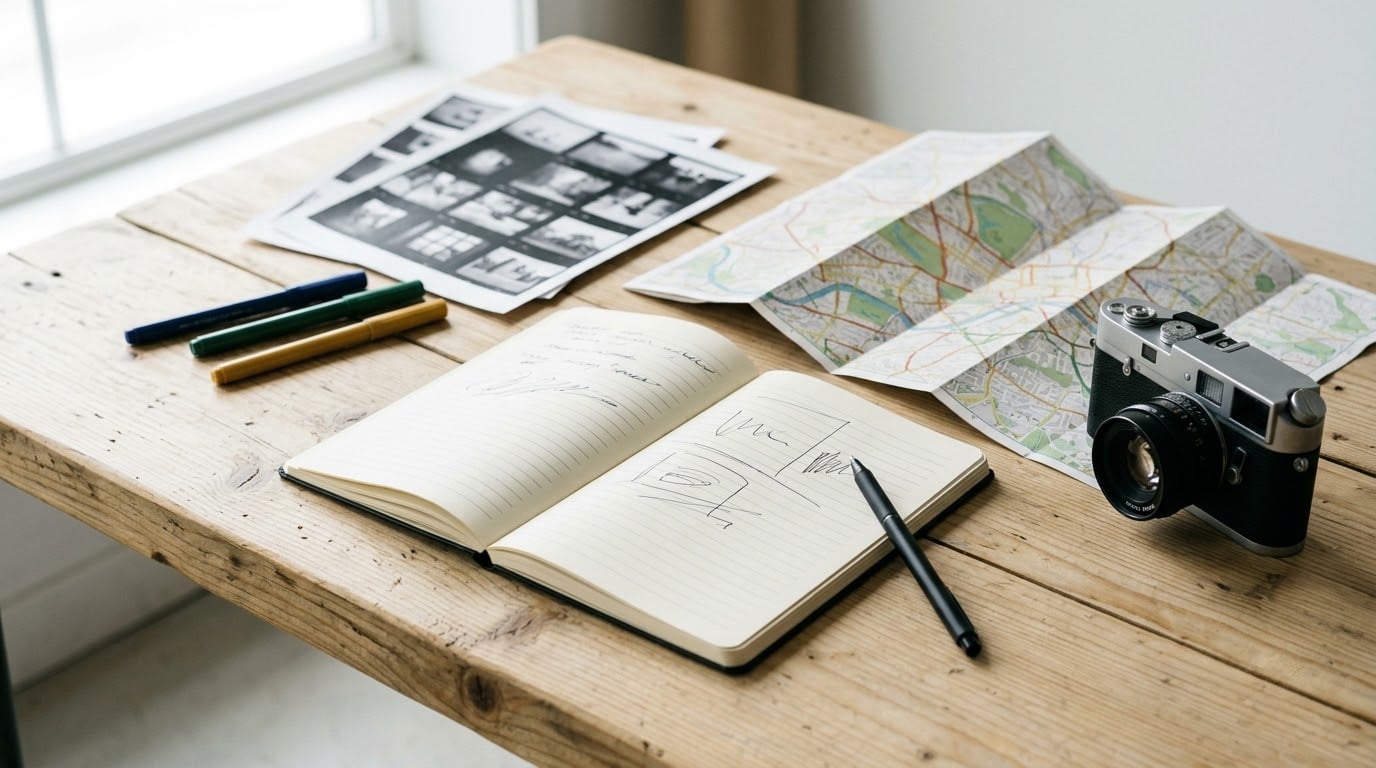
Selection comes first, and it comes from a distance. Build contact sheets, print them small, and mark the frames that answer your central question. Expect to discard the majority of what you shot, including frames you love for reasons that have nothing to do with the story.
Then remove repetition. Three similar frames in a row read as indecision. Keep the one where the light is best, or the one where the person’s expression is most honest, or the one that carries the most context.
Sequence in a deliberate order, usually opening wide and closing in, though chronological works when change over time is the point. Transition images — hands, thresholds, the road between two places — keep a sequence from feeling like a slide deck.
Read the sequence without captions. If you can’t say what the project argues after the last frame, the editing isn’t finished. Add captions or short quotes only after the pictures work alone.
How to plan a documentary photo project: present, publish, and reflect
Choose the format last, not first. A scroll-friendly web story, a fixed print sequence, and a gallery show each ask for different pacing and different image counts, and picking early wastes work.
Credit participants by name unless they asked otherwise, write captions that add information rather than describe what’s visible, and test the sequence with one trusted reader who hasn’t seen the project before. Where you can, let the subject read the captions.
Decide in advance how you’ll handle removal requests, and be willing to pull work rather than defend it. A project people trust is worth more than a complete one.
Finish with a written record: what worked, what you missed, which sessions earned their place, and what you’d scope differently. Photographers on long projects describe the archive as the thing they most regret not organizing during the work — the notes are what make a project repeatable.
Common Mistakes
Starting with too many locations. Fix: one place, four sessions. You can always widen after the first sequence proves the project works.
Leaning on a rigid shot list. Fix: use it as a floor, not a ceiling. Keep the required scenes, then shoot the rest by watching.
Skipping consent. Fix: write the usage agreement before the first shoot, and revisit it whenever the audience changes. Legal uncertainty is one of the most common sources of stress in documentary forums, and most of it disappears once the question is asked out loud.
Confusing activity with meaning. Fix: after every session, ask whether each frame could belong to a different project. If yes, it’s illustrating an activity, not telling a story.
Over-shooting without purpose. Fix: set a session count and an edit date in the calendar. Volume makes selection harder, not easier.
Not backing up. Fix: two copies in two places, verified before you leave. Make it a habit that happens in ten minutes.
Never deciding it’s done. Fix: set a completion date in the brief and honor it. Forum threads about finishing long projects all circle the same point — the project ends when the sequence answers the question, not when the last session happens.
Letting it run you down. Fix: schedule gaps, share progress with one other person, and keep the rest of your paid work. A project that costs you your income and your sleep usually ends unfinished.
Frequently Asked Questions
How long should a documentary photo project be?
Long enough to see repetition and change, short enough to finish. For a single person, four to eight sessions across a few weeks gives you repetition. Following a community or a place through change usually takes three to twelve months. Set an end date when you write the brief, because projects drift otherwise.
Do I need a professional camera to document a story?
No. What matters is that the camera starts instantly, shoots quietly, and works in low light. Most modern phones do all three. The real constraints are permission and attention, not resolution. Borrow or rent a body with a second lens only if working close makes people change how they behave.
How do I ask to photograph someone for a documentary project?
Explain the project in two sentences: what it is about, how long it runs, and where the images might appear. Ask for an introduction through someone they already trust. Say plainly that they can decline any request, and that you’ll show them the pictures. Clarity about limits usually gets more access, not less.
Should a documentary photo project have a strict shot list?
Use a short list for the frames you know you need, like an establishing view of the place and details that explain the work. Beyond that, a strict list works against you because it makes you hunt pictures instead of watching people. Documentarists who over-plan tend to miss the unscripted moments that carry a story.
How many photographs should I include in the final sequence?
Enough to build an argument, no more. For a web story, twelve to twenty images usually reads well. For a fixed print sequence or gallery show, eight to fifteen is comfortable because people spend longer with each one. If a sequence needs forty frames to make sense, the editing probably has a repetition problem.
What is the best way to organize photos from a documentary project?
Catalog as you go, not at the end. Back up to two places each session, build contact sheets, and write a short note about what happened on each shoot with date, location, and people photographed. Use one folder structure with a consistent naming pattern. Photographers who skip this end up with thousands of frames they can’t date or place.
Conclusion
Planning a documentary photo project is mostly narrowing. One question replaces a broad subject, one place and a handful of sessions replace a scattered idea, and a defined end date replaces an open commitment you will quietly drop.
Start this week: write the question, write the one-page brief, list ten people you need to reach, and ask two of them for a coffee. Book the first session for a week where you can go twice, back up before you leave, and write two sentences about it the same evening. Everything else — gear, format, publishing — follows from those decisions.