If you are figuring out how to choose a lens for environmental portraits, the honest answer is that focal length matters less than the room you have and how far the background sits behind your subject. Most working photographers reach for something in the 35mm to 50mm range on full frame, or a 24-70mm zoom when they want to reframe quickly without changing position.
The catch is that a lens has to do two jobs at once: keep the face flattering and keep the place readable. A portrait lens that crops the kitchen out of the frame is technically a good portrait and a failed environmental portrait. This guide walks through the decision in order, from defining the shot to testing the glass in the actual location.
What You Need
Before any of this matters, you need to know what your camera can do, because the same focal length does different things on different sensors.
- Your camera and sensor size. Micro Four Thirds, APS-C, and full frame each frame the same scene differently. A 50mm lens gives roughly the same field of view on all three, but it is physically a different lens and it has different working distances.
- A focal range, not one focal length. A 24-70mm-equivalent zoom covers everything from a tight interior to a full-body frame outdoors. If you own only one lens, this is the range most environmental work needs.
- Awareness of maximum aperture. The widest aperture your lens opens to decides how workable low light is without adding flash or raising ISO.
- Minimum focus distance. On wide lenses this is often shorter than the distance you actually want between you and your subject, so it rarely limits you. On longer primes it can genuinely block a full-body frame.
- A way to test framing before the session. Walk the location with the camera, or frame the shot on your phone and note the distance to your subject.
- Something to add light if the light is bad. A small LED panel and a reflector solve more environmental problems than any fast lens, and neither distorts the geometry of the shot.
Step-by-Step
How to Choose a Lens for Environmental Portraits
Start by writing down what the subject is doing and what the location has to contribute. A baker sliding trays into a commercial oven needs the oven in frame. A software engineer at a desk needs the desk and the room’s shape, not necessarily the street behind the window.
Then decide the tone. Observational portraits let the environment lead and the person sit inside it, while intimate ones use the place as a frame around the face. Observational work usually wants a wider field of view and more distance. Intimate work often wants a longer lens with the background compressed and softened.
Finally, list the two or three details that must stay visible. That short list is what the focal length decision is actually built around. If you cannot name them, you are choosing gear before you have an assignment.
Choose a Focal Length for the Space
Each focal-length band solves a different space problem. Full-body environmental frames on a full-frame body need roughly 1.5 meters of distance at 24mm, about 2.5 to 3 meters at 35mm, roughly 4 meters at 50mm, and somewhere around 6 meters at 85mm.
| Focal length (full frame) | What it looks like | Typical framing | Main risk |
|---|---|---|---|
| 16-24mm | Exaggerated depth, dramatic scale | Group shots, interiors, extreme context | Edge stretching on anyone near the frame border |
| 28-35mm | Immersive, natural, close to the subject | Full body with room around it, small interiors | You have to stand very close, so perspective exaggerates |
| 40-50mm | Neutral perspective, honest proportions | Full body and three-quarter with context | Needs more room in front of you than most people expect |
| 85mm | Flattering, softly separated | Knee-up with background, or full body from far back | Context shrinks to a small patch behind the subject |
| 135mm and up | Compressed, layered, quiet | Environmental frame shot from across a street | You give up the ability to include anything nearby |
Wide angles are not a mistake for people work, but they are unforgiving. Everything closer to the camera than the subject’s face grows larger, so a nose in a three-quarter pose can dominate a frame where a 50mm would have kept everything in proportion. The fix is positional, not technical: keep the subject’s face in the middle of the frame, put their shoulders on a vertical third rather than at the border, and move back when you can.
Longer lenses are underrated for environmental work. A 100-300mm lets you stand across a street or at the far end of a market and still get a frame where the background stacks tightly behind the subject instead of falling away. Photographers describe this deliberately, and it works well for layered compositions where a wall, a doorway, or a row of windows compresses into a clean graphic behind the person.
Forum consensus on portrait focal lengths has been fairly consistent over the years. On r/Nikon, the recurring advice is that any reasonably sharp 50 to 60mm works well. On r/SonyAlpha, people tend to name the 35 as the environmental option and the 85 as the standard. A dpreview forum thread from 2018 named the 35mm f/1.4 and 23mm f/1.4 as preferred environmental portrait lenses, which fits the pattern of wide primes being the tools people reach for when the room is tight.
Match Aperture to Light and Background
Aperture controls two things here: how much light you gather, and how much of the environment stays sharp behind the subject. Those pull in opposite directions, so the aperture you choose is really a decision about how much of the place you want the viewer to read.
For environmental portraits, wide apertures are overrated as a default. At f/1.4 on a 50mm, a subject standing a few meters from a detailed background often gets an eye-sharp face with a background that dissolves into mush, which defeats the point of the genre. Environmental work usually wants f/4 to f/8 so the context stays legible and the frame reads as a place rather than a face floating in blur.
Counter that with light rather than glass. A fast lens is a workaround for bad light, and it is an expensive one. Adding a small LED panel or bouncing a flash off a wall keeps the whole frame sharp at f/5.6 and does not change your focal length, your working distance, or your face. Most photographers who keep reaching for a wider aperture on location are really fighting a lighting problem.
Where a fast lens does earn its place is indoor work at dusk, or any situation where your subject is moving and you need the shutter speed. If your available light is genuinely dim, an f/1.8 prime gives you a stop and a half over an f/4 zoom, and that is the difference between motion blur and a usable frame.
Check Working Distance and Focus
Working distance is the gap between your camera and your subject, and it drives everything: perspective, how much environment fits, and whether you can hold still or move around. It also determines whether you can even get the frame you want.
On full frame, for a standing adult framed head to toe, the approximate distances are below. Add roughly 50 percent more for a vertical frame, because the long edge of the sensor is now horizontal.
| Focal length (full frame) | Full-body frame | Full-body frame, vertical | Room needed behind you |
|---|---|---|---|
| 24mm | About 1.5-2 m | About 2.5 m | Very little |
| 35mm | About 2.5-3 m | About 4 m | A normal room works |
| 50mm | About 4 m | About 5.5 m | Clear floor behind you |
| 85mm | About 6-7 m | About 8-9 m | Street, courtyard, open space |
| 135mm | About 9-10 m | About 12-13 m | Room across a space |
Sensor size changes these numbers but not the logic. Multiply the full-frame focal length by the crop factor and you get the equivalent field of view: 2x for Micro Four Thirds, around 1.5x for APS-C, 1x for full frame.
| Micro Four Thirds | APS-C | Full frame | What you get |
|---|---|---|---|
| 12mm | 16mm | 24mm | Wide context, tight interiors |
| 17mm | 24mm | 35mm | Immersive environmental portrait |
| 25mm | 33mm | 50mm | Neutral, natural perspective |
| 45mm | 60mm | 85mm | Flattering separation |
| 75mm | 100mm | 135mm | Compressed background |
Micro Four Thirds shooters have been working this way for years. Running a 25mm, which is a 50mm equivalent, or even a 17mm f/1.2, is common practice for indoor group and environmental work, where extra depth of field and a compact kit matter more than background blur.
Autofocus deserves a look too. Modern eye detection handles a static subject at most focal lengths, but if your subject is walking toward you, a longer focal length gives you a narrower focus zone and fewer mistakes. Check your lens minimum focus distance against the distance the framing requires, and note that some zooms breathe visibly when they extend from infinity to its close-focus limit, which is only visible on close subjects.
Working distance is also a courtesy issue. Standing several meters back in a public space is less intrusive than hovering a meter away, and it lets your subject relax rather than perform.
Test the Lens in the Real Location
Spend ten minutes at the actual spot before you commit to a frame. Stand where you plan to stand, point the camera at the subject’s expected position, and take test shots at each focal length you are considering.
Look at four things. First, perspective: does the face look right at a natural three-quarter angle? Second, distortion: check the corners, because anything near the frame border stretches, and a subject who wandered there needs repositioning rather than a lens change. Third, background: does the place stay readable at the aperture you plan to use, or does it collapse? Fourth, light: are the highlights in a bright window or a white wall controllable, or are you fighting them?
Then check your gear against the environment. Some zooms are too heavy to hold at arm’s length for a low-angle frame in a tight stairwell, and some wide primes flare badly when a light source sits just outside the frame. A five-minute test answers both questions cheaper than any spec sheet.
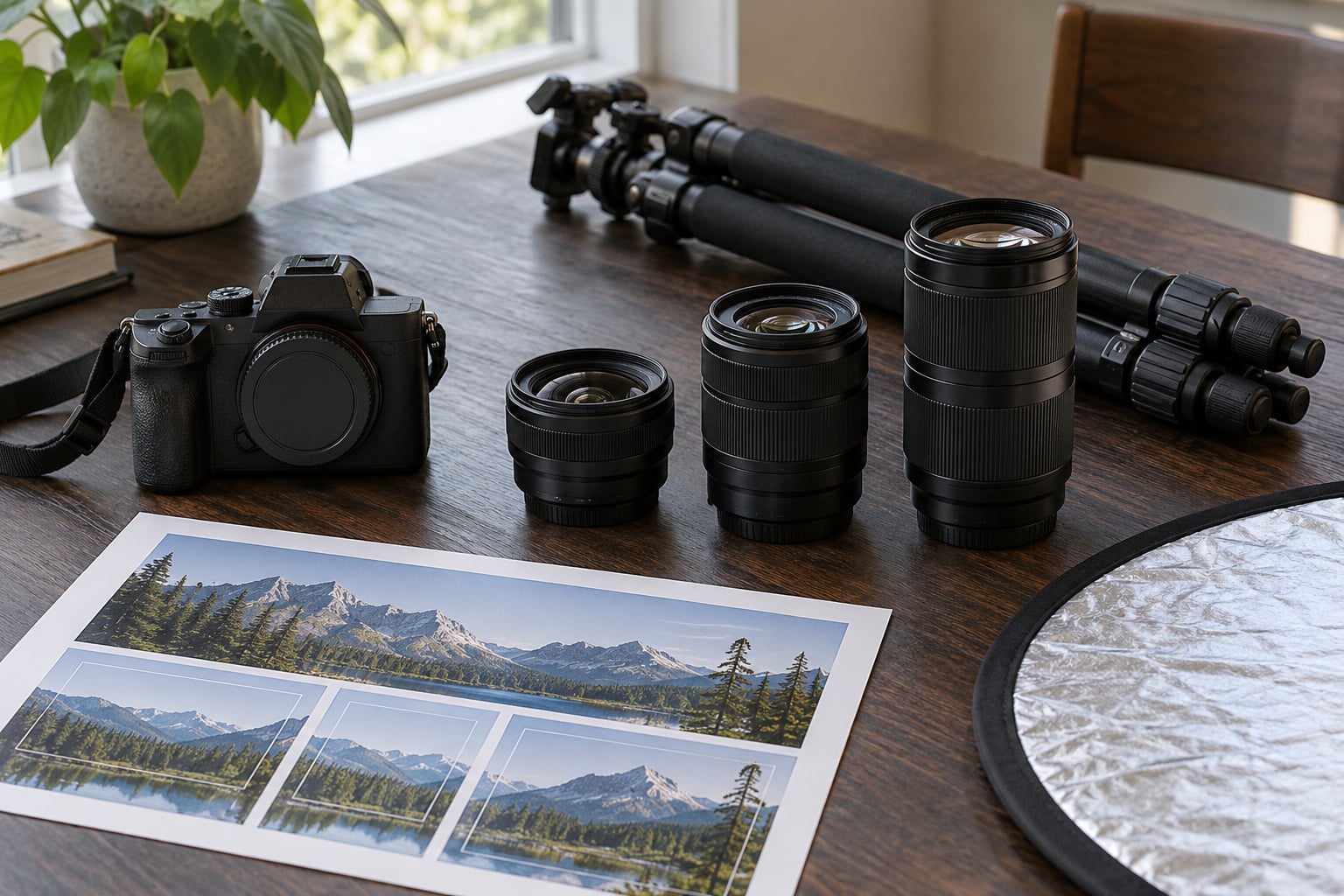
Frame the same subject at 24mm, 35mm, 50mm, and 85mm before the session. Looking at the four side by side on the camera screen is usually the moment the focal-length decision stops being theoretical.
Common Mistakes
Choosing by focal length alone. A number tells you the field of view, not whether the frame works. Decide what the environment must contribute first, then pick the focal length that delivers it.
Standing too close with a wide lens. This is the single most common way people end up unhappy with a 24mm or 28mm. Perspective exaggeration comes from distance, not from the lens itself. Move back and crop, or accept a narrower frame.
Letting the subject sit on the frame border. Edge distortion stretches whatever is near it. Keep faces in the middle two-thirds of the frame and place bodies on thirds.
Treating a slow kit zoom as a failure. The recurring complaint in photography forums is that an f/4 kit zoom does not produce enough subject separation. For environmental portraits that is often the wrong thing to want. Frame it at f/5.6 so the setting stays legible.
Cropping the context out. If you came for the workshop, the kitchen, or the skyline, do not frame a headshot and call it an environmental portrait.
Buying one heavy lens and carrying it badly. A large telephoto that sits in a bag all session helps nobody. Weight and balance decide whether you actually use the lens you own.
Ignoring the background distance. Moving your subject five meters from a wall instead of one meter changes the picture more than any lens choice you make.
Frequently Asked Questions
Is a 24mm or 50mm lens better for portraits?
A 24mm gives you more environment and a more immersive feel, but you have to stand close, which exaggerates faces and stretches anyone near the frame edges. A 50mm gives neutral proportions and still holds a full body in frame with context. For environmental portraits, 50mm suits most outdoor work, while 24mm wins in tight interiors or when the location itself is the story.
Is 24mm too wide for portraits?
Not too wide, but unforgiving. Wide lenses exaggerate whatever is closest to the camera, so a subject who stands near the edge of the frame gets a stretched face. Keep the subject in the middle of the frame, shoot from chest height or slightly above, and move back when the space allows. Treated that way, a 24mm is a legitimate environmental portrait tool.
How far back do I stand for a full body environmental portrait?
On full frame, roughly 2.5 to 3 meters at 35mm, about 4 meters at 50mm, and 6 to 7 meters at 85mm. At 24mm you can manage around 1.5 to 2 meters. Add about half again that distance for a vertical frame. Walk the location before the session and mark your spot, because most location problems turn out to be a few steps short.
Do I need a fast lens for environmental portraits?
Usually not. Most environmental portraits work best at f/4 to f/8 so the background stays readable, and you can get there in dim light by adding a small LED panel or bouncing flash instead of buying faster glass. A fast prime earns its keep when your subject is moving, when light is genuinely poor, or when you are shooting indoors at dusk without any way to add light.
Is a telephoto lens better for environmental portraits?
Different, not better. A 100-300mm compresses the background so a distant wall, doorway, or row of windows stacks tightly behind your subject, which produces clean layered compositions from far away. A wide lens puts the photographer inside the space and gives immersion instead. Choose the compression when the background is visual clutter, and the wide lens when you need the room around the person.
What lens do most portrait photographers use?
In forum threads the names come up consistently: a 50 or 60mm for natural perspective, a 35mm for environmental work in tight spaces, and an 85mm as the flattering standard. Micro Four Thirds shooters usually run a 25mm, which equals 50mm on full frame. The honest answer is that most photographers carry a small zoom and reach for the 35mm end more often than they admit.
Conclusion
Start with the one environmental detail that has to be in the frame, then choose the focal length that delivers it: wide if you need to be inside the space, normal if you need neutral proportions, longer if you need the background compressed. Pick the aperture that keeps that detail readable, which usually means f/4 to f/8 rather than wide open.
Then walk the location before you commit. Ten minutes of test frames at three focal lengths will tell you more than an afternoon of reading specifications, and it is the only way to know whether the distance works in the room you actually have.