A two-hour session timeline is a minute-by-minute plan that splits a 120-minute booking into named blocks, each with a start time, a duration, a shot list and a buffer, so the session is executed instead of invented on the day. Learning how to run a timeline for a two hour session takes about an hour of prep work and saves you from the failure mode every short session has: one late block quietly eats the portraits that mattered most.
Two hours is short. A block that runs ten minutes long does not recover itself later, because the light, the energy and the people on set all move on. The fix is not a longer booking, it is a plan you have already rehearsed.
This guide covers portrait sessions, engagement sessions, maternity and family sessions, birthday and celebration shoots, branding work, and two-hour wedding or elopement blocks. The arithmetic is the same for all of them.
Table of Contents
- What You Need
- Step-by-Step
- Frequently Asked Questions
- How much time should I reserve for breaks in a two hour photo session?
- How many different setups can I realistically photograph in two hours?
- What should I do if the subjects arrive late?
- How do I plan a two-hour session with children or multiple families?
- How do I know which shots to cut when the schedule is running late?
- Conclusion
What You Need
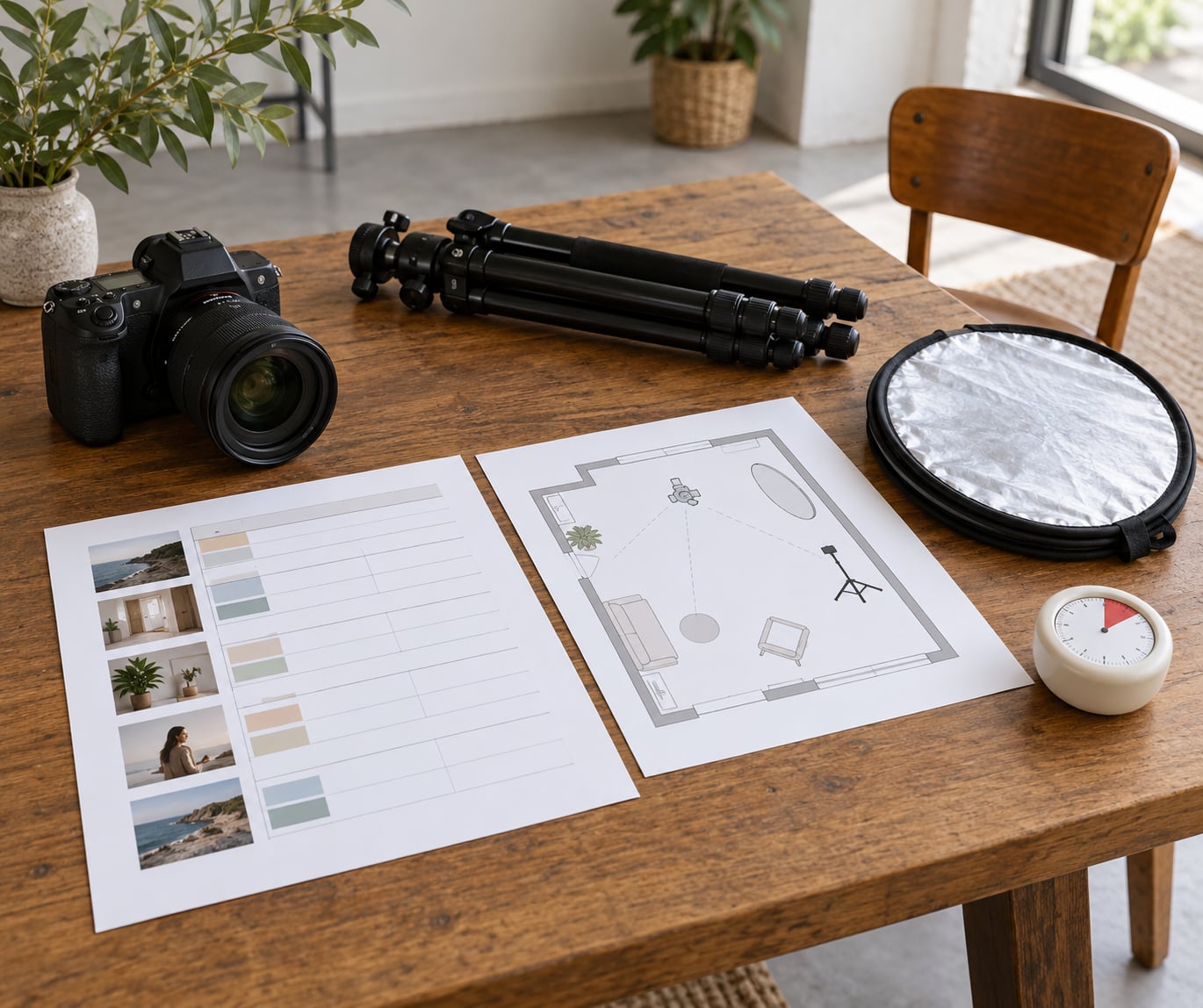
Six inputs, gathered before the day. If any of them is missing, the timeline you build will have holes you discover at minute forty.
- A shot list. The actual frames you want, written down, not the vague categories you carry in your head.
- Time blocks. Named segments with durations, summing to 120 minutes.
- An equipment checklist. Bodies, lenses, batteries, cards, triggers, reflectors, and the backup frame.
- A location plan. Where each block happens, how you move between spots, and whether parking or stairs eat time.
- Subject notes. Named groupings with real names, outfit changes, children and pets, and who is difficult to gather.
- A backup schedule. The indoor or shaded alternative for every block that depends on sun or open sky.
Put all six into one sheet with four columns: Time, Block, What to shoot, Notes. That four-column shooting schedule template is the whole system. Paste it into Word, Google Sheets or Excel, keep a printed copy in the camera bag, and it works offline on a location with no signal.
Step-by-Step
Set the Outcome and Fix the Total Time
Decide what the finished set must contain before you decide anything else. Write one sentence: “At the end of these two hours, this couple has their portraits, their family groupings, and a detail set in good light.” Then lock 120 minutes as a hard ceiling, not a target.
Divide those 120 minutes into five buckets: preparation, portrait blocks, transitions, breaks, and wrap-up. For most two-hour sessions a workable split is 20 minutes of shooting preparation, 80 minutes of actual portrait time, 15 minutes of movement and setup between blocks, and 5 minutes at the end. The rest goes where your specific session needs it.
| Time | Block | What to shoot | Notes |
|---|---|---|---|
| 0:00 – 0:10 | Arrive and settle | Wide establishing frames, venue details, flat lays, getting-ready details | Do this alone before anyone arrives. Lights go up first. |
| 0:10 – 0:30 | First look and warm-up | Solo portraits, first-look reactions, wide environmental frames | Easiest 20 minutes of the session. Start on time or it goes. |
| 0:30 – 0:55 | Couple or hero portraits | Wide, medium, close, back to the sun, walking, quiet moment | Put this in the best light of the day, not the first hour. |
| 0:55 – 1:05 | Transition | Candids during the move, motion frames | Ten minutes is standard for a single-location change. Double it for hair and makeup. |
| 1:05 – 1:30 | Family groupings | Each named group, largest to smallest | Two to three minutes per grouping plus five minutes to gather. Name a wrangler. |
| 1:30 – 1:40 | Break | Candids of the break itself | Children and older relatives need this. Ten minutes is not negotiable. |
| 1:40 – 1:55 | Second location or golden hour | Silhouettes, rim light, wide close-ups, motion | Check sunset time and backlight angle before the day, not during. |
| 1:55 – 2:00 | Hero frame and close | One deliberate portrait, then pack | Backup any missing must-have before you put the camera down. |
Note what the table does: the couple portraits sit at minute thirty, not minute five, and the break is a named block rather than an accident. Time you did not plan is time you will spend apologising.
Build a Prioritized Shot List
Sort every frame into three tiers. Must-have means the booking is broken without it. Useful-to-have means the set is noticeably better with it. Optional means it is a bonus you drop first.
Then estimate a duration for each group using the formula photographers on wedding forums keep returning to: two to three minutes per grouping, plus five minutes to gather everyone. Eleven family groupings works out to roughly 33 minutes. Most family photo blocks that blow past an hour are not slow, they are uncounted.
Not every two-hour session is a couple session. A family, maternity or celebration shoot needs a different 120 minutes, one built around a changing cast of people rather than a fixed pair.
| Time | Block | What to shoot | Notes |
|---|---|---|---|
| 0:00 – 0:15 | Details and arrivals | Decor, food, gifts, kids arriving, candid chaos | Shoot before the room gets loud. |
| 0:15 – 0:40 | Expectant parent or birthday star | Solo and pair portraits, both wide and tight | One person leads. Everyone else gathers around them. |
| 0:40 – 0:50 | Reset | Snacks, water, feet, a genuine break | Children cooperate again after a break. They rarely do before one. |
| 0:50 – 1:25 | Family groupings | Everyone, then subsets, largest to smallest | Pre-confirmed names. One wrangler, not a parent. |
| 1:25 – 1:35 | Play and candids | Running, cake, games, unscripted moments | Ten minutes of real play beats thirty minutes of posed smiles. |
| 1:35 – 1:55 | Golden hour | Whole family outside, backlit portraits, siblings alone | Pick the ten-minute window before the sun drops behind the building. |
| 1:55 – 2:00 | Hero frame | One frame of everyone, then close | Make sure it exists on the card before packing. |
For a celebration session, swap the second block for a cake-cutting run and give it fifteen minutes rather than twenty-five. Candids of a birthday party are the reason people book the session; the posed family groups are the reason they keep it.
Map the Location and Transitions
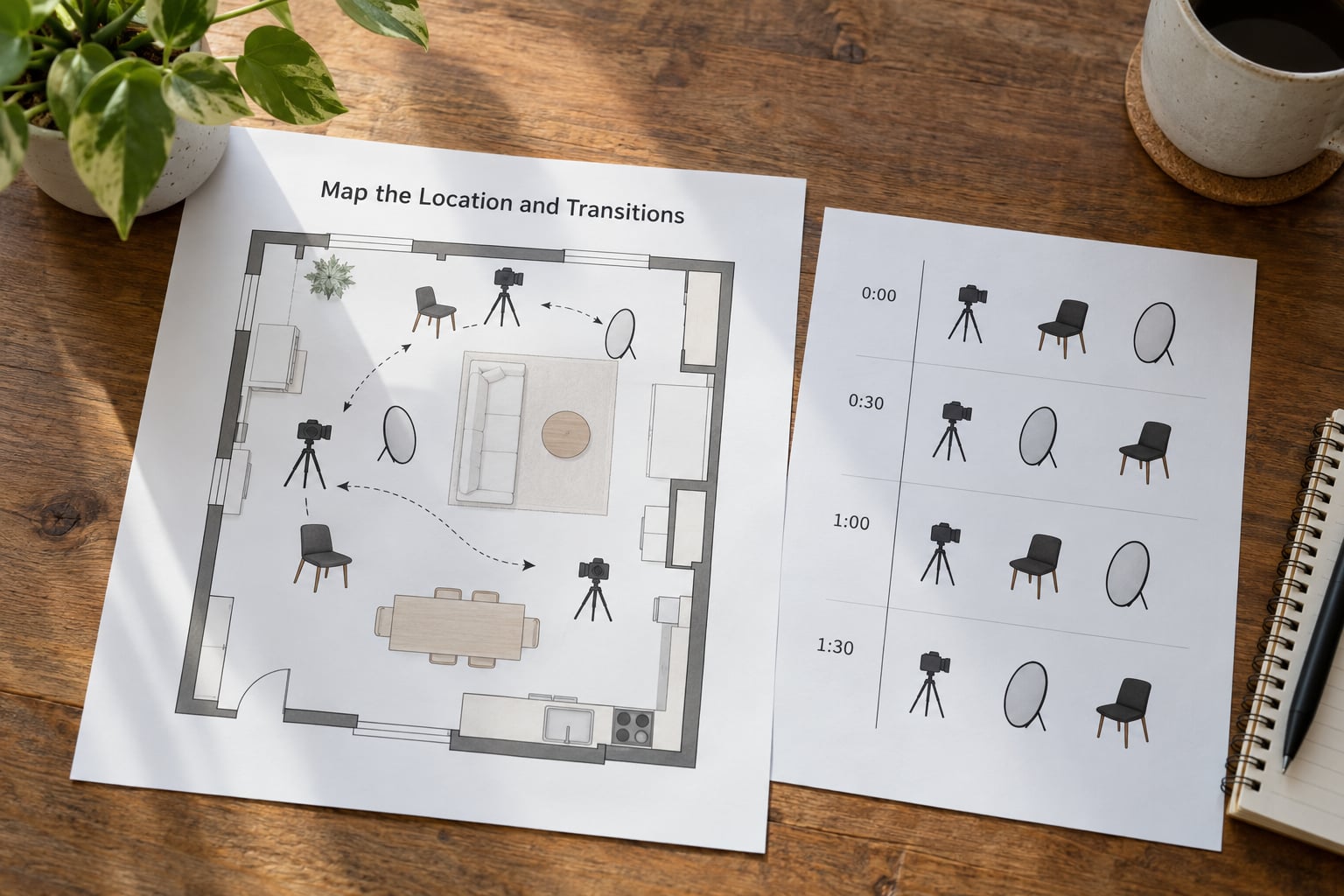
Assign each shot group to a specific spot, then measure the walk. A transition is a row in your schedule, not a gap between rows.
- Same spot, new setup: two to five minutes. Just repositioning the reflector.
- Same location, different room: ten minutes, plus time for the subjects to reset.
- Short drive or walk to a second location: twenty minutes minimum, and it includes parking for everyone.
- Hair and makeup or wardrobe change mid-session: twenty minutes, realistically thirty for a full makeup redo.
Check the light at each spot and at the time you have scheduled it. A wall that looks fine at ten in the morning is flat shadow by three in the afternoon, and a face lit from behind at the wrong hour is worse than no portrait at all. This is the step that separates a planned session from an improvised one.
Rehearse How to Run a Timeline for a Two Hour Session
Before the session, walk the schedule once on paper, minute by minute. Add up every block plus every buffer and check the total lands on exactly 120. If it comes to 135, you have a plan for a session that does not exist yet.
Then time the two transitions that scare you most. Load the car, drive to the second location, park, unpack, and set up. Do it once at the same time of day you will shoot. If it takes fifteen minutes instead of ten, your buffer was a wish.
The rehearsal also exposes the blocks you have underestimated. Most people discover their family groupings need forty minutes, not thirty, and that the fix is trimming the groupings, not rushing the photograph.
Create Checkpoints and Contingencies
Put three checkpoints on the sheet. At thirty minutes, you should be starting the couple or hero portraits. At sixty, you should be leaving or arriving at the family block. At ninety, you should be shooting, not packing. Every checkpoint that has passed late is a decision point, not a surprise.
Write the alternatives next to the block they replace:
- Sun behind a building: the same portraits in open shade, with a reflector filling the shadows.
- Rain starting mid-block: the porch, a cafe, a wide hotel lobby, or a car park with a clean wall behind.
- Wind and hair chaos: move to the doorway or the stairwell, or shoot detail frames and use them as the transition.
- Flats, wrong light, wrong direction: skip. Cut to the backup block instead of burning twenty minutes.
Keep the cut list short and decide it now, not at minute ninety-five.
Run the Session With Clear Cues
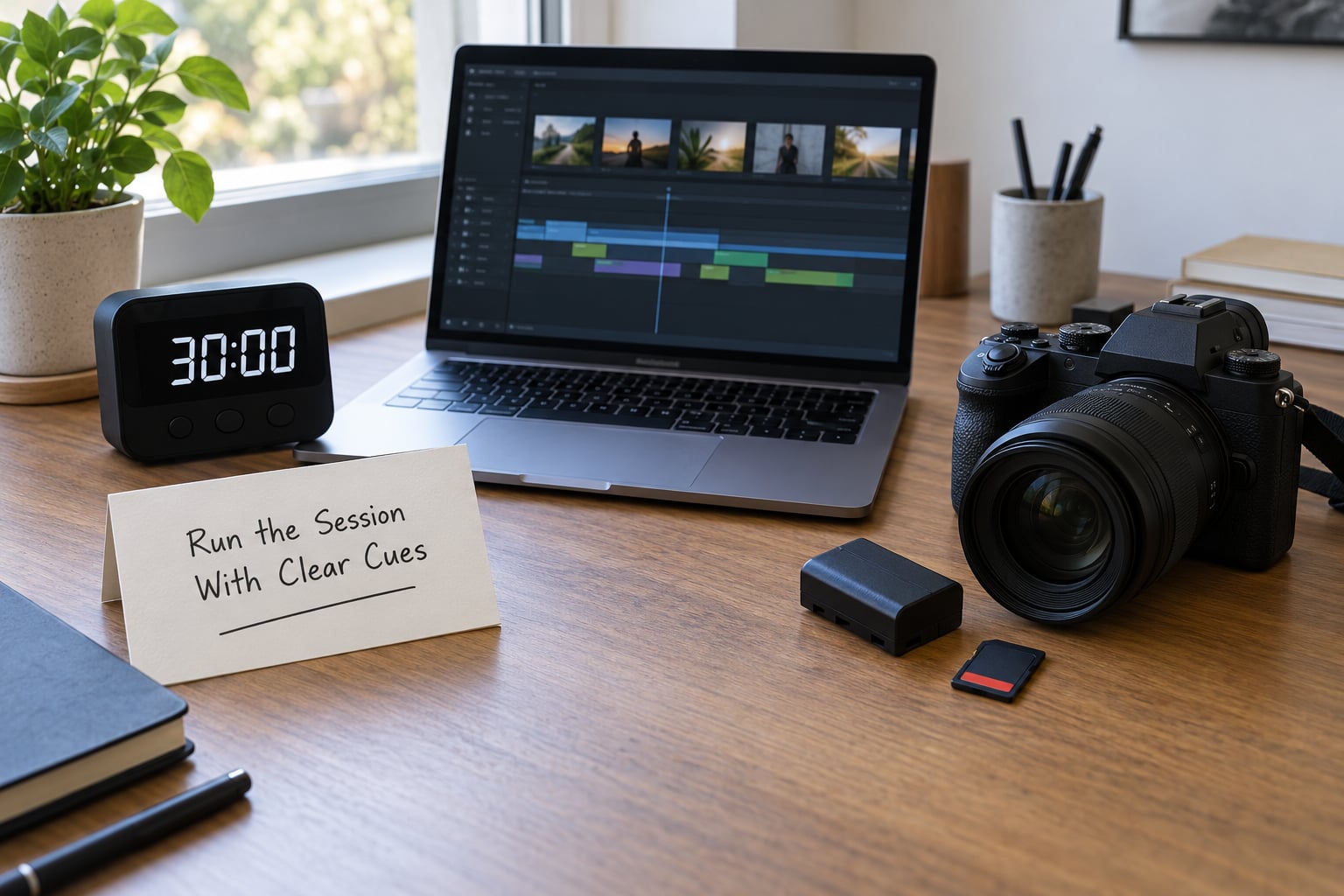
Running the timeline is about language and hard stops. Say the time out loud at every block change: “Ten minutes here, then we move to the family shots.” People accept a tight schedule when they hear the numbers, and push back hardest when the plan is invisible.
Three cue habits carry most of it. Give a subject one instruction at a time, then change it every few frames so nobody is holding a pose. Move between positions yourself rather than asking someone to shuffle. And when a block ends, end it: “That’s the set I wanted, thank you” gets you to the next block faster than any other sentence.
When you fall behind, cut in this order. Optional and bonus shots first. Second locations and any block needing a drive next. Individual portraits that can be recreated another time. Duplicate angles of a group you already have. What you never cut is the couple or hero portraits, the named groupings the client asked for, and the backup frames. Losing those turns a thin set into a disappointing one.
Close, Review, and Adjust
The last five minutes are for finishing, not for one more idea. Take the hero frame first, then check the card for the must-haves you have not got and take them now while the light is still there.
Run a fast on-camera review with your subject. Show three or four frames, ask if anything is missing, and let them name the one picture they would be upset to lose. Then shoot it. It takes ninety seconds and it removes the email you would otherwise get the next morning.
Afterwards, back up both cards before you pack anything, write down what ran long and what you cut, and send the client two things: roughly how many images to expect, and when the gallery lands. Short sessions invite expectations that long sessions never test, and stating the deliverables in writing is the cheapest fix there is.
Common Mistakes
- Filling all 120 minutes with shooting. Fix: budget the transitions up front. Two setups that each overrun by five minutes cost you a block you cannot get back.
- Estimating groupings optimistically. Fix: two to three minutes per grouping plus five to gather, then add ten per ten groupings for the person who went missing.
- Skipping transitions in the schedule. Fix: make walking time a row. If it is not written down, it will be spent.
- Not telling anyone the plan. Fix: share the schedule with the client, the venue and any family wrangler a few days out, and print a copy for yourself.
- Prioritising by what is easiest to shoot. Fix: decide the must-have list before the day. Shooting the easiest ten minutes first is how a session ends with plenty of candids and no portraits.
- Building the plan around the light and ignoring the people. Fix: if a block needs a wrangler or a nap or a warm-up, place it before golden hour, not after.
Frequently Asked Questions
How much time should I reserve for breaks in a two hour photo session?
Ten minutes, placed deliberately rather than left to chance. In two hours, a break is not a luxury, it is what makes the second half usable. Children, older relatives and anyone who has been posing in the sun for an hour all come back sharper after ten minutes off. Put the break on the sheet as a block, use it for candids, and let the shoot continue while people eat.
How many different setups can I realistically photograph in two hours?
Three, and rarely more. Each setup costs ten to twenty minutes once you include the move, the gear change and getting subjects comfortable again. A single-location session can hold four setups if they are small, such as swapping a backdrop or moving the reflector. A session with a drive to a second location realistically fits two setups plus a transition.
What should I do if the subjects arrive late?
Take the late time off the end, never the middle. Shave the optional block first, then the second location, then individual portraits, and protect the groupings and the couple portraits. Tell them the new finish time at the start rather than letting them notice it slowly. If the delay is more than twenty minutes, offer the third option of adding time or moving the gallery date.
How do I plan a two-hour session with children or multiple families?
Cut the number of setups before you cut the people. Build the session around the youngest attention span: warm-up frames early, groupings in one block while everyone is present and fed, then free play. Pre-confirm every name on the list with the client, name one wrangler who is not a parent, and allow three minutes per grouping plus five to gather.
How do I know which shots to cut when the schedule is running late?
Work down a fixed order decided before the session. Cut optional frames, then any block needing a drive, then individual portraits that are easy to recreate, then duplicate angles. Never cut the couple or hero portraits, the groupings the client named, or the backup frames. Writing that order down in advance is what stops panic deciding in the last ten minutes.
Conclusion
Knowing how to run a timeline for a two hour session comes down to three things: define the must-have frames before the day, block those 120 minutes into named segments with transitions counted as real time, and leave a ten-minute contingency buffer you are willing to spend. Print the sheet, say the times out loud, and cut in the order you decided in advance.