If you want to know how to find a narrative in your own photo archive, the honest answer is that it takes a week of evenings, not a year of tagging, and it needs no perfect metadata. A narrative here is simply a small group of images you already shot that, in a certain order, say something none of them says alone. The process is short: ask one question, shrink the archive down to something you can hold, follow the details that keep repeating, and cut everything that does not earn its place.
Most photographers I know have tens of thousands of images and no finished project in them. They shoot well, they file properly, and then they open the library, feel the size of it, and close the laptop. That is the whole problem. Volume is not the obstacle. Not having a way to look is the obstacle.
Table of Contents
- What You Need
- Step-by-Step: How to Find a Narrative in Your Own Photo Archive
- Common Mistakes
- Frequently Asked Questions
- How do I find a story in photos I took years ago?
- What if my photo archive is huge and poorly organized?
- Should a photo story follow the date the photos were taken?
- How many photos should be in a narrative sequence?
- What is the difference between documenting a story and imposing one?
- How do I know when a photo archive sequence is finished?
- Conclusion
What You Need
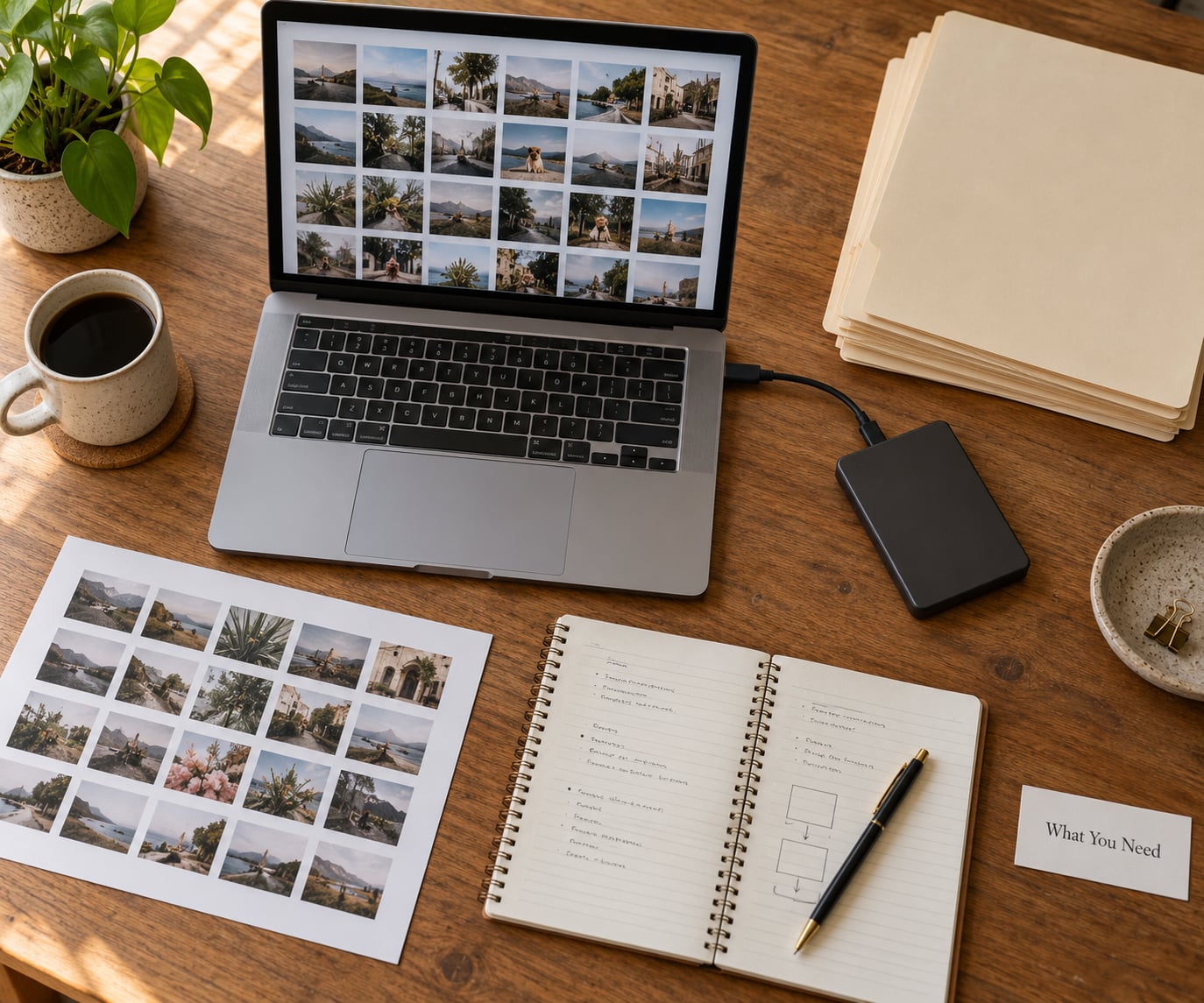
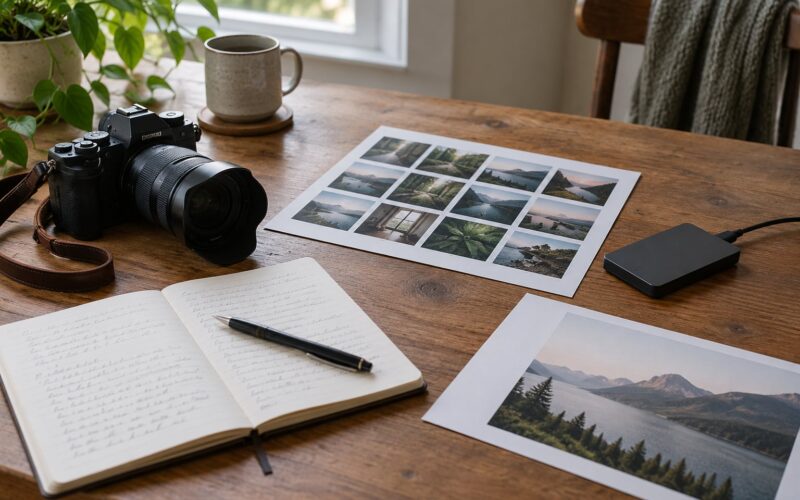
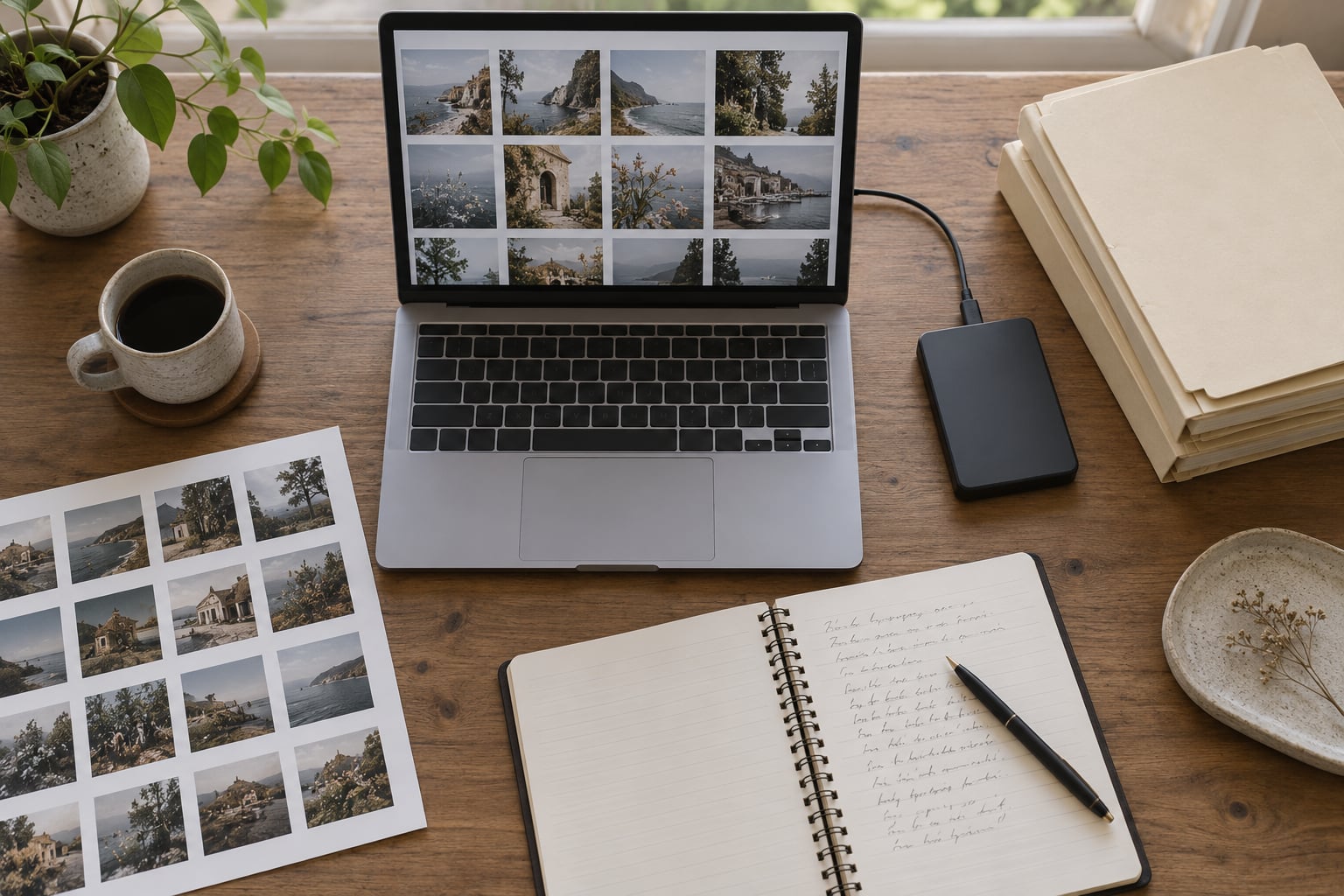
Four things, and nothing expensive. A computer with enough room to open the whole library at once, a way to view images side by side, somewhere to write notes, and a way to make a contact sheet.
- Storage and speed. A recent laptop with a fast external drive is enough. Editing raw files from a decade ago in a single folder will crawl, but viewing them is fine.
- Software. Whatever you already use. Lightroom, Apple Photos, Google Photos, Mylio, Capture One, even a folder tree on a hard drive. No migration required before you start.
- A notes file. A spreadsheet with three columns is ideal, but a phone note or a paper page works just as well.
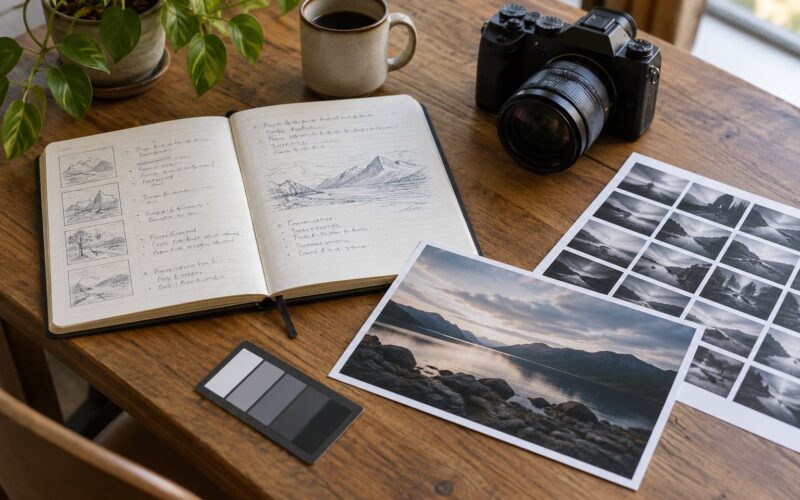
- A contact sheet method. A grid view on screen, a printed sheet, or a small printed contact sheet taped to a wall. Paper has one genuine advantage: it stops you from falling into every frame.
None of this requires advanced editing skills or a completed metadata system. Ten years of untagged images is a normal starting point, not a failure.
Step-by-Step: How to Find a Narrative in Your Own Photo Archive
Start with a question, not a conclusion
Before you open a single folder, write down three or four questions you could actually answer with photographs. Open questions work; conclusions do not.
What are people in these frames doing, and is it always the same thing? How has this one place changed across the years I have been shooting it? What did I keep photographing and never resolve? Which gesture, object or colour shows up in twenty different years?
Four questions give you four possible threads. That is enough. A question like my photography has a hidden theme is not a question, it is a mood, and moods do not narrow an archive down.
Create a manageable first contact sheet
Pick one folder, one year, one trip. Forty to sixty frames is plenty for the first pass. A contact sheet that big is readable in a minute and large enough that repetition becomes obvious.
Label it with whatever you know: date range, place, event, camera, or a technical quality such as focus. The label matters because it stops the set from becoming an abstract mood board.
Print the first one if you can. On paper you notice visual echoes that a screen hides, especially small ones. If you cannot print, view the grid at arm’s length and walk away from it for an hour.
Look for visual threads
A thread is any detail that keeps coming back. Look for a repeated subject, the same gesture made by different people, a colour that owns a whole folder, one composition you keep reinventing, a location you return to without meaning to.
Also look for change rather than sameness. Compare the first frames from a place with the most recent ones. A door that was painted every spring, a road that lost a tree, a kitchen table that lost four chairs.
Watch for the frames taken just before and just after the moment you remember making. Sequences often live in the margins, not in the pictures you were proud of at the time.
One strong detail is enough to start. A single yellow jacket across five different years can become an editorial sequence, an exhibition wall, or a twelve-image slideshow.
Separate facts, interpretations, and possibilities
Archive work goes wrong quietly, when a photograph that shows a parked car slowly becomes a photograph about departure. Keep the three layers apart on your notes.
- Observed facts: what is in the frame. Grey sky, one person, back turned, the same coat.
- Possible meaning: what you infer. Waiting. Leaving. Cold. Repetition as habit.
- Open questions: what the images cannot settle. Who was waiting, and for how long.
Write all three, then only publish the first. The third column is what keeps a personal archive honest. When the photographs do not prove one explanation, saying so is not a weakness in the work. It is the part a viewer can feel.
Build sequences that create tension
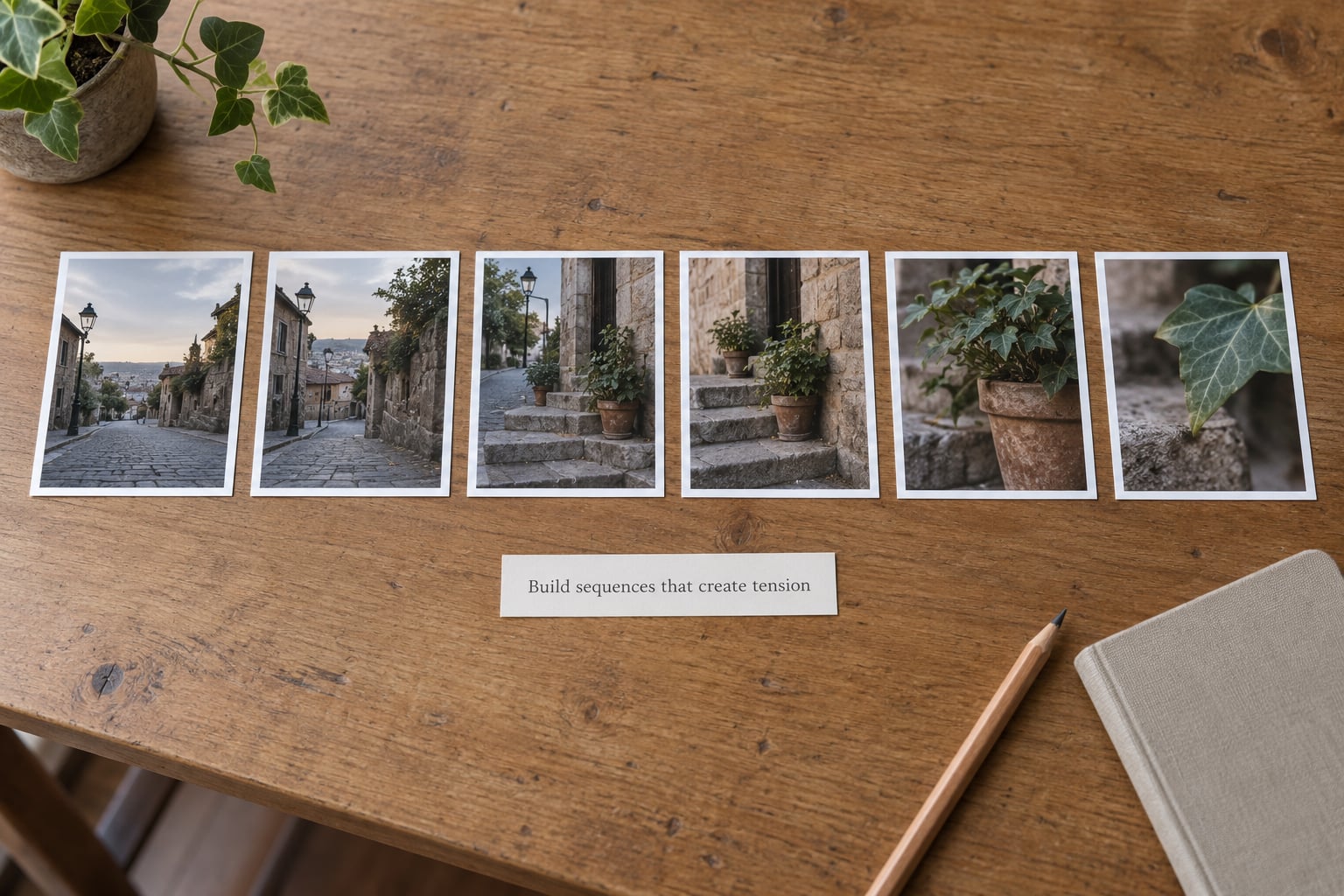
Now arrange the frames so the viewer has to move. A sequence without change is a list.
Open with an establishing image that sets place and scale, so the viewer knows what they are looking at. Then narrow: get closer, cut the context, let one object or one hand fill the frame. Close with the image that complicates the apparent answer.
Three moves are enough to make most sequences work. After that, watch for rhythm rather than content. Alternating wide and tight frames creates pace. Repeating the same framing five times creates pressure.
Test the story against the whole archive
Put the provisional sequence beside the wider library and look again. Three things usually happen.
Images that only repeat an idea get cut, because the idea is already carried by a stronger frame. A counterpoint appears, often a picture that argues against your reading, and it usually belongs in the set. And one gap gets exposed: the moment you thought you had photographed and did not.
Judge every candidate on its function in the sequence. A quiet frame that gives the eye somewhere to rest is worth more than a technically excellent picture that duplicates something already there.
When the set stops growing, it is ready. Twelve images on a wall, eighteen in a slideshow, or eight pages in a small zine. The output is not the hard part.
Common Mistakes
Forcing a single meaning too early
The most common failure is deciding what the archive is about before looking at it. You end up hunting for proof of an idea you already hold, and the photographs become illustrations.
The fix is to keep two readings alive until the sequence is finished. If both survive the test against the whole archive, either one is defensible. If only one survives, that is how you know it was never a choice you made.
Choosing only the strongest individual images
Every archive contains a handful of pictures you would show anyone. Building a sequence only from those produces a beautiful portfolio and no story, because each image is competing with the others instead of moving them forward.
Judge frames by what they do in the set: establish, narrow, interrupt, resolve. Most sequences need more middling frames than hero frames. A slightly blurred frame between two sharp ones can do more work than either.
Ignoring order and viewing time
Chronological order is a default, not a decision. It answers the question when, which is rarely the question you want answered.
Build at least two arrangements: one in date order, one in the order the images pull you. Then view each away from the screen, at the size a stranger would see it. Order, spacing and the length of time a viewer spends on each frame all carry meaning.
Tips for continuing after the first sequence
Save every alternate edit you make, and date it. In six months you will want to know what you believed then.
Keep a running question log. A line a month, written after looking at the library for twenty minutes, will build the raw material for the second and third projects faster than any search will.
Work carefully with other people’s images. If the archive includes family photographs, ask before publishing, and give people a say in how they appear. Some material is not yours to interpret at all, and marking those frames as closed is a normal part of the process.
Come back after new work. Archives change meaning as you change, and the images you rejected two years ago are often the ones that describe you accurately now.
Frequently Asked Questions
How do I find a story in photos I took years ago?
Start with one folder and one written question, then look for a detail that repeats: a gesture, a colour, a location, a composition. Make a contact sheet of forty to sixty frames and mark the echoes. That is usually enough to know whether the folder holds a thread worth following, and you can move on in an evening rather than a month.
What if my photo archive is huge and poorly organized?
You do not need the whole library organised, only one sample per session. Pick a date, a trip or a folder, view it as a grid, and label what you can. If your software offers keyword search, face grouping or automatic similar-image grouping, use them as a shortcut, but fall back to your eyes often, because untagged images often hide their thread in plain sight.
Should a photo story follow the date the photos were taken?
Not always. Chronological order answers when, which is useful for history and dull for tension. Build one sequence in date order and a second in the order the images pull you, then compare them. Choose the order that makes the change visible, and reserve strict chronology for the moments when the passage of time is the actual subject.
How many photos should be in a narrative sequence?
There is no correct number, and any answer that claims otherwise is selling something. A tight sequence of ten images can say more than forty. Cut when a new frame stops adding context, rhythm, tension or change, and resist the urge to fill a wall or a slideshow slot. Most archive sequences I have seen work land somewhere between eight and twenty-five frames.
What is the difference between documenting a story and imposing one?
Documenting means the images carry the meaning and you arrange them so a viewer can follow it. Imposing means you decide what it means first and pick frames that agree with you. The test is simple: can you name at least two things the photographs show that you did not intend? If not, you are probably telling rather than showing.
How do I know when a photo archive sequence is finished?
It is finished when adding an image changes nothing and removing one leaves a hole. Test it by viewing the set at viewing speed, away from the screen, at the size a stranger would see it. If it still works in that setting, stop. Sequences are almost never improved by another week of searching, and often get worse.
Conclusion
Do one thing tonight: pick a single folder, build a contact sheet of fifty frames, and write three questions beside it. Mark every detail that appears twice.
If you are learning how to find a narrative in your own photo archive, that is the whole method. Questions narrow the search, contact sheets make patterns visible, notes keep fact and interpretation apart, and sequencing turns a group of related images into something a stranger can walk through.
Treat the archive as material, not as a finished story waiting to be uncovered. The thread is already in there, probably in the frames you barely remember taking, and it will look different once you put it in order.