To critique your own photographs honestly, you need distance, a fixed rubric and a written note: define what the frame was for, write your first reaction before analysing anything, then walk the same technical, artistic and emotional checklist every time and leave with one specific fix.
Most photographers already know what is wrong with a frame. What they lack is a way to separate a weak photograph from a photograph that is simply unfamiliar to them.
Three things get in the way. Memory inflates the frame you agonised over, excitement from the day of the shoot fades unevenly, and the people closest to you will almost always say the picture is lovely. Practitioners on r/photography talk about this constantly, and their most useful contribution is not the answer but the questions they propose asking: is this frame too busy or too boring, how is the colour and contrast, how could the light have done more for the subject.
Table of Contents
- What You Need
- Step-by-Step: A Repeatable Photography Critique
- Common Mistakes
- Frequently Asked Questions
- How often should I critique my photographs?
- How can I tell whether I dislike a photo because it is weak or because it is unfamiliar?
- Should I ask another photographer to critique my work?
- What if the most visible technical flaw is not what bothers me most?
- When should I stop editing a photograph?
- How do I critique your own photographs without becoming emotionally defensive?
- Conclusion
What You Need
You need four things, and three of them are free.
- A neutral viewing setup. A mid-grey desk, indirect light, no phone next to the monitor showing someone else’s Instagram feed mid-scroll.
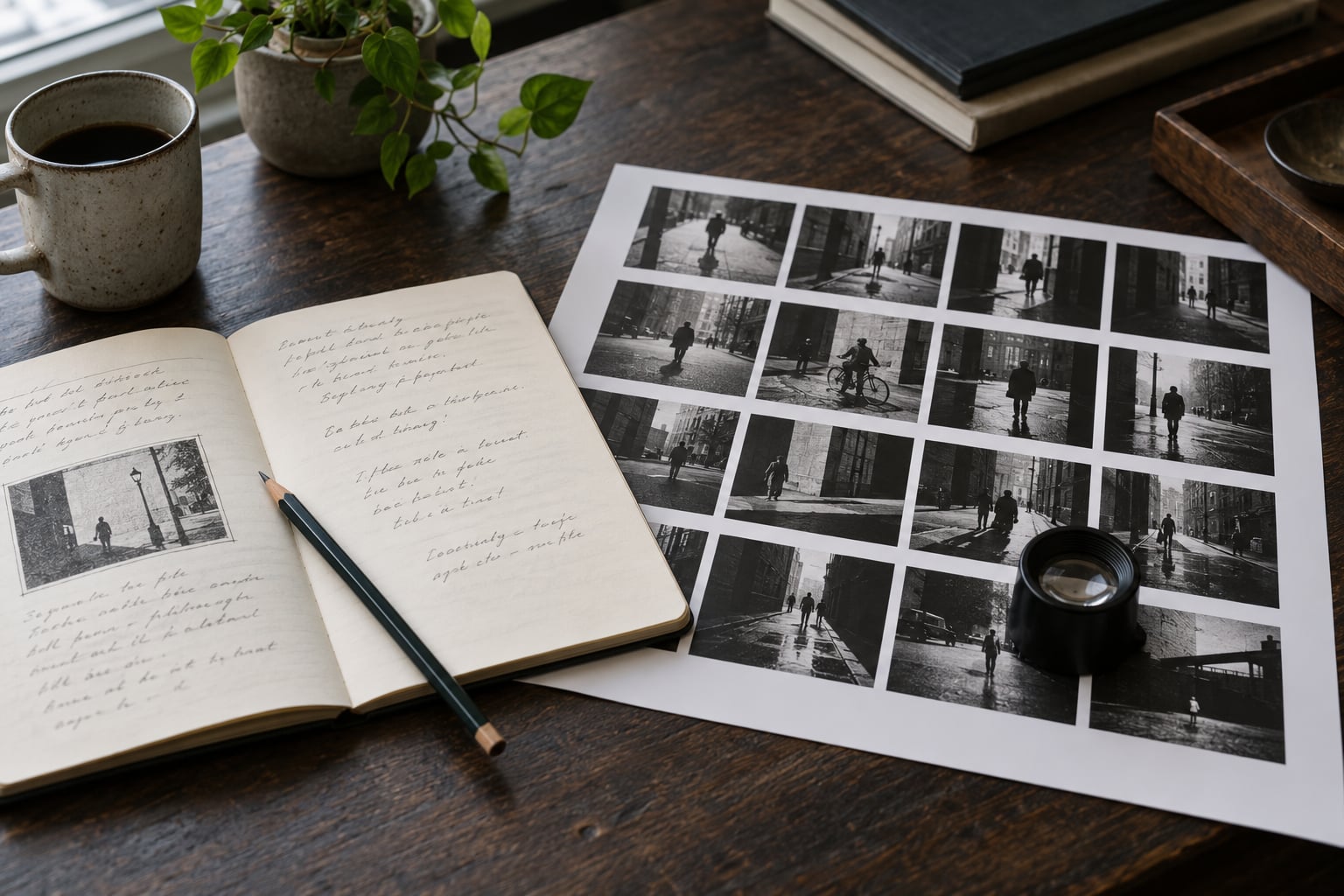
- A contact sheet. Thumbnail view of the whole shoot, so a single frame is judged as part of a sequence rather than in isolation.
- A second surface for close inspection. A calibrated monitor at 100 percent, a tablet, or a print. A print is better and most photographers never try it.
- A notes system. A notebook, a text file, a spreadsheet. Anything that forces your judgement into words instead of feelings.
Software is optional. A histogram and a clipping warning are genuinely useful, but a rubber band across the frame and a squint test cost nothing and work in any editor you already own.
The goal of the setup is evidence-based judgement, not fault-finding. If you spend the whole session hunting for what’s wrong, you will find something in every frame and finish the exercise more tired than you started.
Step-by-Step: A Repeatable Photography Critique
Six steps, in this order. The order matters more than the length of any single step.
Set Your Intention Before Looking
Write the photograph’s purpose in a few words before you open it: what it is for, who it is for, what it should make someone feel. Forum regulars on r/photocritique require exactly this of posters asking for feedback, and the reason is practical.
Once the intent is on paper, deviations stop being automatic failures. A tilted horizon is a fault in a documentary frame and a deliberate choice in a disorienting street frame, and only one of those deserves your correction.
Write Down Your First Reaction Without Judging It
Record the immediate response in one line, before you look at anything technical. Calm, restless, intimate, confusing, confident, quiet.
Keep subjective impressions separate from objective claims, because they answer different questions. “Calm” is a report about your response. “The horizon is tilted three degrees” is a statement about the file. Mixing them is how a defensible argument turns into an unfalsifiable mood.
Build Two Contact Sheets and Change the Scale
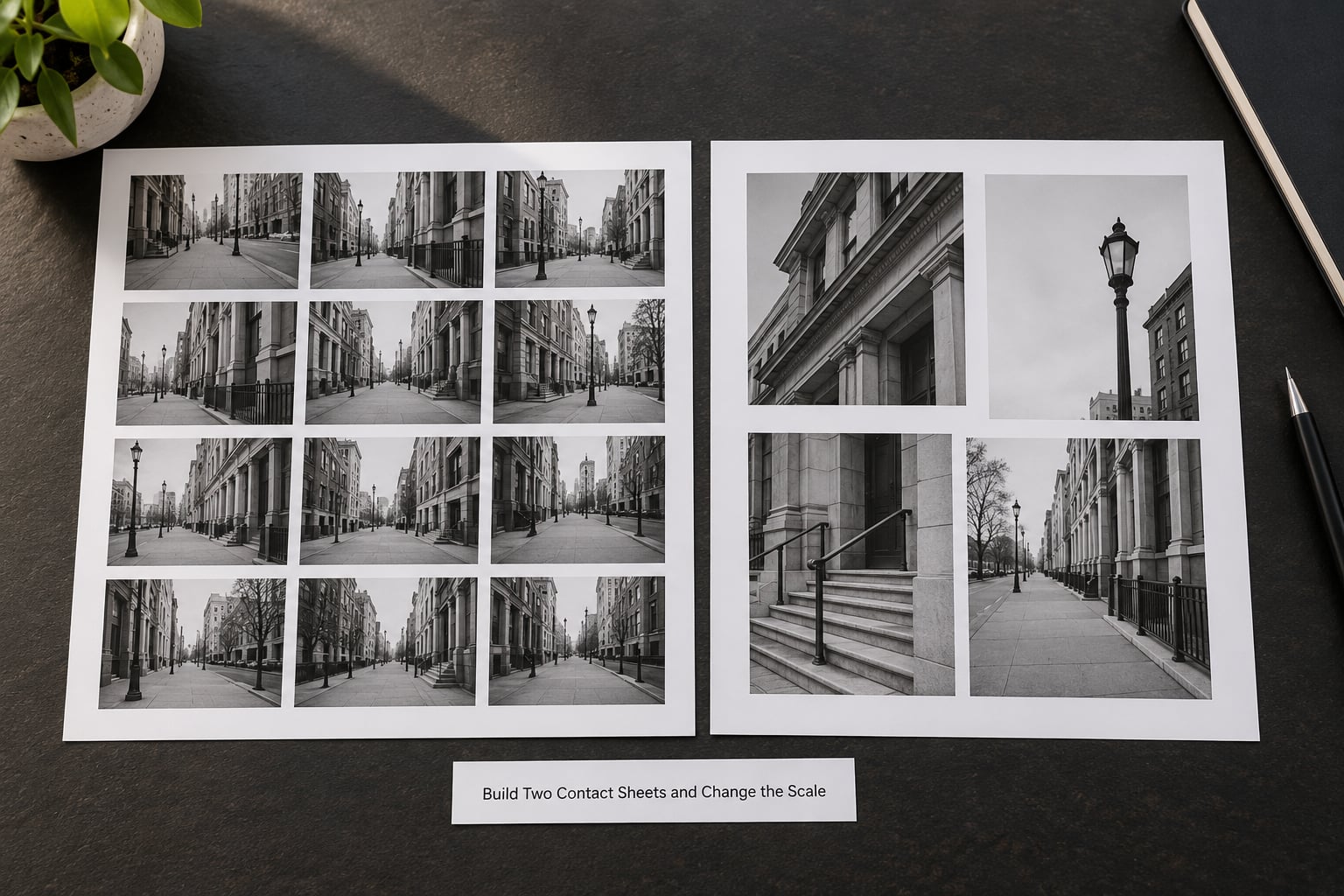
Print or export two contact sheets from the same shoot. Keep the frames in shooting order on one. On the second, keep only the keepers and group them by what they have in common.
Sequence view exposes rhythm: repeated shapes, a camera that drifted, a light that changed and did not change enough. Selection view exposes consistency of intent. Then open one frame at full size, which exposes everything else.
That third stage is where the things you could not see at thumbnail size become visible. Focus that misses the eye. A bright bin lid in the corner. Tonal transitions that go muddy in the shadows. Edge detail that dies under heavy sharpening. What looked resolved on the contact sheet is often merely small.
How to Critique Your Own Photographs Honestly Without Defending Them
Every criticism you write has to pass three tests: what is visible, what effect it has, and what you would do about it. If you cannot complete all three, you have a preference, not a critique.
Here is the rubric. Score each axis from 1 to 5 and write the one sentence that justifies the number.
| Axis | What to check | Example question | Score |
|---|---|---|---|
| Technical | Exposure, clipping, focus, sharpness, white balance, horizon, lens corrections, noise | Is any detail unrecoverable, and can I name it? | 1-5 |
| Artistic | Focal point, composition, distracting elements, colour, tonal contrast, subject isolation | Where does the eye go first, and was that the plan? | 1-5 |
| Emotional | Moment, story, relationship between subject and viewer, what the frame communicates | Does it say what I wanted to say without a caption? | 1-5 |
Technical scoring should be binary underneath the number. A frame either holds its highlights or it does not, either has focus on the subject or it does not. Once you have named the fault, the emotional axis becomes much easier, because you are no longer arguing with a memory.
On the artistic axis, a useful test is distribution of interest. Roughly 20 percent of the frame carries the foreground, 60 percent the middle distance, 20 percent the background. When a frame feels busy, one of those zones is usually doing twice its job. When it feels empty, one is doing nothing.
Watch the labels. Bad, amateur and amateurish are not critiques. “The bright wall behind the subject is the same value as the subject’s shirt, so they merge at thumbnail size” is a critique, because you could act on it.
Compare the Result With Your Intention
Now put the score next to the intention you wrote in step one, and sort every criticism into one of three piles: a genuine mismatch with your stated purpose, a matter of taste, or a technical imperfection that is actually serving the mood you wanted.
That third pile is the one beginners skip and experienced photographers rely on. Grain can be doing the work. Soft focus can be the point. A blown highlight in a night frame may be the only thing that feels like night.
If a criticism survives all three tests, keep it. If it only survives the first, it is taste, and taste is allowed to stay.
Run a Second Pass Days Later

Two to seven days later, look again. Attachment drops and the frame settles into something closer to what a stranger would see.
This time write three lines and nothing more: the strongest issue, one optional improvement, one element to preserve. Three is deliberate. Longer lists produce overediting, and the preserve line matters as much as the fix because it stops you correcting the parts of the photograph that were working.
Wait before making irreversible edits. If a decision still feels arguable after a week, keep both versions and decide which one belongs in the portfolio.
Common Mistakes
Confusing taste with standards. Correct: label every note as a standard or a preference. Standards are arguable with evidence; preferences are just yours.
Hunting for problems. Correct: start from the intention and score the axes, rather than scanning for flaws until something turns up.
Rewriting the concept to match your taste. Correct: if you did not like the frame, decide whether it missed your brief or whether the brief was dull.
Editing while tired. Correct: leave the second pass for a rested session. Fatigue turns a two-minute crop into a two-hour demolition.
Treating polish as value. Correct: score the three axes separately. A technically immaculate frame that communicates nothing scores 5, 5 and 1, and that row of numbers tells you more than any histogram.
Asking people who will not answer honestly. Correction: post to r/photocritique or a camera club, and state your intent with the image, which is the norm there anyway.
A few practical tips. Print at least your best frame from every shoot, since a print kills screen bias in seconds. Reuse one rubric so scores stay comparable across months. Keep the notes, because the journal is the only record of progress you will ever have. And if critique turns into self-doubt that lasts more than a day, close the folder and go shoot something you enjoy for a week.
Frequently Asked Questions
How often should I critique my photographs?
Critique in three passes with different lengths. Spend five minutes on a contact sheet after every shoot to cull and spot patterns. Give your selected frames a full rubric pass once the images have cooled for a day or two. Then review a month of work end to end, which is where growth becomes visible.
How can I tell whether I dislike a photo because it is weak or because it is unfamiliar?
Test it against the rubric. If you can name a visible technical or compositional fact and the effect it has, the criticism is grounded. If the only honest description is a mood word such as strange or wrong, you are probably reacting to a style you have not seen before, which is a very different problem from a weak frame.
Should I ask another photographer to critique my work?
Yes, once self-critique stalls. Bring a specific question rather than asking whether the photo is good. State your intent with the image, as r/photocritique posters are expected to, and ask for one flaw and one fix. A named, actionable note is worth more than a page of praise.
What if the most visible technical flaw is not what bothers me most?
Both are real, and they belong in different places. Fix the technical fault because it is a fault, then record the other reaction as a decision: keep it, change it, or shoot that subject differently next time. Burying an unresolved emotional reaction is how frames you resent end up in your portfolio.
When should I stop editing a photograph?
Stop when a second pass produces no new note beyond the three lines you already wrote: one strong issue, one optional improvement, one element to preserve. If an edit has survived a week without adding anything, it is finished. Continuing past that point usually means editing for a viewer who does not exist.
How do I critique your own photographs without becoming emotionally defensive?
Separate the frame from yourself before you start. Write the intention down, score the three axes with numbers, and insist that every criticism ends in a fix. A note like tighten the crop has a direction, while this frame feels amateur has none and will only trigger the defence reflex.
Conclusion
Honest self-critique is not harshness applied to your own work. It is three moves: name what the photograph is trying to do, describe honestly what it actually does, and choose one evidence-based next action from the gap.
Start today by writing the purpose of your last frame in a single sentence, then writing your first reaction before you touch anything technical. Everything else follows from those two lines.