The single biggest mistake to avoid when shooting your first paid session is starting without a written agreement and a deposit. A text thread is not a contract, and a friendly handshake is not a booking. Everything else on this list — the light, the gear, the posing, the deadline — is recoverable. A scope dispute over what you owe, or a client who walks away without paying, is not.
That is what changes when real money is involved. A practice shoot is a conversation with your own camera. A first paid session is a promise: this many photographs, in this style, by this date, for this use. New photographers tend to over-focus on the craft side and under-prepare the business side, then wonder why a technically fine shoot felt like a bad experience for everyone in it.
Here are the twelve mistakes I see most often in first paid sessions, in the order they tend to happen: booking, preparation, shoot day, then delivery.
Table of Contents
- Mistakes to Avoid When Shooting Your First Paid Session at a Glance
- 1. Starting Without a Clear Written Agreement
- 2. Confirming the Session Without Asking the Right Questions
- 3. Failing to Plan the Shot List and Visual Direction
- 4. Showing Up With Incomplete Gear or Missing Backups
- 5. Arriving With No Time for Setup or Recovery
- 6. Ignoring the Location, Light, and Weather
- 7. Directing Poses and Emotions Too Mechanically
- 8. Forgetting to Back Up and Protect the Images
- 9. Editing Through Pressure Instead of a Defined Process
- 10. Delivering Late or Delivering the Wrong Files
- 11. Undercharging for Time, Travel, and Extra Work
- 12. Treating the First Paid Job as a One-Off Event
- Frequently Asked Questions
- Conclusion
Mistakes to Avoid When Shooting Your First Paid Session at a Glance
The table below pairs each mistake with the moment it turns into a real problem and the fastest way to prevent it. Skim this if you have ten minutes; read the full sections if you have an hour.
| Mistake | When it becomes a problem | Fastest fix |
|---|---|---|
| No written agreement | The day the client asks for “just a few extra” or disputes the date | One-page scope, signed and copied to both of you |
| Booking without asking anything | When you learn on the day that the images are for a passport, a dating profile, or a lawsuit | Six questions about purpose, comfort, must-haves and limits |
| No shot list | Minute twenty, when neither of you knows what to do next | Ten must-have frames written before you leave home |
| Incomplete gear or no backup plan | A dead battery, a full card, a card reader that will not connect | 24-hour pre-flight plus a two-slot redundancy habit |
| No setup or recovery time | You arrive at the booked start, not the light | Arrive 30 to 45 minutes before the client |
| Ignoring location, light and weather | Harsh noon sun, a locked gate, fog you did not forecast | Scout at the same time of day; name a backup plan in writing |
| Mechanical posing direction | Your subject stiffens and starts performing for the camera | Short action prompts, movement, then specific praise |
| No backup of the files | Your only copy dies before the edit is finished | Two copies in two places before you format a card |
| Editing under pressure without a process | Forty hours of culling in a single sitting, inconsistent results | A fixed five-step workflow with a defined final count |
| Late or wrong delivery | The client asks where the photos are on the due date | Add a buffer, check orientation and profile, send early |
| Undercharging for your real time | The invoice, three months later, for less than the gear cost | Price prep, travel, edit, admin and taxes, not shoot hours |
| Treating it as a one-off | The second client finds you through a stranger or a search | Debrief, follow up, ask for a review and a referral in writing |
1. Starting Without a Clear Written Agreement
No written agreement is the mistake that ends careers, and it is the one beginners skip most often. The rule is simple: nothing is booked until a written scope exists, a signature is on it, and money has moved. Photographers on photography forums describe the same pattern repeatedly — a client delays payment for a month, or asks for the pictures before paying at all, and there was no document to point to.
One page is enough. A useful first-session agreement covers the session type and name, date and start and end times, duration, the number of delivered images, the style, the turnaround time, licensing and usage rights, revision limits, cancellation and reschedule terms, payment schedule, travel expenses, and what happens if weather kills the shoot.
Two terms cause more arguments than the rest. Licensing and usage: you keep copyright, and you grant the client a defined use — personal printing, social media, or a small business website. Say explicitly whether commercial use is included. Revisions: write down that the package includes one round of global adjustments, and that extra rounds are billed per hour.
Also get a model release, signed, from everyone identifiable in the frame. It is standard for commercial work, and it protects you if a client later wants you to retract images or uses one in an advertisement. Rules about minors and model releases vary by jurisdiction, so check your local requirements rather than copying a template blindly.
How to check the agreement before accepting the booking
Before you take the deposit, read the scope against the client’s original request line by line. If the request mentioned a date, a location, a number of people, a purpose, or a deadline, confirm that each one appears somewhere in the written terms. Anything the client said verbally and you did not write down does not exist.
Next, flag vague language. “A few hours,” “some edited photos,” “as needed” and “we will see” are all sentences that become disputes later. Replace them with numbers and dates before you send it. Then get written approval — a signed PDF or a clear “yes, this is right” reply in writing — before you collect any money.
2. Confirming the Session Without Asking the Right Questions
Most of a first paid session is preventable, because the answer was sitting in an email you read too quickly. Ask six questions and you will know what the session is for, which saves you from delivering 200 files that nobody can use.
| Question | Why it matters | When to send it |
|---|---|---|
| What will you use the photos for? | Personal prints, a business site, a date profile and a print advertisement need very different framing and licensing | Before confirming |
| How many people, and are any of them children? | Sets the shot list length, the pacing and any guardian release needs | Before confirming |
| Are there specific images you must have? | A grandmother’s ring, three generations together, a matching set of five — these belong in your shot list | Two weeks out |
| How comfortable are you being directed? | Some clients want active posing, others only want candid moments | Two weeks out |
| What time constraints, outfits, or sensitivities? | Sunset deadlines, a child who naps at 3pm, religious or dietary rules at the location | One week out |
| Where exactly, and is parking and access confirmed? | Closed gates, no parking and construction are the most common location failures reported by new photographers | One week out, again the day before |
Follow up in writing. The single most common turning point reported by photographers is the moment they stopped treating expectations as something people remember and started writing them down. A short check-in message a week out, listing the date, time, location, start time, and what to bring, cuts late arrivals and no-shows more effectively than anything else on this list.
3. Failing to Plan the Shot List and Visual Direction
A shot list is not a creative restriction. It is a safety net for the exact moment twenty minutes in, when the light is perfect, the client is relaxed, and nobody can think of anything to shoot. I keep mine in a note on my phone: ten must-have frames, each one a single line, ordered by how quickly they can be done.
Build it from the session type, not from a generic list. A family session usually runs wide family group, immediate family group, each child individually, each parent individually, and the close cuddles that end up on the wall. A headshot session is far tighter: front, three-quarter left, three-quarter right, and a few expressions. Write down three or four reference images the client likes, and bring them to the shoot as a shared reference rather than an art project.
Put the harder shots early, when people are fresh. Poses that need coordination and energy belong at the start, not at minute fifty when everyone is tired. Then leave the last ten minutes unscheduled for accidents, laughter and the frame you did not plan.
4. Showing Up With Incomplete Gear or Missing Backups
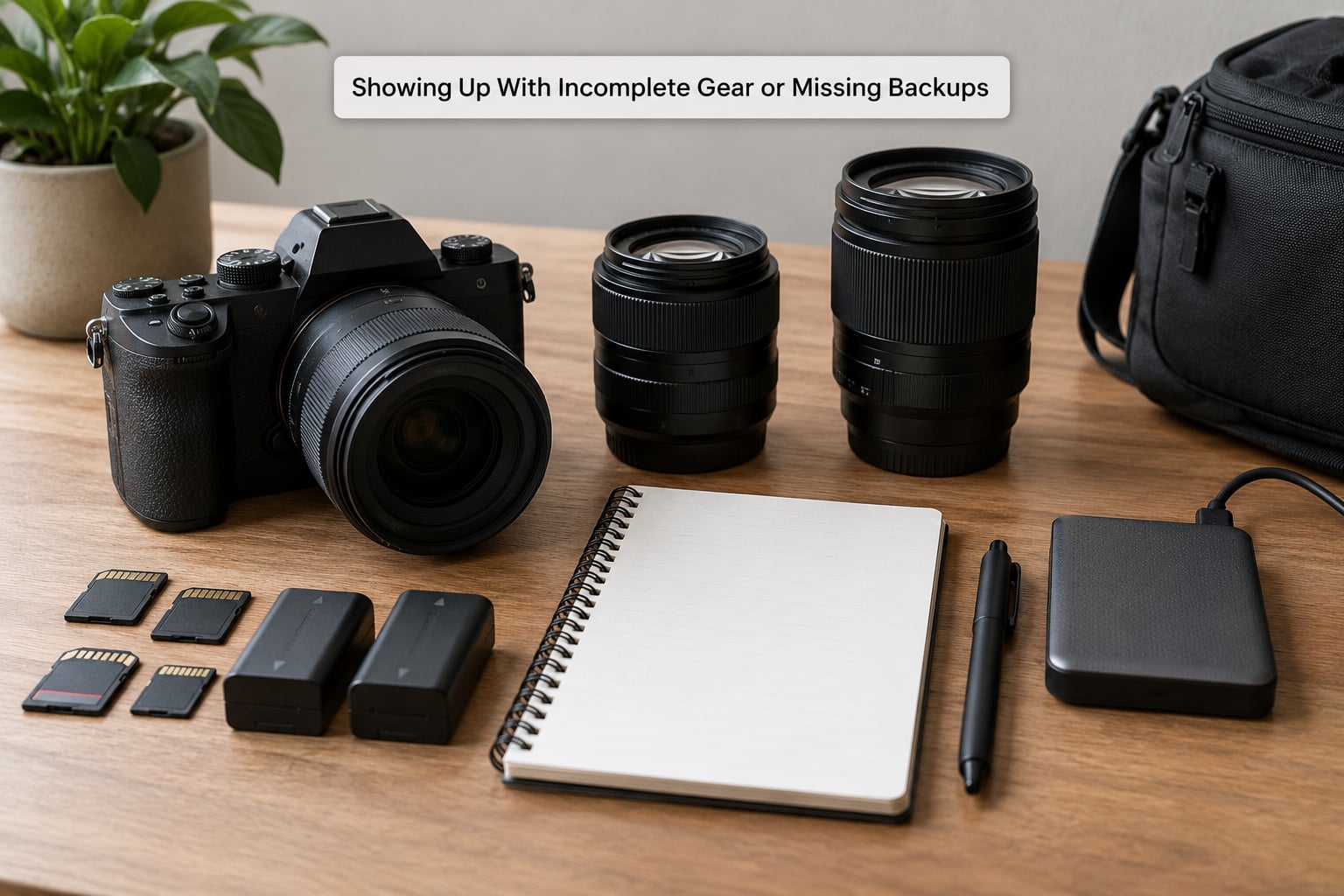
A paid session is the wrong day to discover a dead battery, a locked memory card or a firmware update you forgot to read about. A 24-hour pre-flight takes twenty minutes and removes almost all of that risk.
Go through the camera body, the lenses you actually plan to use, every battery charged and clearly labelled, cards formatted in the camera rather than on your computer, and a spare card even if you do not expect to fill the first one. Then check the light: stands, modifiers, cables, triggers, reflectors, a sandbag if the wind is forecast. Phone full, card reader tested, laptop or drive formatted, and the client’s contact details and address written somewhere offline.
On redundancy: if your camera has two card slots, use them. Writing a copy to both slots costs nothing and turns a card failure from a catastrophe into an inconvenience. And carry a backup drive. The most talked-about technical failures in first paid sessions are dull and entirely avoidable — a card reader that stopped connecting after an operating system update, a memory card that failed mid-shoot, a lens that fogged up after a cold car in humid air.
5. Arriving With No Time for Setup or Recovery
Arrive 30 to 45 minutes before your client, every time. You are not wasting the booking. You are buying the part of the session that decides how it goes: scouting the light, finding a background that is not a dumpster, setting up, testing exposure, and dealing with the fact that the parking is on the wrong side of the building.
| Time (relative to sunset) | Action | Mistake that ruins it |
|---|---|---|
| 90 minutes before | Scout the background, note the sun direction, test a frame | Arriving with the client already waiting |
| 45 minutes before | Set lighting, meter, check a test shot on the camera screen | Adjusting gear while the client arrives |
| 0 minutes | Start with a conversation, then wide establishing frames | Grabbing the camera before anyone relaxes |
| 60 to 15 minutes before | Golden hour: close portraits, backlit frames, movement | Missing the best light of the day on a schedule run |
| 15 minutes after | Stop shooting, save, verify, and make the first backup copy | Packing up while the client is still standing there |
Running past the booked end is a scope and pricing problem, not a generosity problem. Tell your client you are at the end of the session, and if they want more, say what it costs. Photographers who never learn this on the first job end up doing three unpaid hours on their tenth.
6. Ignoring the Location, Light, and Weather
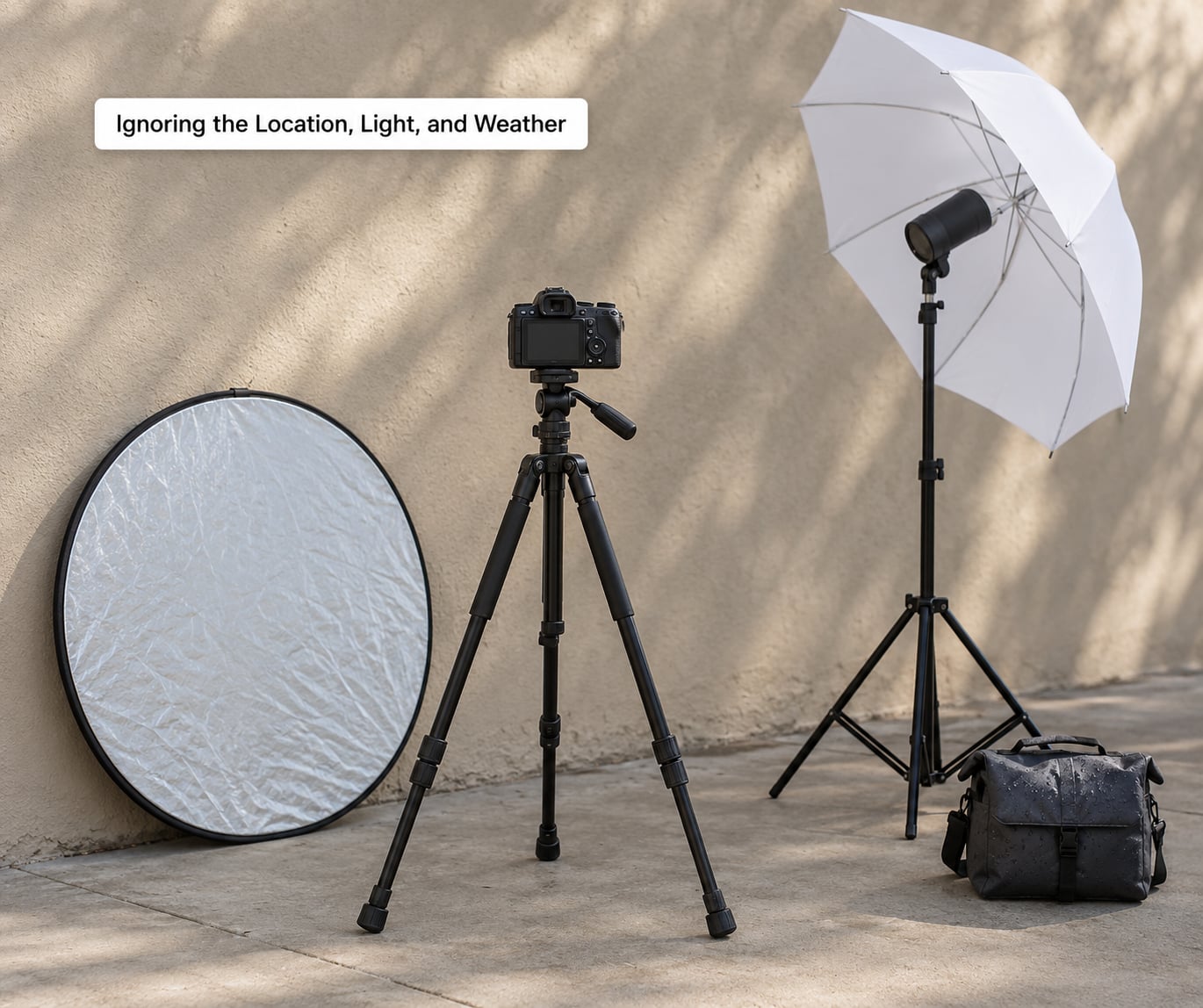
The most cited lesson from photographers describing their own early mistakes is short: scout the location at the same time of day you plan to shoot. A park that looked great at four in the afternoon can be backlit and empty at the hour you actually have. Check the forecast, check the gate hours, check for construction, and check the parking. All four fail quietly until the day.
On the day, watch where the sun is coming from and how hard it is. Midday sun makes harsh shadows under the eyes and nose, and no amount of editing fully rescues it. Overcast skies are a gift — they behave like a giant softbox, and portraits in open shade are forgiving in a way that harsh light is not. Open shade is your friend too, especially for the twenty minutes after the sun moves.
Decide your weather policy in writing before the booking. One reschedule for weather, credited in full, is a fair and easy term to state. It also stops you from giving away a third free date because you did not want an awkward conversation.
7. Directing Poses and Emotions Too Mechanically
“Stand there and smile” is the fastest way to make a paying client look uncomfortable. Mechanical direction produces stiff images, and stiff images are the reason people say a session was weird.
Use movement instead of static poses. Ask them to walk toward you, turn toward the window, sit on the bottom step, then show me the same shot. Movement gives people something to do, and doing beats performing every time. Mix short action prompts with quieter frames: stillness works better once someone has moved for a few minutes.
Give specific praise, not empty praise. “That last one, the way you turned your shoulder” tells them exactly what to repeat. And when a frame is wrong, say why rather than what: “we are not there yet” is more useful than “relax.” Nerves are normal on a first session, and they usually come from the client not knowing what happens next. Telling them the plan out loud calms both of you.
8. Forgetting to Back Up and Protect the Images
The images are the business. Treat the only copy as the actual product, because if it is lost, you are refunding the session and starting over for free. Use the 3-2-1 approach adapted to what you can actually carry: at least two copies, in two places, with one of them somewhere other than your camera bag.
Run the sequence on the night of the shoot, while the adrenaline is still useful. Copy the card to your laptop or drive. Open a few files and confirm they are intact — a file that copies but does not open is a bad sign, and a corrupted file discovered two weeks later is a lost image. Then copy to a second location, label the folders with the client name and date, and only then format the card.
Two habits prevent most of the disasters people describe. Never hand a client the only storage copy of their images, and never delete raw files until the final delivery is out the door and the payment is settled.
9. Editing Through Pressure Instead of a Defined Process
The edit is the biggest unpaid block of time in a first paid session, and it is where enthusiasm turns into burnout. Write your process down once, then repeat it. A workable sequence: import and verify, cull, edit in a consistent order, retouch, crop and straighten, then export and check.
Culling is where the time goes. If a package includes 30 final images, that is a target, not a suggestion. Three hundred unedited files for a 30-image package is not generosity; it is four hours of extra work and a client who now has to choose. Photographers describe the moment they stopped over-delivering as a turning point in their business, and the fix was simply putting a number in the contract.
Export tests matter more than beginners expect. Open a file on your phone, on a second computer, and on the delivery site. Check orientation on every image, check that colours are not washed out because a profile was missing, and check that the client’s download is a usable size for printing. Ten minutes of checking is cheaper than a resend.
10. Delivering Late or Delivering the Wrong Files
Set your delivery date in the agreement, then schedule it in your own calendar with two to three working days of buffer. Under-promise once and over-deliver; the same rule applies to your edit time as it does to your light.
Match the files to the contract. Resolution, colour space, number of images, and usage rights were all specified, and clients deliver business cards, invitations and print ads from what you send. If something goes wrong, say so before the client asks. A message that says “the gallery is one day later than planned, here is why, and here is the new date” costs far less than being chased.
Include the practical extras in the same email: a short note on how the images were made, an invoice for the balance, and your contact details for print questions. That message is doing three jobs, and it is the difference between a transaction and a relationship.
11. Undercharging for Time, Travel, and Extra Work
Beginners price the shoot hours. A real price covers everything else: preparation, travel, setup and teardown, the edit, culling, retouching, revisions, invoicing, administration, taxes, gear wear, insurance, and the unpaid time you spend marketing. Price the job, not the shutter.
Work it out honestly. Add up your time across a typical month, divide by the number of sessions you can realistically deliver, and that is your effective hourly rate before a single cost is subtracted. Then subtract business costs such as insurance, software, storage, travel and equipment wear. Whatever remains is your compensation, and the rate you charge should be set above that number with room for profit, not at it.
A worked example: if a session takes 1.5 hours on the day and 6 hours of prep and edit, that is 7.5 hours of your life. Add 45 minutes of round-trip travel and 30 minutes of admin and invoicing, and you are at roughly 9.5 hours. Charging for a 1.5-hour shoot against 9.5 hours of work is the classic first-job mistake, and the numbers do not improve by hoping the edit goes faster than usual. The fix is boring: quote the package, put it in writing, and price the extra work when it is requested.
12. Treating the First Paid Job as a One-Off Event
Photographers often describe the first paid session as a win even when the client had unmet expectations, because finishing the job at all was the achievement. That is the right read. But the session also sets the price you will be accepted at, and it produces the review that brings the next booking.
Debrief while it is fresh: what worked, what you would shoot differently, what you forgot to bring, which frames the client loved. Write it down. Then send a short follow-up a few days after delivery, ask whether they need anything adjusted within the agreed round, and ask two things — a written review, and whether they know anyone booking the same kind of session. Referrals come from the delivery email, not from a later follow-up campaign.
Protect the boundaries while you build the reputation. Say no to extra images, extra locations and extra people on the first job. A photographer whose first five clients all got double what they paid will have a very hard time correcting that in year two.
Frequently Asked Questions
How Should a New Photographer Prepare for a First Paid Session?
Start with the paperwork, not the gear. Send a written scope, collect a deposit, confirm the date, location, backup location, and number of people, then follow up in writing a week out and again the day before. Scout the location at the same time of day you plan to shoot. Format your cards, charge your batteries, test the gear, and pack a second drive. Write a ten-item shot list and know which three frames are the must-haves.
What Should Be Included in a Photography Agreement?
At minimum: session type, date, start and end times, duration, the number of delivered images, turnaround time, licensing and usage rights, revision limits, cancellation and reschedule terms, the payment schedule, and travel expenses. Add a model release for anyone identifiable in the frame. Keep it to one page, use numbers instead of phrases like a few hours, and have the client approve it in writing before you take payment.
How Many Photos Should a First Paid Session Deliver?
Decide before you shoot and put the number in the agreement. Many first paid sessions land comfortably between 20 and 40 finished images, which gives a client genuine variety without handing them 300 unedited files to sort. Culling is where the hours disappear, so decide the final count, cull to it, and charge extra for anything beyond it instead of quietly giving it away.
How Do You Know When a Portrait Session Is Going Well?
Look for looseness, not smiles. If your subject is talking, moving, forgetting you are there, and reacting to your prompts, the session is working. If they hold a pose, look at you for approval, or repeat a pose exactly the same way three times, slow down, add movement, and start a conversation. Most nervous clients settle after five minutes of ordinary chat.
Should I Offer a Discount for My First Photography Job?
Charge your real rate. A discount on your first booking sets the number every client hears from you, and raising it later is harder than starting there. If you want to work inexpensively, offer a short paid session with a defined deliverable count instead of a lower price on a full session, and trade nothing but scope. Free and TFP work still needs a signed model release.
Conclusion
Start with the written agreement, a deposit, and a shot list. Those three things take an evening and remove the failure modes that actually cost money. Then run the pre-flight: gear tested, cards formatted, location scouted at the right hour, arrival time set 30 minutes early.
The rest — light, direction, pricing, delivery — gets easier with each job, and it gets easier faster if you debrief in writing after every session. The mistakes to avoid when shooting your first paid session are mostly about doing the boring professional work before you arrive, rather than only in front of the camera.