Keeping a long term photo project going is mostly an exercise in removing motivation from the equation. You need a written question the work answers, a cadence low enough to survive a bad week, a small buffer of frames made ahead of time, and a review rhythm that makes slow progress visible. Projects rarely die because the photographs were bad. They die in month three, when the novelty is gone and shooting feels like a chore.
This is about sustaining an ongoing creative project over months or years, not about storing photo files for decades. Backups matter here, but only so the work survives; the subject is your attention.
The short version, in the order it actually works:
- Write the project question and its finish line before you shoot.
- Pick a recurring subject, place or person you can return to without negotiating access.
- Set a cadence you could keep during your worst month, not your best one.
- Keep two to ten buffer frames made in advance for the weeks you cannot shoot.
- Review and edit in one weekly batch instead of after every outing.
- Show progress in small, low-pressure batches rather than daily posts.
- Set a definition of done so the project can end instead of expanding forever.
Most of this takes an hour to set up properly. The hard part is not the setup.
Table of Contents
- What You Need
- Step-by-Step
- Common Mistakes
- Frequently Asked Questions
- How do I stay motivated during a year-long photo-a-day project?
- What are the rules for a 365-day photo challenge?
- How do I get over losing inspiration or motivation?
- How do I restart a photo project I already stopped?
- How do I know when to end a photo project?
- Should I publish my project while it is still running?
What You Need
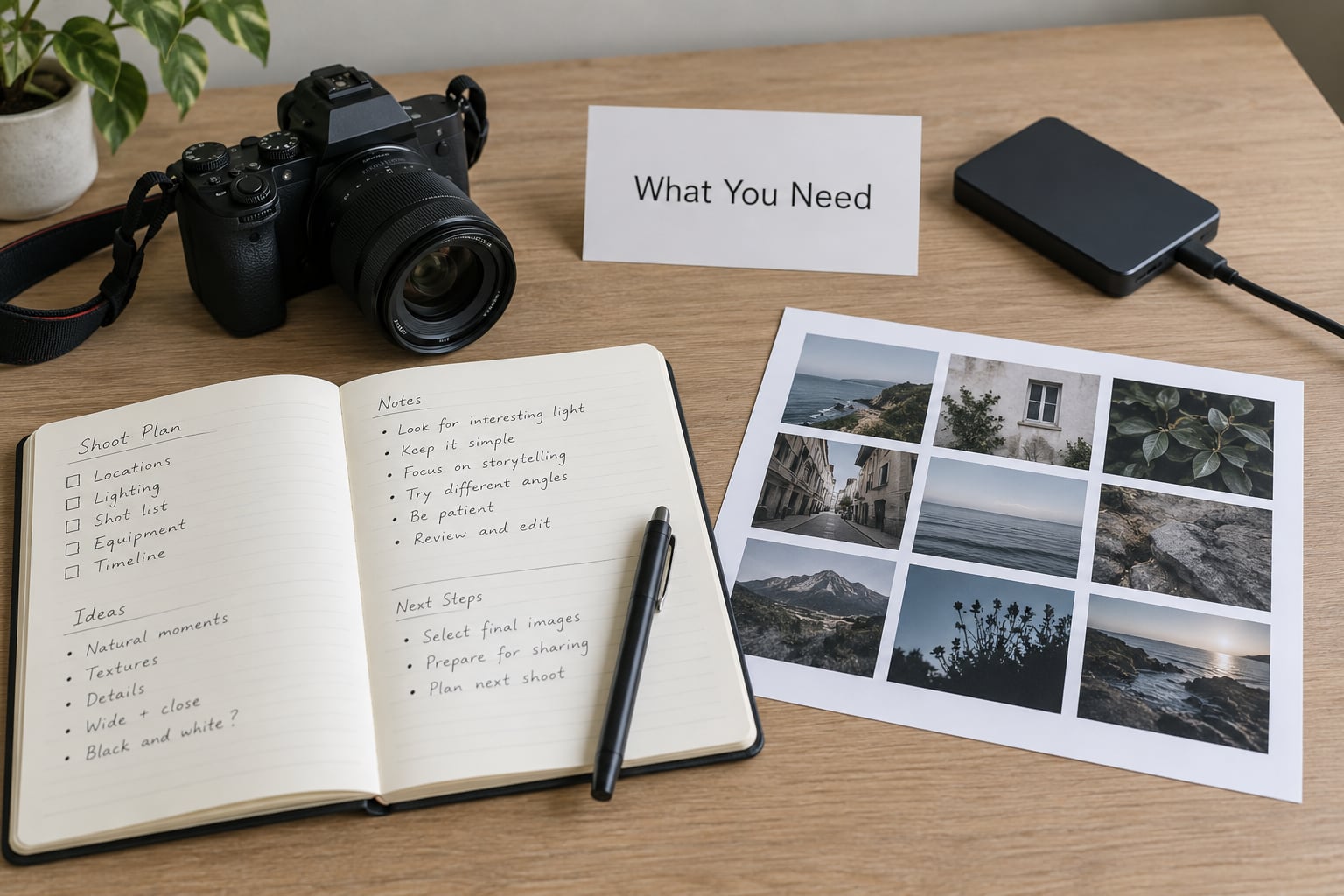
Five things, and none of them are expensive. The point is to write them down before motivation has to supply them for you.
A one-page project brief
One page, no more. It holds the central question, the boundaries (what is out of scope), the recurring setting or subject, the intended output, and the date you consider it finished. A single page is a deliberate constraint: if the project does not fit on it, the idea is still too vague to shoot for a year.
Reliable access
The most common failure is access that depends on goodwill. If your project needs a person, a building, a permit, or a location that is four hours away, confirm now how that works in February, not in August. For recurring locations, count the number of usable visits a year before committing to a daily or weekly schedule.
A camera plan and a two-copy backup plan
Commit to one body and one focal length for the duration of the project. Changing equipment mid-project breaks visual continuity in a way that is hard to repair later, and it is the single most repeated piece of advice in long-term project material.
Format cards in the camera so a dead laptop cannot end the project. Then keep two copies: one at home, one somewhere else. A weekly ten-minute sync to a second drive costs less than one shoot and has rescued more archives than any piece of software.
A tracking method you will actually use
A spreadsheet, a notebook, whatever you will genuinely open. Four columns are enough: date, location or subject, how many frames you made, and one sentence on what you were looking for. The fourth column is the one that pays off, because it is what turns a pile of files into a body of work.
A review rhythm on the calendar
Thirty minutes, once a month, blocked out in advance. Not a promise to yourself during a good week, which is how every good intention in this hobby dies.
Step-by-Step
How to keep a long term photo project going
You keep a long term photo project going by answering one written question with every session, and by deciding in advance when the answer will be good enough. That is the whole mechanism. Everything below is a way of protecting those two decisions.
A good central question is narrow and open at the same time. “What does this place look like when nobody is performing for anyone?” is a question. “This town” is a subject, not a question. “How does this person’s posture change over five years?” is a question. The narrow version gives you a way to know whether a frame belongs, which is what stops month four from turning into an undirected pile of travel snapshots.
Then set three boundaries in writing. A time boundary (one year, one season, one hundred visits). A scope boundary (this one street corner, this one person, this one building). And an output boundary (a set of forty images, or a contact sheet of 365, not an open-ended archive).
Finally, name the recurring setting. The strongest recurring-subject projects in photography all work the same way: the same place over time, a single person across years, or one seasonal study repeated on a schedule. Repeating a single location across years is the clearest example of how a place keeps producing new material long after you think you have exhausted it.
Build a sustainable shooting rhythm
Choose a cadence you could keep in your worst month. For most people working full time, that means one to three sessions a week of 30 to 90 minutes, not a daily obligation. Daily projects work when the daily frame is genuinely small, and they fail when the daily frame quietly grows into “a good photograph” every night.
Alternate the two kinds of session. Short visits keep the thread alive and are usually where the surprising frames come from, because you are shooting without preparing. Once a month, do one deeper session where you return to the same vantage point and reproduce earlier frames deliberately, so the set has a spine.
Log the outing immediately, even if the log is three lines. Date, location, count, one idea. This is what makes month seven navigable instead of a memory test.
The shape of a project changes as it goes, and the risk changes with it:
| Phase | Motivation | Main risk | Cadence that works | What to review |
|---|---|---|---|---|
| Day 1 to 30 | High and fragile | Overcommitting | 3 sessions a week | Whether the question still interests you |
| Day 31 to 90 | Falling, predictable | The motivation crash and the first gap | 2 sessions a week, plus buffers | Which frames support the question |
| Day 91 to 365 | Low and steady, or gone | Silent drift into a pile of files | 1 session a week, monthly batch edit | Cohesion, and whether to finish |
Note the third column. Early on the risk is overcommitting; later the risk is drifting. They need opposite responses, and treating them the same is why people quit in the wrong month.
Create a repeatable field routine
A fixed routine removes the decision work that stops you leaving the house. Most people do not skip sessions because they lack ideas. They skip them because starting feels like a small creative problem every single time.
Before you go, in ten minutes: check the log, pick the one thing you are going to look for, format cards, charge the battery.
While you are there: shoot for a set time rather than until you get tired, rotate your position even when the light is good, and take one frame you know is mediocre. The community calls this permission to suck, and it works because a session that produces one good frame and nine ordinary ones still counts, while a session abandoned at the first soft composition produces nothing.
After: make the minimum viable session official. One frame, culled and filed, is a completed session. That single rule is the most effective defence against a broken streak, and it removes the temptation to skip a low-energy day entirely.
Then log it and stop. No editing, no second-guessing, no scrolling back through the day’s files. The review is a separate appointment with a different purpose.
Review, edit, and archive in small batches
Process each session once, in a single weekly batch, rather than nightly. Nightly editing is the most common reason a long-term project collapses: it turns every outing into a small judgement about your own work, and after a week of that, shooting feels like exposure rather than practice.
In the batch, do three things. Cull to the frames that support the question, and move everything else to a separate folder you are not required to delete. Apply a consistent baseline edit across the set, since consistency of white balance, contrast and crop does more for a body of work than any hero frame does. Then log what you changed and why, in one line per session, because in eight months you will not remember.
Keep that second backup synced before you close the folder. Projects have been lost to a single failed drive, and the whole argument for a long project depends on the earlier work still being there when you reach the end.
Do not build a full contact sheet every month either. A quick thumbnail pass at the quarterly review is enough to show you whether the set is actually becoming cohesive or whether you have been making six different projects.
Share progress without creating extra pressure
Sharing is useful, but it is also the fastest way to turn a private project into a performance. The anxiety people describe around going public is real and it is usually larger than the anxiety of the work itself.
Batch it. A monthly contact sheet of twelve thumbnails tells a better story than a daily post, because it shows change over time rather than one frame stripped of context. If you want to publish the finished set, delay the reveal and share behind-the-scenes material in the meantime: the contact sheets, the log, the frame you culled and why.
Keep a private progress log for yourself. It is the version nobody can react to, and it is where the honest account of month four goes instead of into a draft you delete.
Pick two or three people for real feedback, not an audience. Tell them what kind of answer you want. On the forums, the most useful responses to long-term projects are always from working photographers saying “show me the one you hate”, not from strangers reacting to individual frames.
And ignore the numbers. Follower counts say very little about whether the work is improving, and the photographers who finish a full year tend to mention the same thing: the handful of consistent supporters who turned up mattered far more than the size of the audience.
Adapt the project as the story changes
Long-term work drifts, and drift is not automatically failure. The test is whether you decided to move. Review the project quarterly and make one of three explicit decisions: hold the same question and shoot harder, narrow the question to the part that is actually working, or expand it with a new viewpoint or a second recurring setting.
A useful evolution looks like adding a return visit at a different hour of day, or photographing the same corner in four seasons instead of one. A useful narrowing looks like deciding that the project is about the people in the frame rather than the building behind them. A useful expansion looks like adding a second location once the first has a working rhythm.
An unhelpful move is changing the question every time a session feels flat. That is the plateau talking, not insight. Write the new question down, with the date you changed it and the reason, so the change is a decision rather than an excuse.
One practical way to keep finding material in familiar material: reproduce your earlier frames. Same spot, same focal length, same time of day, months later. The differences become the story, and the comparison frames are the ones that hold a series together.
Common Mistakes
Waiting for the right conditions. Perfect light does not arrive on your schedule, and the sessions you postpone are the ones that would have kept you in the habit. Fix: fix a session length, not a light condition. Bad light is a constraint, and constraints are what long projects are good at.
Collecting without editing. Months of files with no selection feels like progress and produces nothing you can show. Fix: one batch edit a week, no exceptions, and move rejected frames out of the working folder rather than deleting them.
Overpromising the output. Committing to a finished book by spring guarantees that month eight feels like failure. Fix: plan twelve months, expect eighteen, and keep the output format undecided until the work exists.
Keeping one copy. The longest projects accumulate the most to lose. Fix: two copies, one off site, synced weekly, before you close the editing folder.
Abandoning the central question too early. The first flat stretch is normal, and switching projects then means you will collect a shelf of half-finished sets. Fix: give any question at least two full flat months before you judge it.
Reading a bad week as a verdict on the work. It is a week, not an assessment. Fix: hold a fixed definition of the minimum viable session and do it, badly, on purpose.
There is one more worth naming, because it is the most common and the least discussed. People confuse two problems, and they need opposite responses.
| Sign | What it actually is | What to do |
|---|---|---|
| Work still gets made, it just does not excite you | Plateau | Keep the cadence, change the angle: new time of day, tighter subject, deliberate repeats |
| Nothing gets made, everything feels like an obligation | Burnout | Stop the schedule for two to four weeks, shoot only when you want to, then re-enter at half cadence |
A plateau is a craft problem and it responds to novelty within the project. Burnout is a resource problem and it responds to rest, and pushing through it is what turns a temporary dip into a permanent stop.
Frequently Asked Questions
How do I stay motivated during a year-long photo-a-day project?
You do not stay motivated, you remove the need for it. Keep the daily frame small enough that a tired evening still qualifies, log every session so you can see the count, and hold a buffer of frames made in advance. Expect the drop around month three or four, and plan the cadence for that month rather than for the first one. Progress you can see is a stronger motivator than the idea of the finished project.
What are the rules for a 365-day photo challenge?
Five rules cover most people. One subject or place, not whatever is near. One camera and lens for the whole year. A daily frame that can be mediocre, because consistency beats quality. A buffer of between two and ten frames made in advance for travel, illness and busy weeks. And no going back to fill gaps, which turns a missed day into a week of catch-up work. Write the rules down before day one.
How do I get over losing inspiration or motivation?
First decide which problem you have. If you are still making frames and they simply do not excite you, that is a plateau, and it responds to a new angle: a different time of day, a tighter frame, or repeating your own earlier compositions months later. If you are making nothing and everything feels like an obligation, that is burnout, and it responds to rest. Stop the schedule for two to four weeks and come back at half cadence.
How do I restart a photo project I already stopped?
Do not restart at full size. Pick a two-week trial with a fixed question and a small output, and pick a finish line you can actually reach, such as a contact sheet of thirty frames. Lower the bar to one usable frame per session, go back to the location you already know rather than searching for a new one, and look at the old archive before you decide whether to continue or close it. Most stalled projects end as a curated set, not a restart.
How do I know when to end a photo project?
Decide before you start, then hold to it. Most self-imposed projects are two to four times longer than they need to be, and extending one is the main reason people feel permanently unfinished. The practical test is whether your last three months of work still add something your earlier months did not. If they do not, the story is told. Finish with a small edit, a printed or shared set, and a written note on what you learned.
Should I publish my project while it is still running?
Usually not the finished work. Publishing early puts you in a position where every frame is judged before there is a body for it to belong to, and the anxiety people report about going public is often larger than the anxiety of the work itself. A monthly contact sheet of thumbnails, or behind-the-scenes frames, keeps accountability without that cost. Hold the final edit until the set is closed.
Start smaller than feels legitimate. Write the one-page brief, choose a recurring subject you can reach without asking anyone’s permission, and set a cadence of two sessions a week for a month with a stated finish line. That is enough to learn whether the system holds, and any project that survives its first flat month will usually survive the year.