A photo a day project survives when it costs almost nothing. Shoot five days a week instead of seven, keep two themes rotating at a time, use the camera already in your pocket, batch all editing into one fixed weekly slot, and adopt a no-zero rule so a missed day never resets the year. That is how to do a photo a day project without burning out, and it is much closer to habit-building than to willpower.
Nobody quits a 365 project because they ran out of skill. They quit because a hobby quietly turned into a daily performance review: every frame judged, every streak watched, every day posted to an audience that was never asked for. On a 365project.org thread titled Potential 365 burnout?, people ask each other whether hitting the wall mid-year is normal. It is. It is also mostly a project design problem, not a discipline problem.
Here are the rules that keep the project light:
- Shoot five days a week, not seven. Two planned rest days are part of the design, not a failure of it.
- Bank days in week one. Use them when a week gets busy, and never treat a banked day as debt.
- Keep two themes running at a time. More than that and the daily decision starts costing energy.
- Shoot with whatever is in your pocket. A phone is a legitimate project camera.
- Decide once what counts as a valid photo, then stop re-arguing it every evening.
- Edit in one weekly batch, never on the same night you shot. The editing treadmill is where these projects die.
- Keep it private by default. Posting daily converts a practice into an obligation.
- Give it a real end date and a plan for the week after.
Table of Contents
- What You Need
- Step-by-Step
- Common Mistakes
- Frequently Asked Questions
- Do I need a dedicated camera to do a photo a day project?
- How long should I spend taking a photo each day?
- What if I miss several days during a photo a day project?
- Do I need to edit every photo I take for the project?
- Should I post my daily photos online?
- How do I restart a daily photography project after losing motivation?
- Start Small and Make the Project Sustainable
What You Need
The gear list for this is short, and most of it is not gear. Here is what actually has to be in place before day one.
- Something you can reach in under ten seconds. A phone in your pocket, a compact camera on the hallway shelf, anything without a bag. If getting to the camera takes longer than a minute, most days will be skipped without you noticing.
- A fixed capture spot. A charged battery, an empty card, the camera in the same place every evening. Friction is the reason projects die quietly, not enthusiasm.
- A two-copy backup. Before you ever format a card, the day’s frame needs to exist in two places. The moment you lose three weeks of work, the project is over for reasons that have nothing to do with motivation.
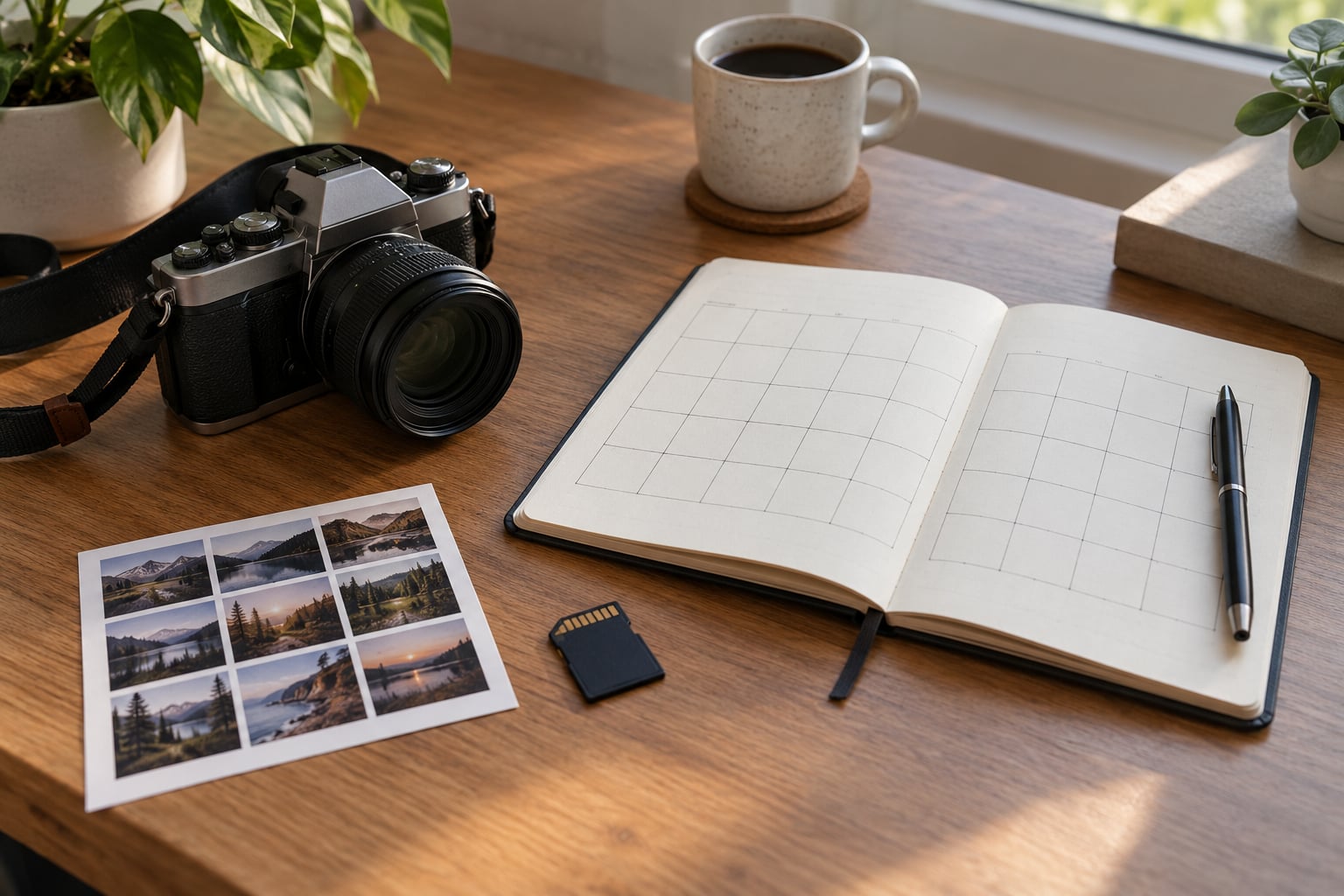
- A private tracking method. A paper calendar, a note on your phone, a spreadsheet, a folder with dates in the names. Private means private: nobody is grading it.
- A written definition of success. One sentence, decided in advance. Mine is: one intentional frame, taken and kept, at least once every seven days. Anything vaguer than that turns into a debate every night.
- A real end date. A year is a fine choice. A hundred days is also a fine choice. What kills projects is an open-ended commitment with no finish line to look forward to.
What you do not need: a new lens, a tripod, a follower count, or evening editing time. Projects die on those four things constantly.
Step-by-Step
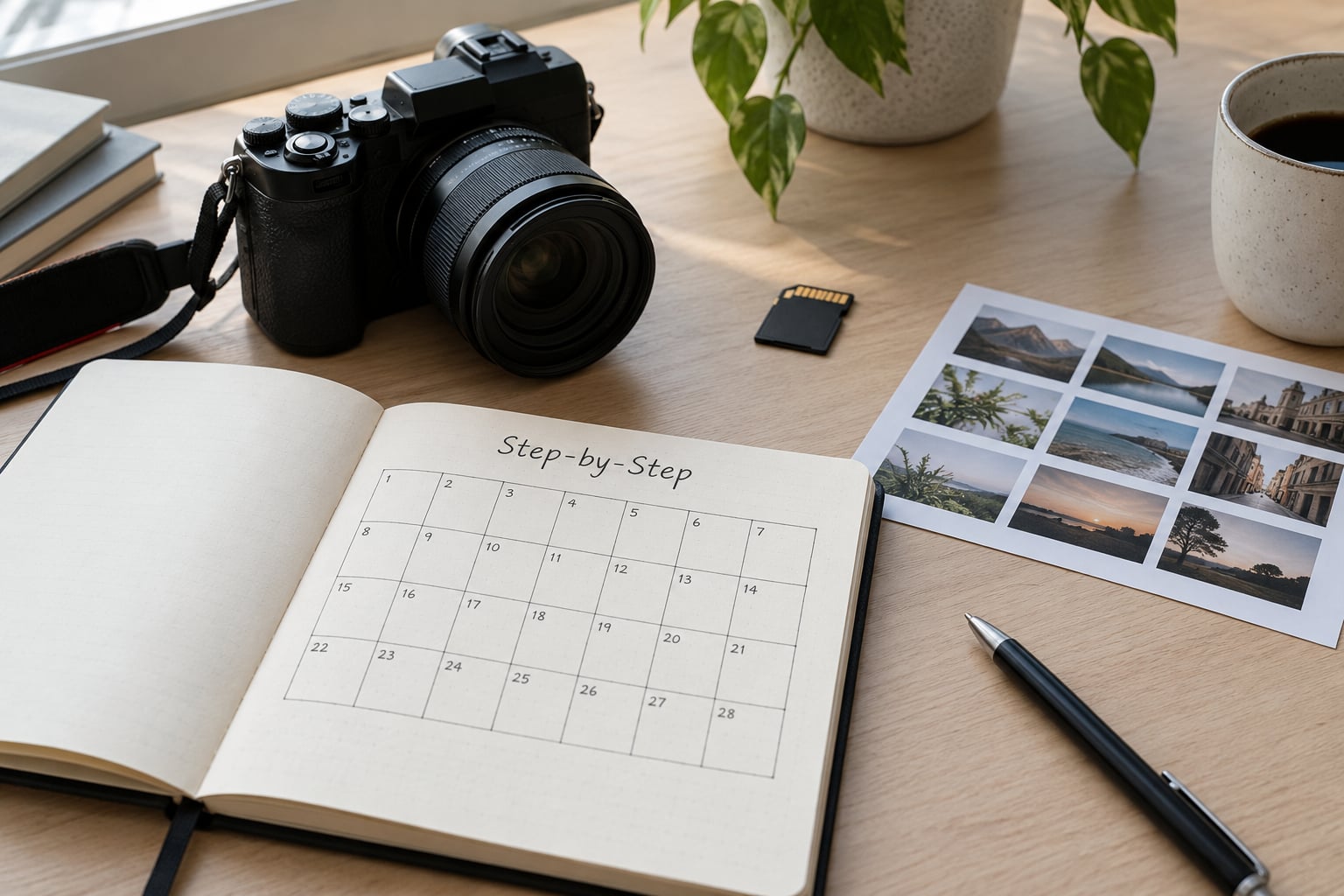
How to Set a Sustainable Daily Goal
A daily goal should be small enough that a bad day still clears it. Ten to twenty minutes of actual shooting, one frame you chose on purpose, and you are done. Not three keepers, not a sequence, not a backup shoot in case the light comes back.
The trick is separating attention from output. You can spend twenty minutes looking for a frame and make one good one, or shoot forty frames on autopilot and make none worth keeping. The first version is a practice; the second is a production quota wearing a practice’s clothes.
Write the goal as a floor, not a target. Fifteen minutes or one frame, whichever comes first, counts as a successful day. Once the floor feels easy for a full week, raise it. A floor you clear on your worst Tuesday is what keeps a year intact.
How to Choose Themes Without Running Out of Ideas
Ideas are not the scarce resource. Decisions are. Deciding what to photograph takes about thirty seconds of low-energy thinking, and on a tired evening that is the part that kills the session before the shutter goes.
So pre-decide. Pick two themes for the month and let them carry you: light, hands, shadows, colour, doors, the same corner at four different times, one subject repeated all year. Rotate them on a fixed date so you never spend creative energy choosing what to photograph today.
Constraints make this lighter, not heavier. One lens, one room, no faces, always the same hour. A smaller field to work in is less exhausting than a wide one because the searching stops. If you get bored of a theme, swap it on the calendar rather than abandoning the project.
How to Build a Low-Friction Shooting Routine
Repeat the same five steps in the same order until the session runs itself: notice something, compose it, make one frame, look at it once, stop. That last part matters more than the others, and most people skip it.
You are allowed to shoot on a phone. You are allowed to walk back to the same street you shot last Tuesday. The routine exists to get you to one deliberate frame, not to produce novelty. A familiar location shot with fresh attention is a better exercise than a new one shot while distracted.
If you find yourself explaining to yourself why today is not the day, that is a signal, not a negotiation. Give yourself a two-minute version instead: one frame, no review, done. The habit is protected by lowering the stakes, never by talking yourself into the full session.
How to Track the Project Without Adding Pressure
Pick one tracker and leave it alone. A grid of small squares on paper you fill in with a pen works well, because the whole weekly review takes about a minute and nothing about it demands a reaction. A dated photo folder is just as good, and a spreadsheet is better if you like numbers.
Whatever you use, review weekly rather than daily. Daily checking turns the project into a scoreboard, and scoreboards produce exactly the two states that end projects: streak anxiety and shrugs. Once a week is enough to notice that you shot four days instead of five and to decide whether that is fine or not.
Keep it off a public feed unless publishing is genuinely part of what you signed up for. Public streaks convert ordinary days into evidence of failure the moment a bad week arrives, and that is a self-inflicted wound with a very predictable outcome.
How to Use Rest Days and Flexible Catch-Up Rules
Here is the rule that decides whether you finish the year: the no-zero rule. A missed day adds a zero and changes nothing else. You do not restart from day one, you do not extend the project by a week, and you do not owe the skipped day anything. The counter is a record, not a debt.
Rest days work the same way. Plan them into the week where you can, treat them as a fixed appointment, and stop calling them rest when you skip them. The usual pattern is a hard first month, a real dip somewhere in months two to four, and a long flat stretch after that. One photographer described a project that reached 136 days before it stalled. That is not a failure rate; it is the normal shape of a self-imposed year.
Bank days make the catch-up question disappear. Shoot three or four in your first week, keep them in reserve, and spend them in the weeks when travel, illness or a busy stretch takes the camera out of your hand. A banked day is a day you already took, which is the cheapest flexibility you will ever get.
How to Review and Adjust the Project
Spend fifteen minutes a week with three questions: which frames did I enjoy making, which sessions cost more than they gave, and what do I want to change before next week. Adjust the format before motivation drops, not after. Shrinking the project is a legitimate response to a hard month, and a five-day week that runs for a year beats a seven-day week that ends in March.
Be careful which questions you ask, though. Looking at what you enjoyed and what you want to try keeps you curious. Looking at how many days you have left, how many you missed, or how your frames compare to a stranger’s feed keeps you performing. Interest is a renewable resource; a streak counter is not.
If the dip lasts more than a month and shooting feels like an obligation, take a real break. Two weeks off with permission is a design decision, not a lapse. A 30-day recovery works like this: shoot three days a week, at one theme only, no editing at all, and judge it by whether you look forward to the fourth day.
Common Mistakes
Making the daily goal a quality standard. The moment a frame has to be good, the day becomes a test. A frame is allowed to be a snapshot; the practice is in noticing, not in the file you end up with.
Posting every day to an audience. On the 365project.org Missed shots thread, one photographer wrote about the cost of looking at life as a potential picture and kicking themselves for missing it. Public posting adds an audience to that feeling. Keep the project private by default and revisit the decision at the end.
Letting the counter run the project. A streak is a tool for noticing, not a scoreboard. Once missing a day feels like failing, the project has become a source of stress, which is the opposite of the reason you started it.
Turning the camera roll into a Lightroom queue. The most common burnout report from hobbyists is not missed days; it is time. Shooting takes twenty minutes and editing takes three hours, and the imbalance drains people faster than anything else. Batch it, once a week, and cap the session.
Scrolling other people’s feeds as project research. It is research on nothing. Every edited frame next to yours makes an ordinary Tuesday feel like failure. Unfollow the accounts that do it to you, and look for communities that share straight-out-of-camera work if you want company.
Setting the project up with no end date. A commitment with no finish produces a commitment with no reward. Pick the day, and put something small on the calendar for the week after: three favourite frames, a contact sheet, one print.
Frequently Asked Questions
Do I need a dedicated camera to do a photo a day project?
No. A phone is the most reliable project camera most people will ever own, because it is already in your pocket and its battery is already charged. Dedicated gear is worth using when it is within reach, and a good entry mirrorless body works fine too. The only real requirement is that you can get from noticing something to one kept frame in under a minute. If your dedicated camera lives in a bag under a desk, it will lose to the phone most days.
How long should I spend taking a photo each day?
Ten to twenty minutes of genuine shooting is enough, and one intentional frame is a complete day’s work. Longer sessions are fine when you have the energy, but they are not the target. What drains hobbyists is the opposite problem: an hour of shooting followed by three hours of editing. Keep the daily floor low enough that you clear it on your worst evening, and raise it only after a full week of easy days.
What if I miss several days during a photo a day project?
Nothing happens. The counter gains a zero and the project carries on, which is the whole point of the no-zero rule. Restarting from day one is the single biggest reason people abandon a 365, because one bad week turns into a fresh start nobody has time for. Bank three or four days in your first week and spend them in the weeks life takes over, and treat a gap as weather rather than evidence about you.
Do I need to edit every photo I take for the project?
No, and skipping editing is often the right call. The project is a shooting practice, and the moment editing becomes a daily requirement it becomes a second job with a deadline you set yourself. If you edit, batch it into one fixed weekly slot and cap the time. Editing more than you shoot is a common sign of a project that has quietly turned into a post-processing routine, which is a much harder habit to keep for a year.
Should I post my daily photos online?
Only if you would enjoy it on a bad day. Daily public posting adds an audience to a private practice, and the comparison trap is real: an edited portfolio next to your Tuesday snapshot makes normal work feel amateur. Plenty of strong 365 projects are never published at all. If you do post, set a rule that a missed day needs no apology post, and consider curating ten frames at the end instead of a daily feed.
How do I restart a daily photography project after losing motivation?
Restart smaller, not harder. Pick one theme, commit to three days a week, and run it for thirty days with no editing and no posting. Judge it by one question: do you look forward to the next session? Interest returns through low stakes, not through a bigger goal. Projects have stalled at 136 days and restarted successfully many times over, and the restart only works when the new version is easier than the one you abandoned.
Start Small and Make the Project Sustainable
You can start this today without buying anything. Choose one theme you can photograph from your kitchen, make one frame you chose on purpose, and write it into a calendar with a rule that says a missed day changes nothing. Then put a date on the calendar for when you will look at the whole thing again.
How to do a photo a day project without burning out comes down to keeping it smaller than you think it needs to be, and keeping it private. Five days, two themes, one frame, one weekly editing slot, no streak to protect. That version is the one that still exists in December.