Most group photos are not ruined by bad lighting or bad framing. They are ruined because one person blinked in the only frame that mattered. The fix is not luck and it is not a faster camera: it is a cue that makes opening the eyes involuntary, plus a short burst so you always have a second option.
Here is the whole method in one breath. Ask the group to close their eyes, count down from three, and press the shutter on the last word so the eyes open and the frame is taken at the same instant. Fire three or four frames half a second apart. Then pick the one where every face is open.
The rest of this guide is the preparation that makes that countdown work: how you arrange people, light them, focus, and talk to them so the shot takes five seconds instead of five minutes.
Table of Contents
- What You Need
- How to Photograph a Group Portrait Without Closed Eyes: Step-by-Step
- Common Mistakes
- Frequently Asked Questions
- How do you keep everyone from blinking in a group portrait?
- What settings work best for a large group portrait indoors?
- Should I use burst mode when photographing a group?
- How can I get children to keep their eyes open?
- Where should the photographer focus in a group portrait?
- What is the best way to check for closed eyes before editing?
- Conclusion
What You Need
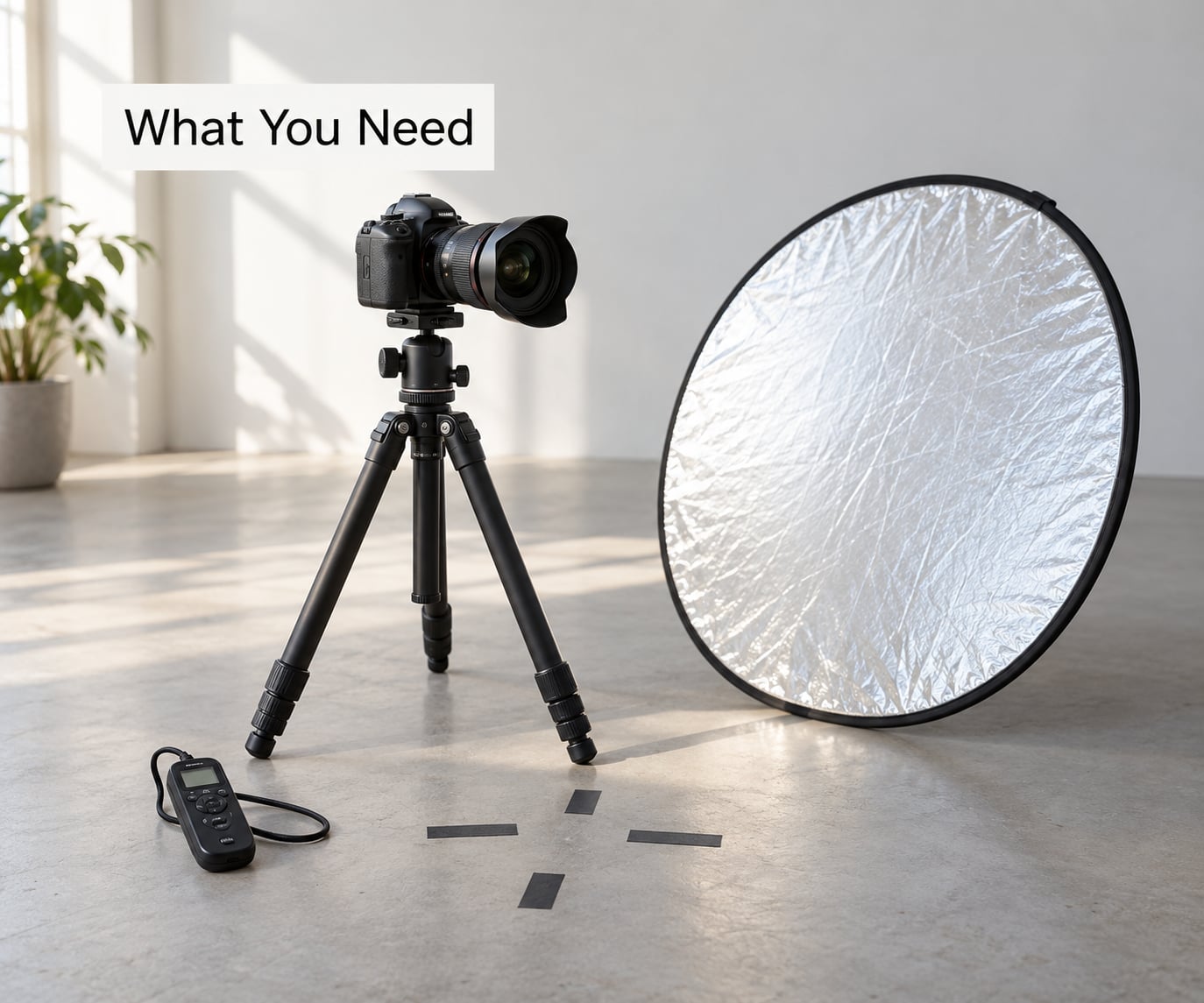
The gear list is short. Almost any camera made in the last fifteen years can do this job, and the phone in your pocket can do about eighty percent of it.
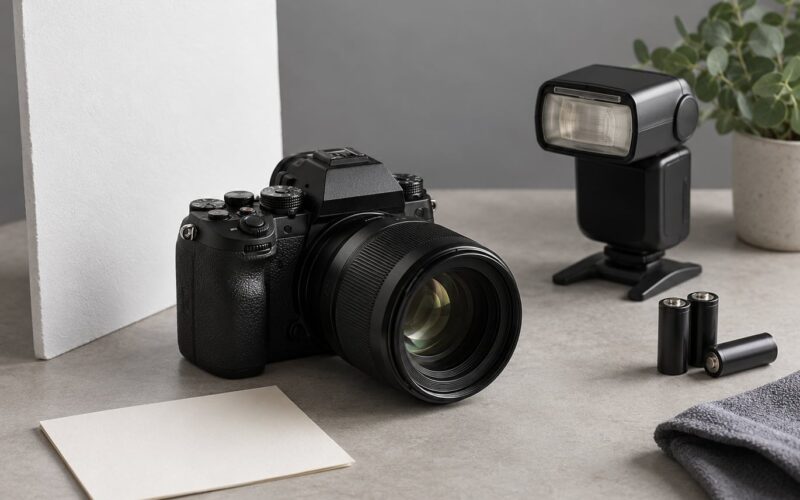
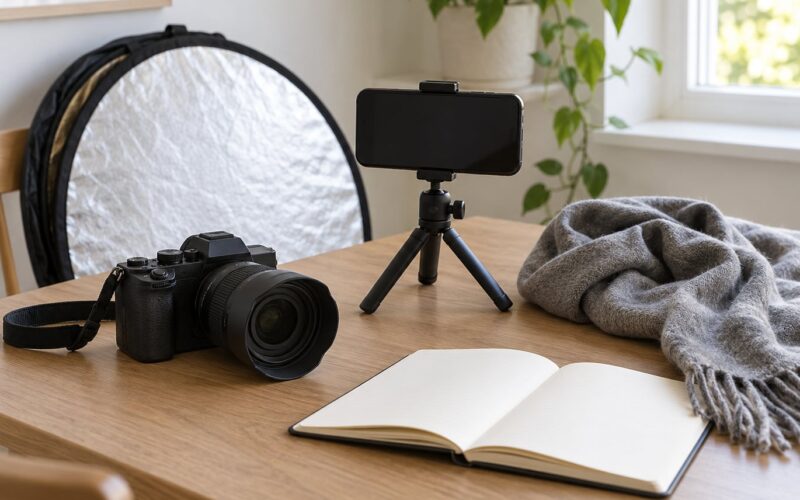
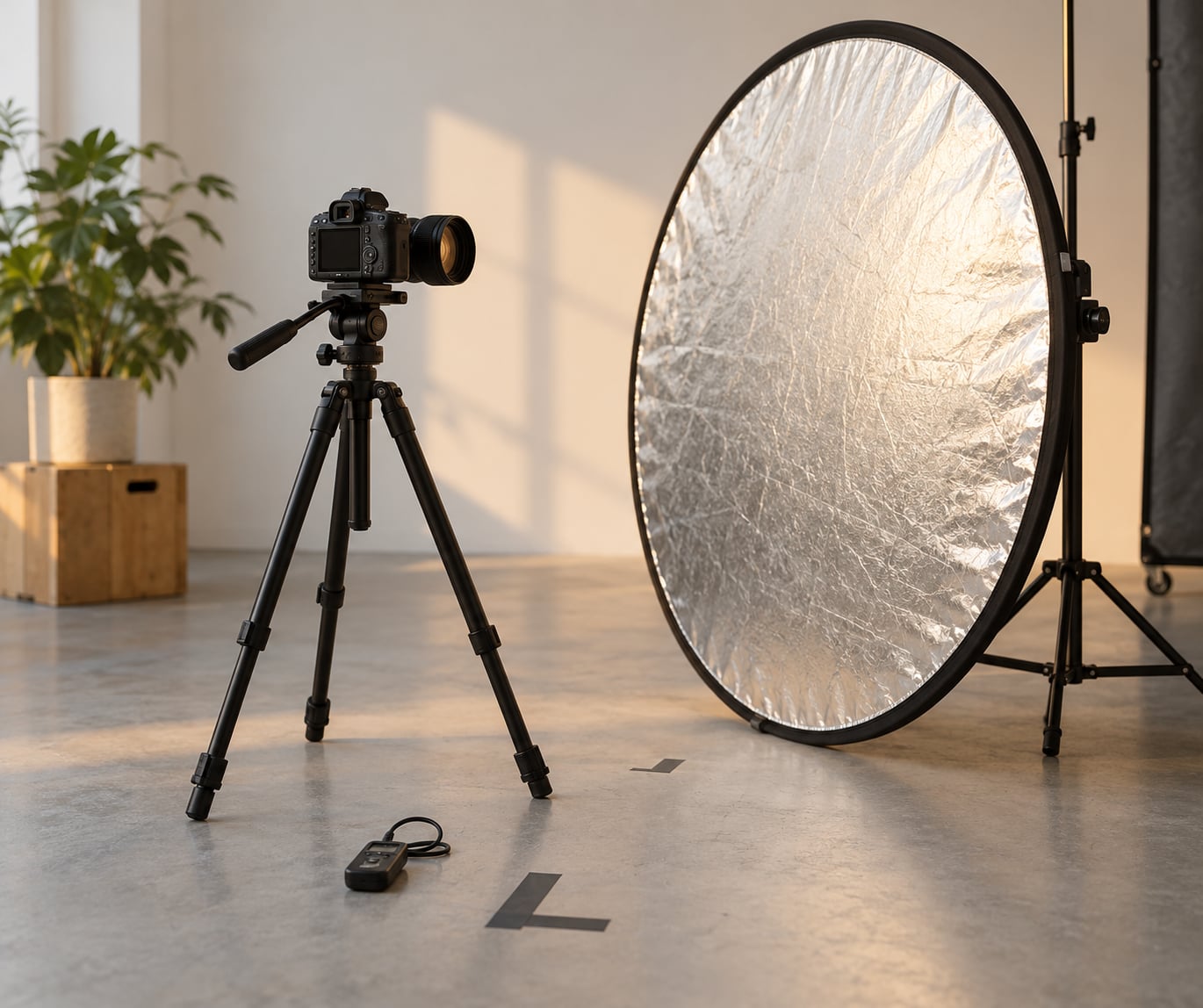
- A tripod and a remote release or two-second timer. This is the single most useful item on the list. Without it you are either asking someone else to take the picture, or you are not in the picture. With it, both problems disappear.
- A wide-angle lens. Something in the 24 to 35mm range on a full-frame body. You need the width to fit twelve people into a frame without standing so far back that faces get small.
- A light source that hits faces evenly. Open shade, a large window, or a single reflector-backed flash. Not bare sun.
- A white or silver reflector. Cheap, light to carry, and it fills the shadow side of a face so nobody is squinting into a bright patch of sky.
- Tape or gaffer tape for floor marks. Floor marks keep people from shuffling between frames, and shuffling means re-doing the arrangement every time.
- An assistant for anything over about eight people. Their entire job is to hold the back row in place while you work the front.
That is genuinely all of it. Professional wedding photographers work with less, because the technique matters more than the kit.
How to Photograph a Group Portrait Without Closed Eyes: Step-by-Step
Arrange the group before the camera is raised
Standing people should be in staggered rows, not a flat line. If everyone is shoulder to shoulder, the people at the edges are half hidden and the middle faces look crowded.
Build the back row first, on the floor marks, standing a step higher than the front row if there is any slope, a low wall, or a set of steps to use. Then place the front row in the gaps, slightly turned inward. A row of four in front and five behind beats nine in a straight line every time.
Find the short people and the tall people before you start directing. Tall subjects belong at the back or at the ends, short subjects in the middle of the front row. Somebody will always be hidden behind a taller cousin otherwise, and hidden faces are usually the ones that end up shut.
Ask everyone to stand about a foot back from the person in front of them. That gap is what stops heads from merging into one shape when you stop down the aperture.
Use lighting that reaches every face
Squinting looks almost identical to blinking on a small screen, and bright sun causes a lot of it. Put the group in open shade, or wait for the sun to move behind a building.
Position the main light so it comes across the group rather than from directly in front of any one face. A reflector placed opposite the light fills the shadow side, so nobody has to hold their face into brightness to see you.
Keep the light behind the camera or just off the camera axis. Backlight from a low sun is flattering and it gives people a reason to squint, so raise it or turn the group. If you must use flash, watch the pre-flash warning: subjects who are sensitive to flash tend to close their eyes on the pre-flash rather than the exposure, which is the opposite of what you want.
Set focus for the faces, not the center of the frame
Depth of field is the deciding factor here. You need everyone sharp, from the nose of the person in front to the ears of the person at the back.
Start at f/8 on a full-frame body. If the group is deep, the rows are staggered, or you have a lot of people, go to f/11. Keep the shutter speed at 1/250s or faster so nobody blurs mid-blink, and leave the ISO at whatever keeps the exposure correct, usually 100 outdoors and higher indoors.
Put your focus point on the front row, not the middle of the group. Backwards from there, the depth of field extends away from the camera and covers everyone behind. Getting this backwards is why the back row is soft in so many family photos.
Turn on eye-detection autofocus if your camera has it, and confirm that it locks onto a face before you commit. On a body with a mechanical shutter, the mirror movement makes a noise that starts some people blinking on the frame itself. Silent mode, electronic shutter, or mirror lock-up removes that sound.
| People in frame | Aperture | Shutter speed | ISO | Lens | Frames per burst |
|---|---|---|---|---|---|
| 3 to 6 | f/5.6 to f/8 | 1/250s | 100 | 35mm or wider | 3 |
| 7 to 15 | f/8 | 1/250s | 100 to 400 | 24 to 35mm | 4 to 5 |
| 16 and up | f/11 | 1/320s | 100 to 800 | 14 to 24mm | 6 or more |
The burst column matters more than people expect. Each person in the frame blinks independently, and blinks cluster because the whole group tends to blink on the same beat. The odds improve with volume, so scale the burst to the size of the group rather than firing three frames at everyone.
Keep attention high with short, active prompts
Counting up is the problem. Say “one, two, three” and every person in the frame has heard a countdown before, and every one of them closes their eyes on “three” and opens them just after you pressed the button.
Count backwards instead. Three, two, one. Nobody has heard a countdown that ends on one, so the anticipation never fires, and the group opens as the count ends rather than before it.
The close-eyes countdown does the same job even better. Wedding photographers have used this for years: tell the group to close their eyes, count down from three, and shoot on the last word. The open is a reflex at that point, not a decision, so there is nothing to forget.
Now the exact sequence, in the order to give it:
- Position everyone first. Do not raise the camera until the arrangement is done, because the arrangement is what people fidget with.
- Give one short direction and one clear target: “Look at the person holding the reflector. Chin up slightly.”
- Say “Everybody close your eyes.” Wait for it to land. This takes about a second.
- Count “Three, two, one” in an even voice, and press the shutter on the word “one”.
- Keep firing. Three frames about half a second apart is the standard, and it catches the frames where somebody opened a fraction too early or too late.
Keep the whole exchange to a single sentence of direction. Photographers who narrate continuously, adjusting chins and shoulders between every frame, make people self-conscious, and self-conscious people blink. Talk for fifteen minutes, shoot for five, and reverse that ratio and you will fix a lot of closed eyes on its own.
Take several frames instead of hoping for one
One frame is a coin flip. Six frames is close to a certainty for a small group, and the cost is nothing but card space.
Switch to continuous shooting and hold the button through the whole cue rather than pressing once. Change the conversation between bursts so the expressions differ: after the formal frame, ask for a laugh, then for the serious one, then shoot a candid set while people are relaxing and not thinking about the camera.
The candid frame immediately after the formal one is usually better than the formal frame. Relaxed faces do not blink on cue, because nobody is anticipating anything.
Check eyes, expressions, and edges before stopping
Zoom to 100 percent on the rear screen and run a short check before the group disperses. Five seconds of checking saves a reshoot.
Scan faces left to right and count open eyes. One closed face means reshoot immediately, while everyone is still standing. Then check the edges of the frame for clipped hands, half-cut feet at the bottom, and someone leaning out of shot.
Check focus on the back row by zooming in, not by looking at the thumbnail. Watch for a face looking at the neighbour instead of the lens, and for that slack, post-prompt expression where everyone stopped smiling three seconds ago.
Only stop when you have one frame where every eye is open, every face is sharp, and nobody is cut off. One clean frame is the deliverable.
Common Mistakes
Here is what goes wrong, and what to do instead.
- Counting up to three. The single most complained-about failure. Count down to one and the anticipatory blink disappears.
- Giving long chains of direction. “A bit to the left, chin up, now smile, more smile” makes people over-think. One direction, one cue, shoot.
- Holding the pose too long. Attention drifts within seconds. Take the frame early rather than waiting for a perfect pose to arrive.
- Letting the mirror or shutter noise start the blink. Use silent mode, electronic shutter, or mirror lock-up if the group reacts to the sound.
- Shooting in hard sun. Faces squint, and squinting reads as closed eyes on screen. Move to open shade.
- Firing a single frame at a big group. With twenty people the odds of one clean frame from one attempt are poor. Fire six and eight.
- Focusing on the middle of the frame. The back row goes soft. Focus on the front row and let depth of field reach backwards.
- Trusting the camera screen at arm’s length. Zoom to 100 percent. Closed eyes are invisible on a small screen at normal viewing size.
A few situations deserve their own handling. For children, get down to their eye level, ask them to make a face rather than smile, and expect to shoot far more frames than you think. For anyone wearing glasses, angle the light so it is not reflecting straight back at them, and raise the glasses if they keep catching. For people with heavy or drooping eyelids, have them stand slightly higher in the frame and avoid shooting from far below, which exaggerates the lids.
For groups of twenty or more, change the strategy rather than the technique. Use tiered rows, get the camera above head height on a balcony, a ladder, or a raised arm, and use an assistant to keep the back rows still. Keep the burst long. Talk to the group for a while before shooting, so the shot itself is the fastest part.
Doing it on a phone works the same way. Use the wide-angle camera, not the standard one, so everybody fits. Set a three or five second timer, and in the final two seconds tell everyone to open their eyes and smile. Avoid portrait mode for large groups, because it simulates a shallow depth of field and will blur the back row into mush.
Finally, if the only good frame has one closed face, there are retouching tools and AI retake apps that will open a pair of eyes for you. Use them sparingly. Painted eyes are obvious on a close crop and they break trust once anyone knows. It is better to fire another burst.
Frequently Asked Questions
How do you keep everyone from blinking in a group portrait?
Ask the group to close their eyes, count down from three, and press the shutter on the last word so the eyes open and the frame is taken at the same instant. Fire three or four frames half a second apart and pick the one where every face is open. Counting down to one, never up to three, stops the group from blinking in anticipation.
What settings work best for a large group portrait indoors?
Start at f/8 for depth of field, 1/250s or faster to freeze movement, and raise the ISO until the exposure is correct rather than dropping the shutter speed. Focus on the front row so the back of the group stays sharp. Put the light behind or beside the camera with a reflector opposite, and shoot near a window rather than under overhead lights.
Should I use burst mode when photographing a group?
Yes. A single frame is a coin flip, and each person blinks independently, so the odds improve with the number of frames. Scale the burst to the group: about three frames for three to six people, four or five for seven to fifteen, and six or more for groups of sixteen and up. Review at full zoom before the group moves.
How can I get children to keep their eyes open?
Get down to their height so you are shooting slightly upward across the group rather than down on them. Ask for an action or a silly face instead of a smile, since smiles get held too long and drift. Shoot early rather than waiting for a pose to settle, keep the sequence short, and expect to fire far more frames than with adults.
Where should the photographer focus in a group portrait?
Focus on the front row, ideally on a face in the middle of the front row, not on the center of the frame. Depth of field extends backwards from the focus point, so front-row focus is what keeps the back rows sharp. Stop down to f/8 or f/11 for deeper groups, and check the back row by zooming into the image at 100 percent before you stop shooting.
What is the best way to check for closed eyes before editing?
Zoom the rear screen to 100 percent and scan the faces left to right, counting open eyes before anything else. A closed eye is invisible at normal screen size. If one face is shut, reshoot immediately while the group is still standing, and only move on once you have a frame where every eye is open and every face is sharp.
Conclusion
Start before anyone is standing still: arrange the rows, mark the floor, set f/8 and 1/250s, focus on the front row, and get the light onto every face. Then close the eyes, count three, two, one, shoot on the word, and fire a burst long enough for the size of the group.
Check every face at full zoom before the group moves. That combination, not a lucky frame, is what turns photographing a group portrait without closed eyes into a repeatable step rather than a coin toss.