Most photography contests are not worth entering. The ones that are share four things: named judges, a stated prize worth chasing, a usage license limited to promoting the contest, and enough track record to show winners actually get paid. Learning how to enter photography contests worth entering is mostly about filtering out the rest before you pay a fee.
The good news is that the filter takes about five minutes per contest. The rest of this guide covers how to find credible calls, read the rules properly, prepare files that survive technical checks, and submit something that reflects your strongest work rather than your most recent shoot.
Updated for 2026.
Table of Contents
- What You Need
- Step-by-Step: How to Enter Photography Contests Worth Entering
- 1. Define what you want from a contest
- 2. Find contests that fit your photography
- 3. Verify the contest is legitimate
- 4. Read the brief and eligibility rules
- 5. Select one image or a deliberate series
- 6. Edit the image for the contest context
- 7. Prepare and submit the entry
- 8. Track results and use the experience
- Common Mistakes
- Frequently Asked Questions
- Conclusion
What You Need
You need a defined photographic focus before you look at a single contest. Judges can tell within two frames whether an image has a point of view, and a submission that strays across three genres rarely places anywhere.
Before entering, get these in place:
- A defined focus. The genre you actually shoot, not the genre you wish you shot.
- An edited shortlist. Twenty or thirty images you have already culled and edited, not a whole card.
- Correctly named files. Lastname_Firstname_Title_01.jpg, exported clean, with no watermarks or visible borders.
- Accurate submission details. Real name, correct category, and your own copyright statement. A wrong category is a common disqualification.
- A deadline and fee record. Note the closing time, its time zone, and what the entry costs per image before you pay.
- A rights and release note. Record whether a model release or property release exists for recognisable people or private interiors.
If you cannot fill in that last line for a given photograph, you do not submit it to that contest. Most require a signed release for editorial and portrait categories, and a missing one gets the entry pulled after judging.
Step-by-Step: How to Enter Photography Contests Worth Entering
1. Define what you want from a contest
Decide the payoff before you spend time or money. Contests typically deliver one of five things: exposure to a new audience, cash, publication, an exhibition or print run, or a named judge giving you a scored opinion.
Those payoffs are not equal, and the honest arithmetic matters. Cash prizes rarely beat the total entry revenue the organizer collects from entrants, so treat money as a bonus. Exposure and a scored critique are the parts you can actually plan around.
If your goal is a stronger portfolio rather than a trophy, say so before you start. It changes which contests you enter and which images you pick.
2. Find contests that fit your photography
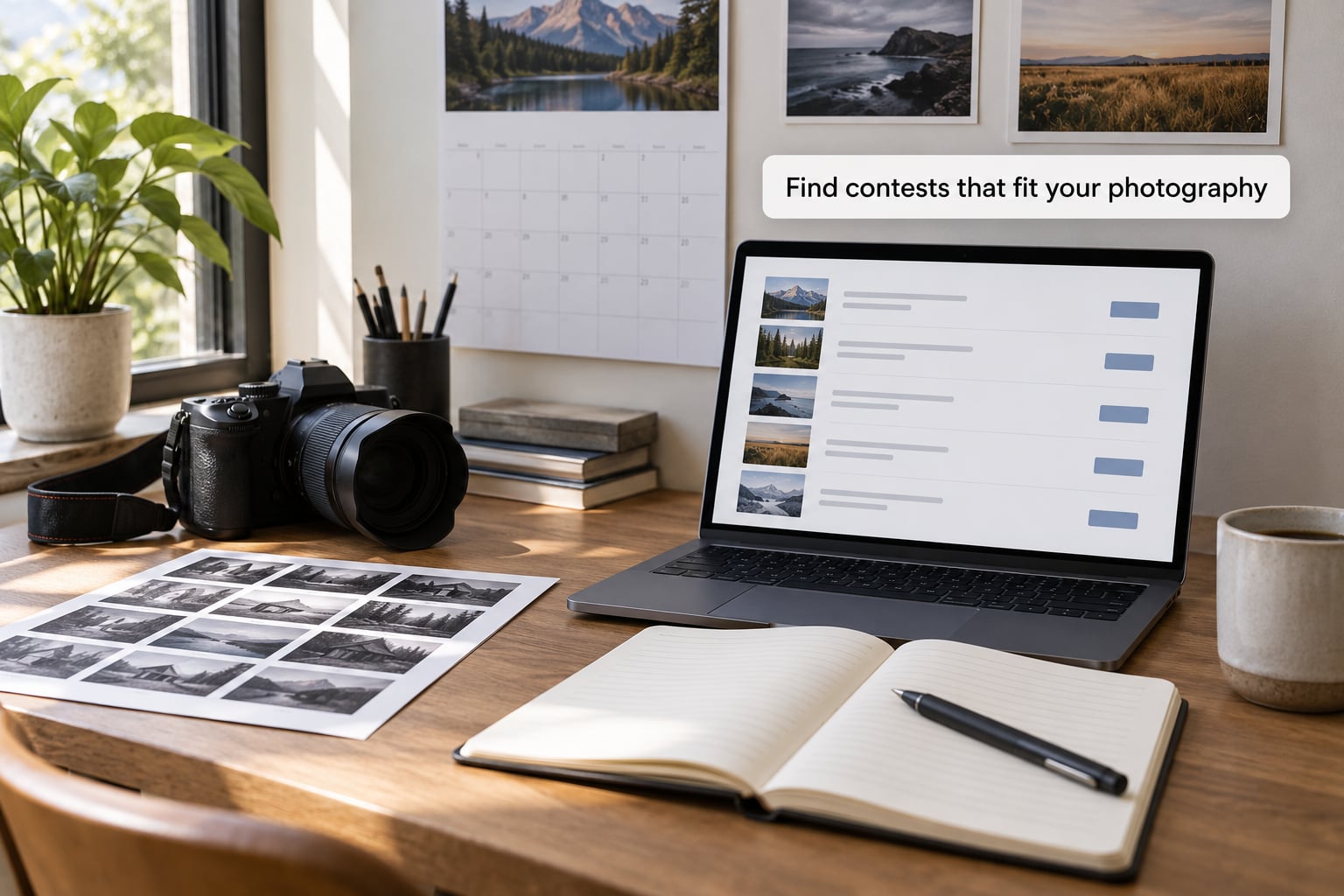
Search by genre and by rule, not by prize size. Portrait, documentary, street, nature, fine art, editorial and mobile-only contests each judge differently, and most have dedicated categories you would miss inside a broad open call.
Three sources work well. Aggregator directories such as PhotoContest and free-entry listings give you volume and let you filter by fee, format and deadline. Camera clubs and local fairs run smaller contests with far lower fees and useful in-person critique. Award programs with published past winners galleries tell you what a jury actually likes.
Sort out the near-free options first. Across photography forums, the most repeated advice is that harvest fair and camera club competitions, often capped at three images with no entry fee, are where beginners get honest feedback at almost no risk.
3. Verify the contest is legitimate
A contest is credible when you can verify who is behind it, who is judging, what is at stake and how winners get paid. If the site has no named judges, no contact details, no privacy policy and no history of paying winners, walk away.
Forum regulars on photography boards and in beginner groups ask one question constantly: is the entry fee normal or is this a scam? The fee itself is normal. What matters is whether it buys you something real.
Look for these trust signals:
- An itemised fee per image, with the prize pool stated.
- A judging panel with published names and credentials.
- An organisation that has run the contest for years, with an archive.
- A limited usage license tied to promoting the contest.
- Real cash or a physical exhibition, not just a blog feature.
- No requirement to buy products or buy votes.
Then read the license clause closely. This is where legitimate contests and predatory ones separate.
| The clause | What it says | What it means |
|---|---|---|
| Contest-only license | Non-exclusive, worldwide, limited to promoting the contest and its results, for up to two years. | Reasonable. Your copyright stays with you. |
| Rights grab | Grants the organizer unlimited, perpetual use of any submitted image, winning or not. | You paid a fee to license your own work indefinitely. Skip it. |
| Print-on-demand | Winners must purchase copies of the book or prints before publication. | The prize is a sales tactic, not an award. |
Deal breakers are simpler: perpetual usage rights granted on entry, no named judges, brand promotion dressed up as a contest, or a fee that dwarfs any realistic return.
4. Read the brief and eligibility rules
Read the rules like an editor checking a submission, not like an optimist skimming a prize list. Every disqualification you can avoid starts here.
Check the theme fit, the maximum number of images, required pixel dimensions, accepted file formats, the exact closing date and time zone, and any geographic restriction on who may enter. Then look for the three clauses photographers most often miss.
Releases are first. Recognisable people, private interiors and sometimes private land all need a signed model or property release, and editorial categories almost always require one.
AI policy is second. Rules on AI-generated elements and heavy compositing changed fast, and most contests now specify whether generative fill, sky replacement, cloning and stitching are permitted. If the rules are silent, assume any AI element disqualifies you.
Third, check whether the same image may already have been published or won another award. Exclusive-entry contests will pull the file later, and that clause applies whether you won or not.
5. Select one image or a deliberate series
One strong frame usually beats three similar ones. Judges score clarity of communication first, and a single image that states one idea cleanly outranks a set that repeats it from three angles.
Pick the frame that a stranger would understand, that holds up at full size on a decent screen, and where you can name the subject in one sentence. Check the technical details too: focus where you meant it, no blown highlights, no missed focus at the edges.
Choose a series only when the contest asks for one, and then make sure the images relate. If you cannot describe how the set hangs together, submit the single strongest frame instead.
6. Edit the image for the contest context
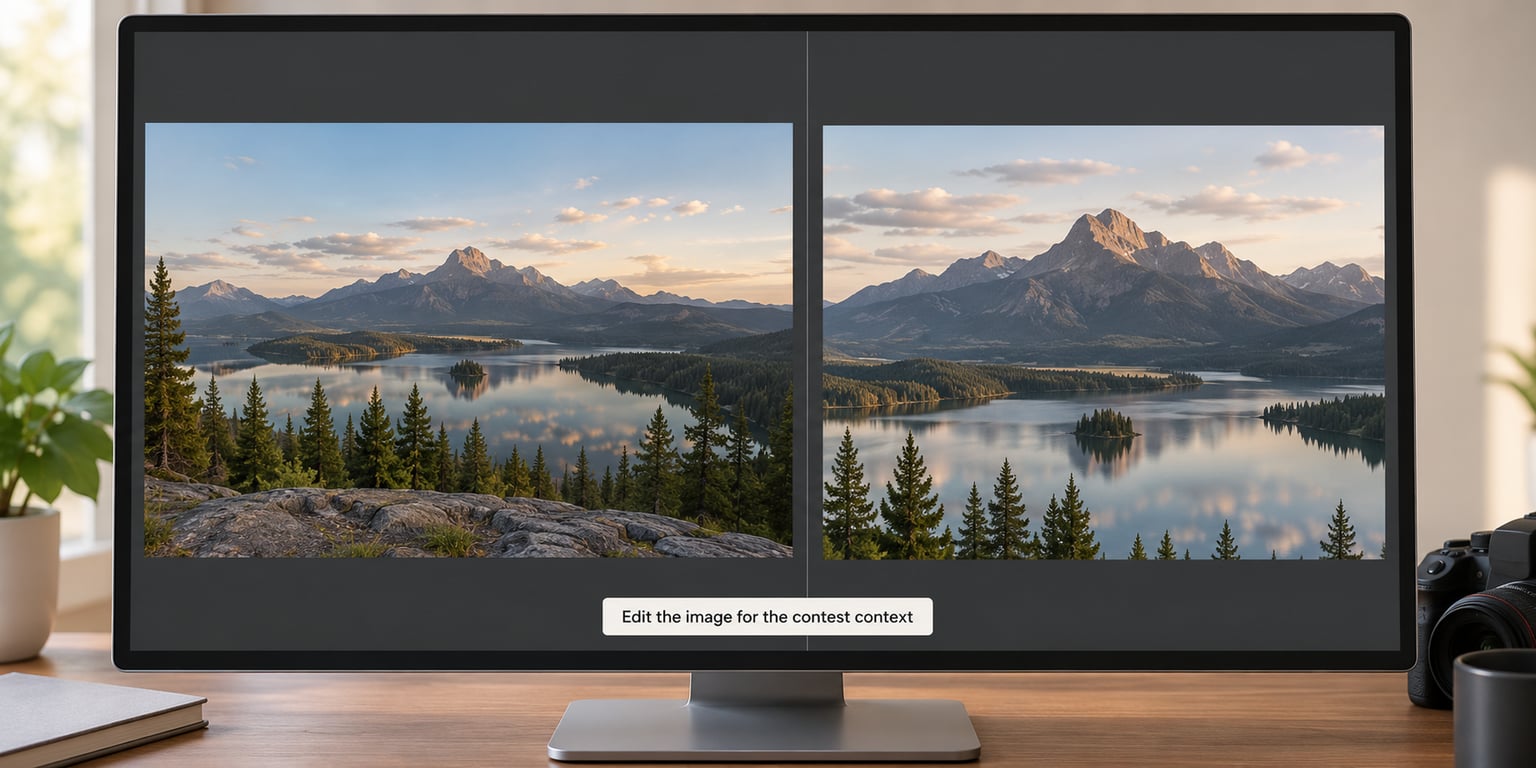
Edit for the medium, not for the feed. Online viewing rewards a slightly lower contrast and controlled highlights; a judged print rewards detail, so do not crush shadows to hide noise.
Export in sRGB unless the rules explicitly ask for Adobe RGB. Crop deliberately and remove nothing that matters to the story. Sharpen last, lightly, for output size.
Stop before the image becomes something other than what you photographed. Judges see heavy dodging and burning instantly, and rules on compositing and AI elements get stricter every year.
7. Prepare and submit the entry
Submit two days before the deadline, not two hours. Upload windows close early, sites go down, and payment steps fail.
Run this final checklist:
- File named per the required convention, exported from the correct folder.
- Correct pixel dimensions, file size limit and colour profile.
- A title of three or four words and a short statement of intent.
- The right category and any required theme keywords.
- Uploads, declarations and releases completed.
- Payment finished and the confirmation email saved.
Save the confirmation, the rules page as a PDF and a screenshot of the upload. Disputes about what you submitted are rare, but they are unwinnable without a record.
8. Track results and use the experience
Keep one row per entry: contest, category, image filename, fee, date submitted, result, judge score and one note about what you learned. After six entries the pattern becomes obvious. Most photographers find their placements cluster in two categories, not the ones they expected.
Read the feedback when it exists, even harsh feedback. A single sentence from a judge, such as a note about a distracting background or an over-tight crop, is worth more than a prize.
When nothing comes back, treat it as editing data rather than a verdict on your talent. On critique boards the consistent advice is to enter even when you do not expect to win, because the deadline forces the edit and the result calibrates your eye.
Common Mistakes
Entering a contest that does not fit the work. Wrong category or wrong genre. The fix is simple: if your shortlist has nothing that speaks to the brief, skip it. A fee spent on a mismatch teaches nothing.
Submitting without releases. Recognisable faces and private property are the most common avoidable disqualification. Fix: check every frame for people and locations before upload, and keep signed releases with the file.
Using reposted or manipulated files. Heavy compositing, borrowed watermark layers or a lifted border invite disqualification and, with a claimed prize, a takedown. Fix: submit work that is unambiguously your own.
Choosing an entry purely for prize potential. The biggest prize usually has the most entrants, so the expected value is often the worst. Fix: enter for a standard you can measure yourself against.
Not reading the terms. The license clause decides whether the entry is worth anything to you, and it sits near the bottom of a long page. Fix: read terms and privacy policy before you read the prize list.
Paying before verifying legitimacy. Forum beginners ask this constantly. Fix: run the legitimacy checks in step 3 first. Every one of them is free and takes minutes.
Submitting a technically weak file. Wrong dimensions, wrong profile, a missed focus point. Fix: open the export full size on a second screen before you upload. Judges see technical errors faster than style.
Frequently Asked Questions
Are photography contests worth the entry fee?
Usually not as a financial proposition, since prize pools rarely exceed the entry revenue the organizer collects. They are often worth it as a deadline, a forcing function for editing, and a scored opinion from a working judge. Treat cash as a bonus and judge value by feedback and exposure. If you want to test that yourself, local club and fair contests with no entry fee give you the same calibration at almost no risk.
Do photography contests take my copyright?
Not usually, but only if you read the terms. Most contests request a non-exclusive license limited to promoting the contest and its results for a stated period. Some request unlimited or perpetual usage of every submitted image, including losers, which is a rights grab. Professionals who license their work should skip any contest with that clause. Hobbyists should still read it before paying.
Can AI-generated or heavily composited photos win photography contests?
Rules vary and they tighten every year. Many contests now state that generative AI content is not eligible, while others permit minor generative fill or sky replacement above a stated threshold. An AI-generated image has reportedly won a competition, so judges are not a reliable filter. Read the AI and compositing clause in the rules and assume silence means any AI element disqualifies the entry.
Why was my photo disqualified from a contest?
The usual reasons are technical and administrative rather than artistic: wrong pixel dimensions or colour profile, a missing model or property release, an image that had already won an award or been published in an exclusive contest, a watermark or border, late submission, or the wrong category. Most organizers list a disqualification note with the result. If it is not there, email them and ask, because the answer is usually a rule you missed.
How many photos should I submit to a contest?
Read the limit first, then submit fewer than you are allowed. One strong frame that states its idea clearly usually places better than several similar ones, because judges score clarity of communication first. Submit a series only when the contest asks for a portfolio category and the images genuinely relate to each other. Entering the maximum number allowed does not improve your odds of placement.
How do photo contests choose winners?
Serious contests use a named judging panel that scores each image against published criteria such as composition, technical quality, originality and fit with the theme. Weaker ones rely on public voting, which rewards networks rather than photographs. Before entering, click through to a past winners gallery: if the winning images all look like one another, you can see the jury’s taste and decide whether your work belongs in the room.
Conclusion
Start narrow. Pick one body of work you are genuinely proud of, find three contests whose briefs match it closely and whose terms survive the legitimacy check, then submit one frame to each and record what happens.
Three entries is enough to learn the mechanics, read the feedback and see whether the effort is worth repeating. If you want a second opinion before spending anything, post the shortlist in a critique community and compare that response with the judges’ later.